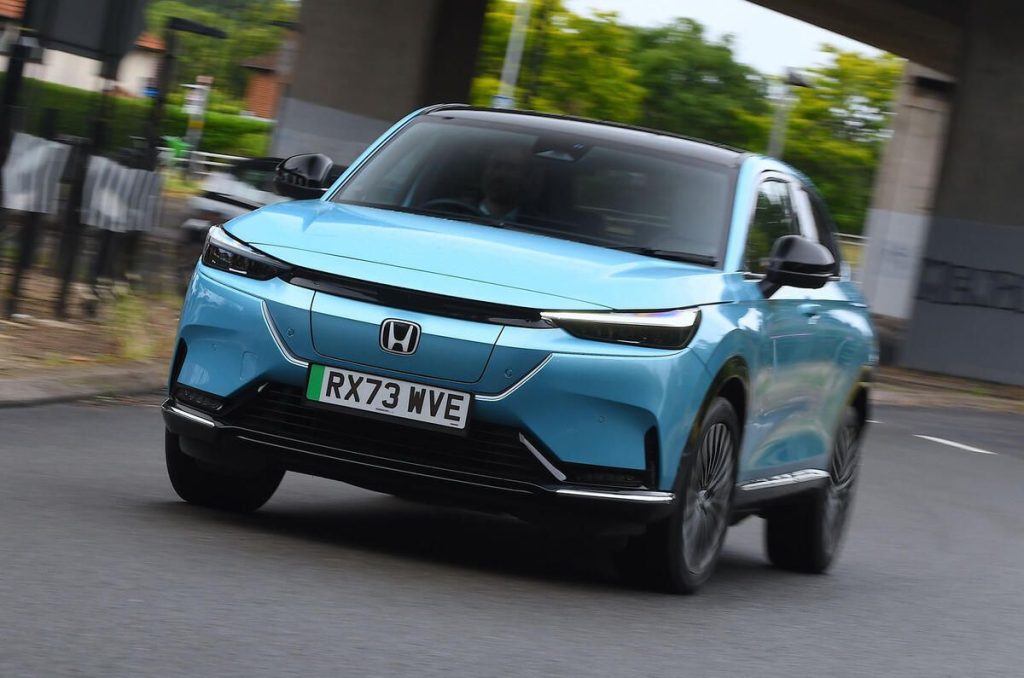
Honda's European president says Brussels' push for a single-technology solution is suppressing new-car sales across the region.
Honda wants stricter carbon limits. Just not Brussels' way of getting there. Hans De Jaeger, Honda Motor Europe's president, told Autocar that the European Commission's all-electric mandate is actively harming new-car sales and cutting off options for buyers who are not yet ready to go electric.
The distinction matters in 2026 more than it did in 2023. European new-car registrations fell 6.3 percent year-on-year in the first quarter of 2026, according to ACEA's Quarterly Registration Report, published March 2026 — and EV share remains stuck below 15 percent in most non-Nordic markets. Honda's argument, that CO2 targets and technology mandates are separable questions, is one that several non-German volume producers have started making publicly.
De Jaeger's Challenge to Brussels
Hans De Jaeger, president of Honda Motor Europe, chose unusually direct language when addressing the European Commission's decarbonisation approach. He told Autocar that a lack of "consistency" in Commission policy is making things "extremely difficult" for manufacturers operating in the region. The phrase is a diplomatic way of saying Brussels is changing rules mid-cycle — model programmes carry six-to-eight-year development windows, and regulatory certainty over that horizon is non-negotiable for capital planning. De Jaeger did not reject the CO2 reduction goal. He rejected the single-technology route ordered to achieve it. That is a legally and commercially different position, and Honda's European leadership is now making it in public, where it previously stayed on record only through ACEA lobbying channels. For broader context on how EU trade and regulatory pressure is reshaping manufacturer decisions, see coverage across the EV regulation Europe 2026 cluster.
The Sales Arithmetic Behind the Complaint
The commercial picture explains why Honda escalated to public criticism. European passenger-car registrations in Q1 2026 totalled approximately 2.61 million units, down from 2.79 million in Q1 2025 — a gap of roughly 180,000 units, according to ACEA's Quarterly Registration Report, published March 2026. Battery-electric vehicles accounted for 13.8 percent of Q1 2026 registrations, meaning roughly 360,180 EVs were sold. The remaining 86.2 percent — approximately 2.25 million units — were non-pure-electric. That calculation shows the mandate is asking dealers to sell a product mix that the market has not yet adopted at the required rate. Honda's European volume in 2025 sat below 200,000 units annually, making each percentage-point shift in the regulatory environment disproportionately large relative to its continental footprint compared with a Volkswagen Group running closer to 3.5 million European units per year.
One Goal, Two Very Different Mandates
The EU's approach and the one Honda is advocating are not identical policies with different labels. The EU's CO2 Regulation (EC) 2019/631, as amended in 2023, ties fleet-average targets to a 2035 zero-emission endpoint with no credits for hydrogen, synthetic fuel, or hybridisation beyond narrow transitional windows. What De Jaeger is calling for is closer to the United States' Corporate Average Fuel Economy model, which sets fleet-level numerical limits but allows manufacturers to mix technologies to reach them. Kia UK, which crossed 100,000 cumulative EV sales, has similarly questioned ZEV mandate pace — a sign that even volume EV sellers find the current trajectory commercially untenable. The EU's technology-prescriptive approach differs sharply from that of Japan's domestic standard, which retains credit pathways for strong hybrids through at least 2030 under the Ministry of Economy, Trade and Industry's fuel-efficiency roadmap.
Endorsing the Target While Opposing the Method
Here is the part that does not sit neatly together. Honda's public line accepts, even welcomes, tighter CO2 reduction timelines. De Jaeger did not ask Brussels to ease the end-state. He asked for freedom to choose the technology mix getting there. But Honda's own European EV line-up entering 2026 is thin — the e:Ny1 is the sole battery-electric model available in volume across continental showrooms, and Honda has no confirmed European-spec EV below €40,000 in the near-term pipeline, according to Honda Motor Europe's published product communications as of Q1 2026. Calling for technology neutrality while holding a limited EV portfolio could be read as a delay tactic. It could equally reflect genuine product-cycle constraints that pre-date the Commission's 2035 decision. Honda's North American product gap through the 2027 CR-V redesign suggests the pipeline pressure is real, not manufactured. The question of motive is one Honda has not yet answered cleanly.
What a Policy Shift Would Actually Change for Honda Europe
If the European Commission were to amend EC 2019/631 to allow hybrid and hydrogen credits toward the 2030 interim CO2 target — a revision that Commission officials have not confirmed as under active consideration, according to publicly available Commission legislative tracker records as of April 2026 — Honda would be positioned to sell its e:HEV hybrid range without the per-unit EV mandate pressure it currently faces. The e:HEV system, deployed across the Civic, CR-V, and Jazz in Europe, delivers certified WLTP CO2 figures between 102 g/km and 118 g/km — well below the 2025 EU fleet average target of 93.6 g/km for Honda's fleet size bracket when pooling credits. Technology-neutral targets would let Honda bank those reductions without pushing buyers toward pure-electric models the market is absorbing slowly. The EU Industrial Accelerator Act's proposals on UK EV manufacturing access add a further layer: any rule change affects supply chains, not just sales mix.
Honda Motor Co. submitted a formal response to the European Commission's CO2 Regulation review consultation in October 2023, a document the company has not publicly released in full. The e:Ny1, Honda's only current European-market battery-electric model, carries a starting price of approximately €45,000 in Germany. The complete Honda model history and specifications are catalogued in the Global Auto Index manufacturer database.
