
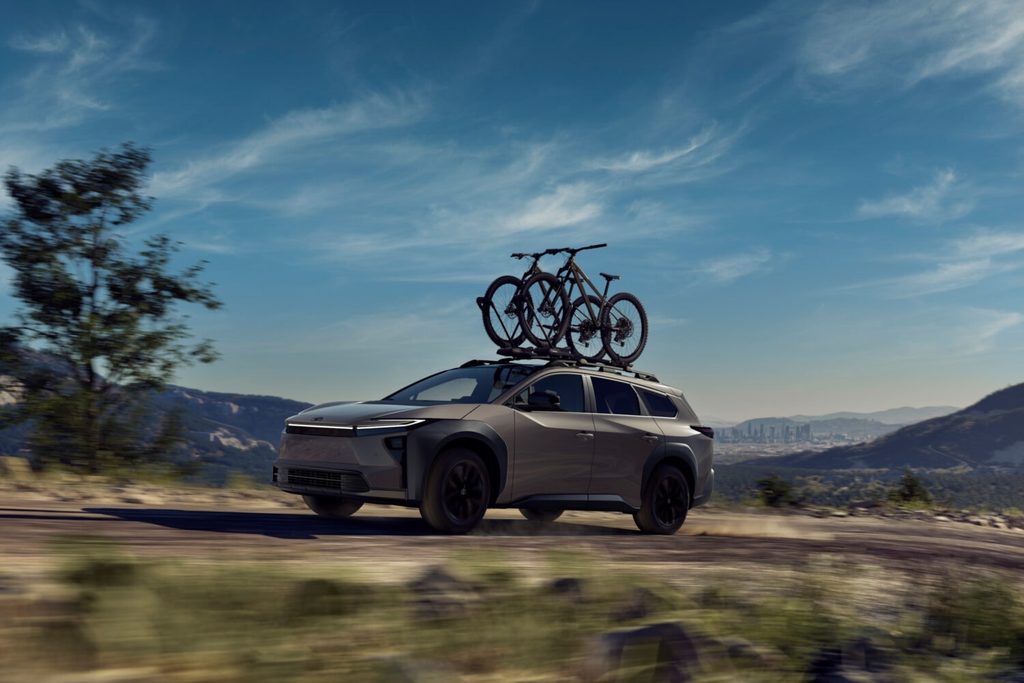
A six-month Spain pilot with Repsol fuel and Bosch verification is Toyota's live proof-of-concept.
Toyota wants the EU to count certain petrol cars as zero-emission. Not a typo. The proposal rests entirely on fuel source, not tailpipe output. Twenty vehicles are already on Spanish roads running Repsol's 100-percent renewable Nexa 95 to prove it works. Results are not yet published.
The proposal matters now because the European Commission is weighing a revised CO2 target — a 90-percent fleet reduction by 2035 instead of the existing 100-percent cut — according to Toyota Motor Europe's 'Made With Europe' briefing materials, released October 2025. Where the original rule left room for nothing but battery electrics, the revised version opens a narrow door. Toyota wants its VEEF category wedged into that gap before the legislative text is finalised.
What VEEF Actually Says
VEEF — Vehicles running Exclusively on Eligible renewable Fuels — is the category Toyota has formally proposed to EU legislators. Under the classification, a combustion car earns zero-emission status only if it is designed and built to accept no other fuel. A standard petrol vehicle that occasionally fills up with renewable gasoline would not qualify; the exclusivity requirement is written into the definition. Toyota's briefing document, presented at the 'Made With Europe' press event in October 2025, frames the ask as a shift from tailpipe-only carbon accounting to full life-cycle measurement. Under life-cycle rules, fuel derived from organic waste, biomass residues, or synthetic e-fuels can offset the CO2 leaving the exhaust. The company describes the request as one for "partnership and pragmatism" — an eight-word phrase that does a lot of political work. One draft timetable covers 2028 to 2032, a five-year window that would sit inside the post-2035 combustion ban. For EU zero-emission vehicle regulation in Europe, the VEEF category represents the most direct legislative challenge to a BEV-only compliance model yet tabled by a volume manufacturer.
The Arithmetic Behind the Compliance Pressure
The numbers explain Toyota's urgency. The existing EU regulation mandates a 100-percent reduction in new-car fleet CO2 by 2035, referenced in Regulation (EU) 2019/631 and its 2023 amendment. The European Commission's revised proposal drops that to 90 percent — meaning manufacturers could theoretically emit 10 percent of their 2021 baseline across the fleet. Toyota's 2021 EU fleet average CO2 was approximately 102 g/km, according to the European Environment Agency's CO2 monitoring data, published February 2024. Ten percent of 102 g/km equals 10.2 g/km of permitted residual. A VEEF-classified vehicle emitting zero on a life-cycle basis would contribute nothing to that residual total, giving Toyota headroom it cannot currently get from hybrids alone. The Spain pilot runs 20 vehicles over six months from July 2026. Twenty cars is not a statistically large sample, but the point is verification architecture, not volume. Bosch's Digital Fuel Twin system cross-references vehicle telematics and fuel-card transaction data. If the system holds across 20 cars for 180 days, Toyota's argument to Brussels gets a data annex.

Toyota's Own Words Frame the Political Pitch
Toyota has not buried the ask in technical appendices. The 'Made With Europe' briefing, delivered by Matt Harrison, President and CEO of Toyota Motor Europe, used the phrase "partnership and pragmatism" to describe the VEEF proposal. Harrison's position is that technology neutrality — letting multiple low-carbon solutions compete — serves decarbonisation better than mandating a single drivetrain. That argument is not new from Toyota; Akio Toyoda, the company's chairman, made a version of it publicly as early as 2021. What is new is the specific legislative vehicle: a named category, a draft timetable, and a live pilot generating compliance-grade data. The European Automobile Manufacturers' Association (ACEA), in its position paper on the 2035 regulation review published March 2025, stopped short of endorsing VEEF by name but called for "fuel-agnostic life-cycle accounting" in the revised text — language that aligns closely with what Toyota is asking for. That alignment matters because ACEA speaks for Stellantis, Volkswagen Group, and BMW alongside Toyota, giving the life-cycle argument broader industry support than Toyota alone could deliver.
The Verification Problem Nobody Has Solved
Here is what does not add up. The Spain pilot involves 20 cars, a single fuel supplier — Repsol — and one verification platform from Bosch. The EU passenger car fleet runs to roughly 250 million vehicles. Scaling Bosch's Digital Fuel Twin from a controlled six-month trial to a continent-wide enforcement mechanism is not an engineering question Toyota has publicly answered. There is also a fuel supply problem. Renewable gasoline at the volumes needed to run even a fraction of Europe's combustion fleet does not currently exist. Repsol's Nexa 95 is a real product on sale in Spain, but production capacity is not published at a scale that matches mass-market VEEF adoption. If the EU accepted the category and Toyota sold VEEF-classified vehicles at volume, where does the fuel come from? Toyota's October 2025 briefing materials do not contain a supply-chain projection. The European Commission's own impact assessment on sustainable fuels, published alongside the revised CO2 targets in 2025, flagged feedstock availability as "a binding constraint before 2030" — which overlaps exactly with Toyota's proposed 2028–2032 VEEF window.
What a VEEF Win Means for BEV-Only Manufacturers
If the EU accepts the VEEF classification — even in a limited form — the compliance arithmetic changes for every manufacturer, not just Toyota. Stellantis and Renault both carry higher BEV exposure in their 2025–2027 product plans than Toyota does. A VEEF credit mechanism would give Toyota a compliance route that neither Stellantis nor Renault could exploit at the same scale, because neither has Toyota's existing hybrid manufacturing depth nor a parallel renewable-fuel pilot running. For Volkswagen Group, the picture is different: the Group has invested heavily in e-fuel infrastructure through Porsche's Haru Oni plant in Chile, which produced synthetic fuel commercially from 2023. A life-cycle accounting rule that credits e-fuels could benefit Volkswagen Group's internal combustion sport models at Porsche and Audi. Pure-BEV manufacturers face the sharpest exposure. A VEEF category that allows combustion cars to count as zero-emission would reduce the regulatory pressure on Toyota, Stellantis, and Volkswagen Group to accelerate BEV sales volume — directly softening the market conditions that BEV-only producers depend on to justify their fixed-cost base.
Toyota sold approximately 1.1 million vehicles in Europe in 2024, of which around 68 percent carried a hybrid or plug-in hybrid drivetrain, according to Toyota Motor Europe's annual sales data released January 2025. None of those hybrids currently qualifies as zero-emission under EU rules. The VEEF window covers 2028–2032 — the same period Toyota's next-generation powertrain platform reaches European dealerships. The complete Toyota model history and specifications are catalogued in the Global Auto Index manufacturer database.
