
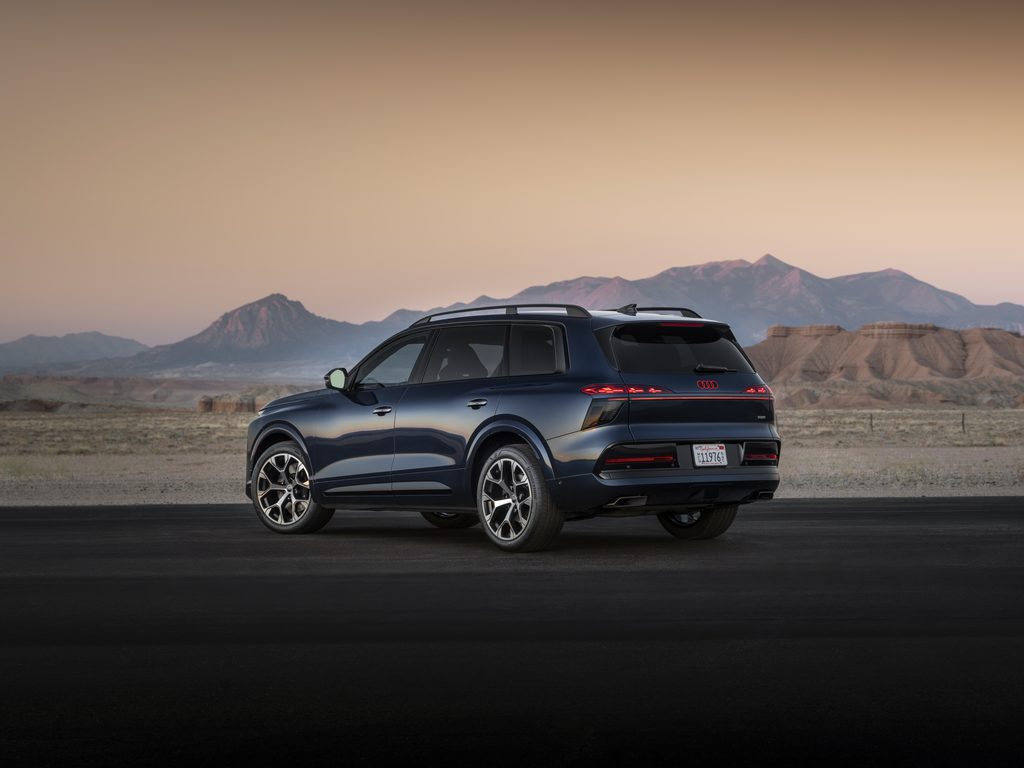
Six glass panels, each just 0.1 mm thick, wrap lighting around the rear quarter panels — a configuration no rival currently offers.
Audi revealed the Q9 in July. The taillights are the talking point. Six curved OLED panels — 0.1 millimetres of glass each — wrap around the rear quarters where a flat lens simply stops. Total controllable segments: 512.
Flat-panel OLED taillights have appeared on Audi production vehicles since 2019, when the e-tron became the first series car to carry segmented OLED rear lighting, according to Volkswagen Group's product communications release dated July 2025. Curved substrates are a different engineering problem. Mercedes-Benz and BMW have not announced equivalent curved-glass OLED units for their flagship SUV lines — the GLS and X7 respectively — as of October 2025.
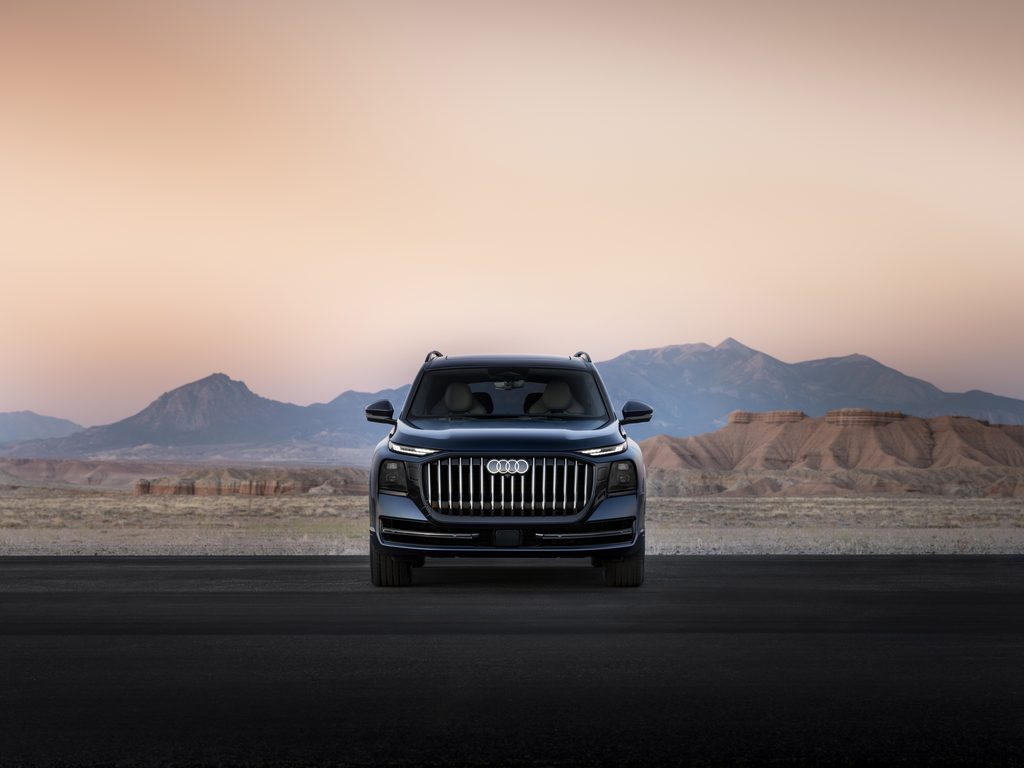
How Audi Bent the Glass Without Breaking the Light
Conventional OLED lighting bonds an emitting layer to a rigid flat substrate. Audi's engineers at the Ingolstadt lighting development centre spent roughly a decade working toward a flexible alternative, according to the brand's technical briefing published alongside the Q9 world premiere. The solution bonds the OLED layer directly to a borosilicate glass substrate milled to 0.1 mm — thin enough to follow a compound curve without fracturing the emitter. Each finished panel measures one millimetre of total depth once the protective cover and adhesion layers are counted in. The glass then follows the shape of the rear quarter panel, which bulges outward toward the wheel arch, rather than sitting flat against a vertical plane. That geometry lets light project sideways as well as rearward. Audi connected each of the six panels to the vehicle's central electrical control unit via a CAN bus line, giving individual addressing to every segment. This is the strand of European flagship SUV development that the Q9 sits at the end of — a decade of incremental OLED work now visible in bent glass.
Segment Counts, Panel Areas, and One Millimetre of Depth
The six panels divide across three positions on each side of the tailgate. Audi's production specification, confirmed in the July 2025 technical release, lists the following per-side segment counts: outer panel, 99 segments; central panel, 84 segments; inner panel, 73 segments. Running the arithmetic: (99 + 84 + 73) × 2 sides = 512 segments total, which matches Audi's published figure. The outer curved panel on each side is, by Audi's own description, the largest single rear-light panel the brand has placed on a production vehicle. At one millimetre of finished depth, the entire light element is thinner than a standard credit card, which runs 0.76 mm — meaning Audi's light stack is approximately 32 percent thicker than a credit card, against the several centimetres of depth needed by a conventional LED reflector housing. Glass substrate thickness of 0.1 mm sits at roughly the gauge of a human hair's diameter, which ranges 0.06–0.12 mm depending on follicle type. These are not marketing approximations; they are production tolerances submitted as type-approval documentation to European regulators.
Audi's Own Claim and What It Rests On
Audi describes the curved OLED taillight arrangement as a "world first" in its July 2025 premiere materials — a claim it has not walked back in subsequent communications as of late October 2025. The phrase carries weight because Audi also held the original "world first" claim for segmented OLED taillights on any production car, a distinction it earned with the second-generation e-tron launch. Thomas Sigi, head of exterior lighting at AUDI AG, stated in the premiere briefing document that "the curved glass substrate allows us to follow body surfaces that were previously off-limits for OLED technology." That framing is precise rather than expansive: Sigi did not claim superior brightness or longer service life compared with flat OLED units, only the geometric capability. The underlying OLED supply chain draws on panels from LG Display, which has publicly disclosed its flexible OLED automotive programme in filings to the Korea Exchange, though Audi has not named LG Display as the Q9 supplier in any official release reviewed for this article.
What Audi Has Not Said About the 512-Segment System
Three months elapsed between the Q9's July premiere and late October 2025, and Audi has still not confirmed several details that would ordinarily accompany a production lighting specification of this complexity. The brand has not published whether drivers can alter the startup or shutdown light animation sequences through the onboard menu — a feature Audi does permit on some current Q7 and Q8 variants. It has not stated whether all markets receive the same turn-signal projection pattern onto the pavement, or whether that feature is disabled in jurisdictions where road-surface projection lighting is unregulated or restricted. US pricing remains unannounced as of this writing. Most conspicuously, Audi has released no independent photometric data — luminous intensity in candela, illuminated area in square centimetres, or ECE R148 compliance test results — that would allow an independent assessment of whether 512 individually addressed segments produce materially better brake-signal detection distances than, for example, the 32-segment OLED units already on the Q8. The segment count is real. What it delivers in practice has not been independently measured.
Where the Q9 Stands Against Its Direct Rivals
The Q9 slots above the Q8 in Audi's line-up and targets the Mercedes-Benz GLS and BMW X7 in the large luxury SUV segment, where transaction prices in Western Europe typically run between €110,000 and €160,000 depending on specification. Neither Stuttgart nor Munich has announced curved OLED rear lighting for those models. The GLS received a mid-cycle update in 2023 that retained conventional LED taillights with fibre-optic trim strips. The X7 facelift, also 2023, moved to a split-headlight design up front but kept flat LED units at the rear. Audi's flat OLED Q8 taillights, introduced at series launch in 2018 and updated for the 2023 SQ8 facelift, used 32 segments per light — compared with the Q9's 256 per side (512 ÷ 2). That is an eight-fold increase in addressable resolution on a per-side basis, on a vehicle that Audi positions directly against rivals who have not yet committed to OLED rear lighting at all.
Audi first showed OLED taillights on a concept car — the Prologue — at the 2014 Los Angeles Auto Show, putting eleven years between that concept debut and the Q9's curved production version. The Q9 is expected to reach European showrooms in the first half of 2026. The complete Audi model history and specifications are catalogued in the Global Auto Index manufacturer database.
