Polish rally champion Miko Marczyk drove 45-plus hours straight, averaging 7.09 kWh/100 km across public roads.
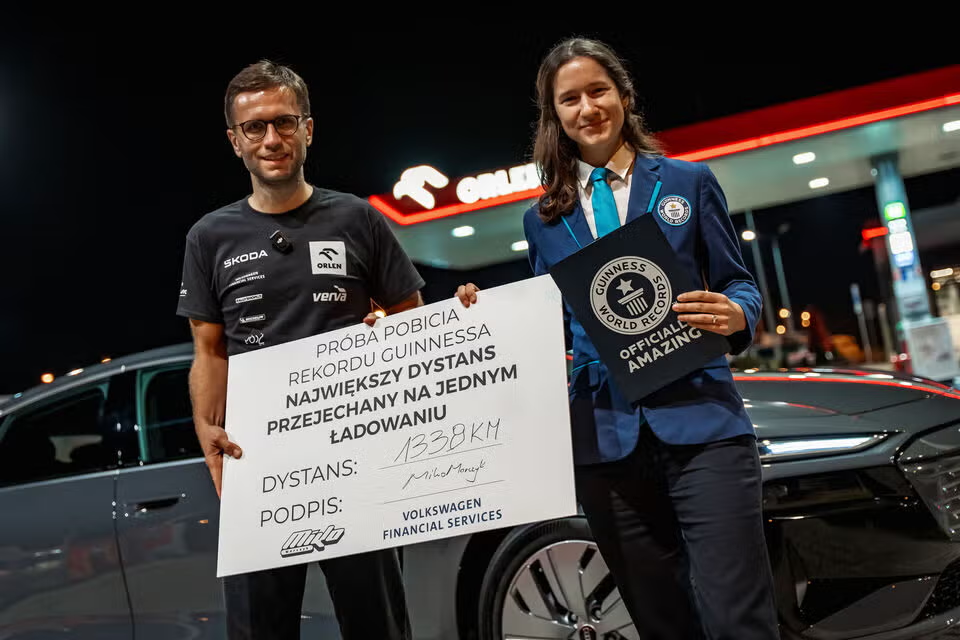
1:55 AM. September 11. A car rolls out of Poland into darkness with a full battery and no charging stop planned. Rally driver Miko Marczyk drove the Audi A6 Sportback E-Tron 1,338 kilometres before the pack died — somewhere on a Polish dual carriageway between Toruń and Ciechocinek, more than 45 hours later.
The run, certified Records as the longest single-charge journey by a production electric vehicle, covered 72 percent more distance than the A6 Sportback E-Tron's official WLTP rating of 777 km. For context, the previous Guinness production-car EV range record sat well below 1,000 km. According to Audi AG's official press release, published September 2025, the attempt was conducted on open public roads under standard traffic conditions.
Krakow to the Baltic and Back
Marczyk departed from southern Poland before dawn, following the Vistula river corridor north. He passed through Kraków, Sandomierz, Warsaw, and Toruń before reaching Hel — the narrow sand spit jutting into the Baltic Sea. Then he turned around. The return leg retraced much of the same route. Overnight temperatures dropped to 7°C, rising to an average of roughly 15°C across the full attempt. Rush-hour traffic in Warsaw added load to the drive cycle that no laboratory test replicates. The car ran on public roads throughout; no closed track, no tow. Marczyk managed energy use the way a rally navigator manages pace notes — precisely, without margin for error. The battery reached zero between Toruń and Ciechocinek, a stretch of flat agricultural lowland that offered no further recuperation gradient. The BMW and Audi performance EV transition now has a concrete distance benchmark attached to it.
What the Numbers Actually Say
The A6 Sportback E-Tron carries a net battery capacity of 94.9 kWh. Marczyk averaged 7.09 kWh per 100 km across the full 1,338 km. Multiply those figures: 7.09 × 13.38 = 94.86 kWh consumed — within rounding error of the pack's rated net capacity, which confirms the arithmetic is coherent and that no meaningful charge was added mid-run. Audi quotes the car's official combined consumption at approximately 15.7 kWh/100 km under WLTP. Marczyk's figure is therefore 54.8 percent below the rated value — less than half. At that consumption rate, the WLTP-rated 94.9 kWh pack would theoretically cover 1,338 km, which is exactly what happened. The A6 Sportback E-Tron's drag coefficient is 0.21 Cd, the lowest Audi has certified on any production car. Regenerative braking on this platform recovers up to 220 kW and, according to Audi AG's technical documentation accompanying the September 2025 press release, handles approximately 95 percent of everyday braking events without friction brake intervention.

Record Within a Record: Production vs. Prototype
The 1,338 km figure is not the absolute Guinness distance record for electric vehicles. That mark belongs to the TUfast Eco Team at the Technical University of Munich, whose 'muc022' prototype covered 2,573.79 km in September 2023 on a controlled circuit in Germany. Marczyk's run is specifically certified for production cars on public roads — a categorically different and arguably more relevant test. The gap between the two records is 1,235.79 km, which illustrates how much aerodynamic and weight engineering separates a purpose-built student prototype from a saloon you can order from a dealership. This is not a minor asterisk. It is the entire point. The production-car category is the one that tells a buyer something actionable. On that measure, 1,338 km on public roads, in traffic, overnight, in single-digit temperatures, represents a distance that no production EV had previously certified under Guinness protocols. Kia UK's ZEV mandate concerns centre partly on range anxiety — a record like this reframes that conversation, at least at the specification ceiling.
The Gap No One Is Talking About
Here is what Audi's press materials did not address: charging infrastructure along the Vistula corridor. If a driver cannot replicate even 60 percent of Marczyk's range — call it roughly 800 km between charges — the record is irrelevant to network planning. The average DC fast-charger spacing on Polish motorways currently falls well short of 400 km intervals according to the European Alternative Fuels Observatory's infrastructure dataset, Q2 2025. Marczyk's run required zero charging stops, but a driver targeting 600 km between charges would still encounter meaningful coverage gaps on secondary routes. The record demonstrates what the battery chemistry permits; it says nothing about whether the network can serve a driver who simply wants to travel from Warsaw to Gdańsk without detour anxiety. That question — infrastructure density versus demonstrated vehicle range — is precisely where the EV case either strengthens or stalls. The EU Industrial Accelerator Act's EV manufacturing provisions address production but leave charging network obligations to separate directives.
The Driver's Method, in His Own Words
Marczyk outlined his approach in Audi AG's accompanying September 2025 press material, describing the discipline required: "know the car, use regenerative braking intelligently, keep the tires properly inflated, anticipate traffic." That eight-word core — anticipate traffic, avoid unnecessary acceleration — is also the complete anti-thesis of how most drivers use a performance-oriented liftback. Marczyk is the reigning European Rally Champion, a credential that makes his sudden conversion to maximum-patience driving somewhat absurd on its face. He previously applied the same efficiency logic to a Skoda Superb diesel, covering 2,831 km on a single tank and averaging 2.61 litres per 100 km — a separate Guinness production-car record documented by Guinness World Records in 2024. The same driver, the same Volkswagen Group, two entirely different powertrains, two records. Whether that pattern reflects a deliberate VW Group communications programme or simply one very disciplined driver is a question neither Audi nor Volkswagen Group communications answered by publication time.
Audi first showed the A6 Sportback E-Tron concept in April 2023 at the Shanghai Motor Show, with series production beginning at the Brussels plant in late 2024. The Brussels facility produces exclusively battery-electric vehicles. Marczyk's certified attempt adds a third Guinness record to the A6 nameplate's history alongside prior efficiency benchmarks. The number that will follow this car around showrooms is 831. The complete Audi model history and specifications are catalogued in the Global Auto Index manufacturer database.
