Assembly capacity at the German plant now shifts to A5 Sedan and Avant variants, effective immediately.
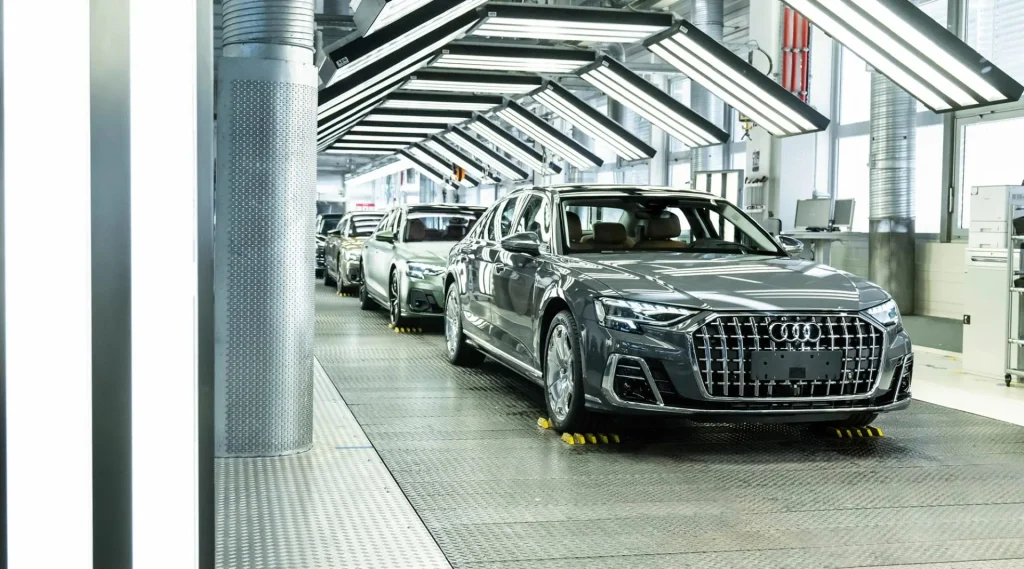
The line stopped in mid-October. No ceremony was announced. After 32 years at Neckarsulm, Audi's D5-generation A8 ended production quietly, with the brand yet to confirm powertrain, platform, or launch window for whatever follows. A successor is planned. That is all.
The closure lands at a moment when Mercedes-Benz S-Class and BMW 7 Series retail volumes are holding, making the A8's withdrawal look like a retreat rather than a pause. According to Auto Motor and Sport's reporting, published November 2024, Neckarsulm now joins three other Volkswagen Group sites — Emden, Zwickau, and Hanover — without secured production allocations beyond 2030, per VW Group's Future Plan 2030 document approved Board.
Thirty-Two Years, Four Generations, One Last Car
Neckarsulm received its first A8 body in 1994. That D2 generation arrived built around Audi's Space Frame construction — bonded and riveted aluminium — which separated it structurally from the steel-bodied S-Class W140 and BMW E38 of the same era. The D3 followed in 2002, the D4 in 2009, and the current D5 in 2017. A facelift arrived in 2021 and extended the model's commercial life by roughly four years. Audi stopped accepting individual customer orders in Germany in February 2024, directing buyers to dealer stock. By mid-October, that stock was the production run. Workers at Neckarsulm completed the final car without a recorded public handover event. The European full-size luxury sedan segment now has one fewer nameplate in active production.
What the Numbers Say About the A8's Market Position
The D5 A8 launched in 2017 at a base price above €90,000 in Germany. The 2021 facelift model extended that into a seven-year production window — long by flagship standards. VW Group's Future Plan 2030, approved by the Supervisory Board, states that European production capacity exceeds demand by more than 500,000 vehicles annually. Neckarsulm's total workforce stands at approximately 15,500 employees across all model lines, according to Audi's 2023 Annual Report. The A5 Sedan and A5 Avant now absorb the assembly slots vacated by the A8 — two body styles replacing one, but both positioned at roughly half the A8's transaction price. That substitution produces a rough revenue-per-unit drop of around €45,000 to €50,000 on each slot, assuming average A8 transaction prices near €110,000 versus A5 averages near €60,000. Volume would need to rise by nearly 83 percent on those lines just to hold equivalent gross revenue per shift.
Marcel Bestle's Statement Leaves More Questions Than Answers
Marcel Bestle, model line spokesperson for Audi, told Motor1 earlier in 2024 that a decision had been reached internally. His exact words: "The decision on an A8 successor has been taken and we intend to present it towards the end of this decade." That statement, issued before production ended, confirms intent but specifies no powertrain, no platform, and no factory. "Towards the end of this decade" means anywhere from 2027 to 2029 for a reveal — or later for a sale. Bestle also confirmed that the Audi Q9, produced in Bratislava, Slovakia, would expand the brand's portfolio at the top as a full-size SUV. That phrasing carefully avoids calling the Q9 a flagship replacement, though operationally it now occupies that role. Audi has not published a product roadmap document that places the A8 successor on a named platform or assigns it to a specific plant.
While the A8 Exits, Stuttgart and Munich Hold the Line
Mercedes-Benz reported S-Class sales of 65,245 units globally in 2023, according to Mercedes-Benz Group AG's Annual Report 2023. BMW Group's 7 Series, including the i7 electric variant, posted 37,204 deliveries in the same period, per BMW Group's Annual Report 2023. Audi has not published standalone A8 sales figures in recent annual reports, bundling the model into broader segment totals. That alone signals where the A8 stood commercially. The S-Class has a fully electrified EQS sibling. The 7 Series runs in parallel with the i7, sharing a platform. Audi attempted no equivalent split: the A8 remained available as TFSI petrol, TDI diesel, and TFSI e plug-in hybrid, but never reached a full battery-electric variant in the D5 cycle. The gap in electrification coverage likely constrained fleet eligibility in markets where BEV quotas apply to company-car schemes, particularly in the Netherlands, Norway, and the United Kingdom after April 2025 benefit-in-kind revisions.
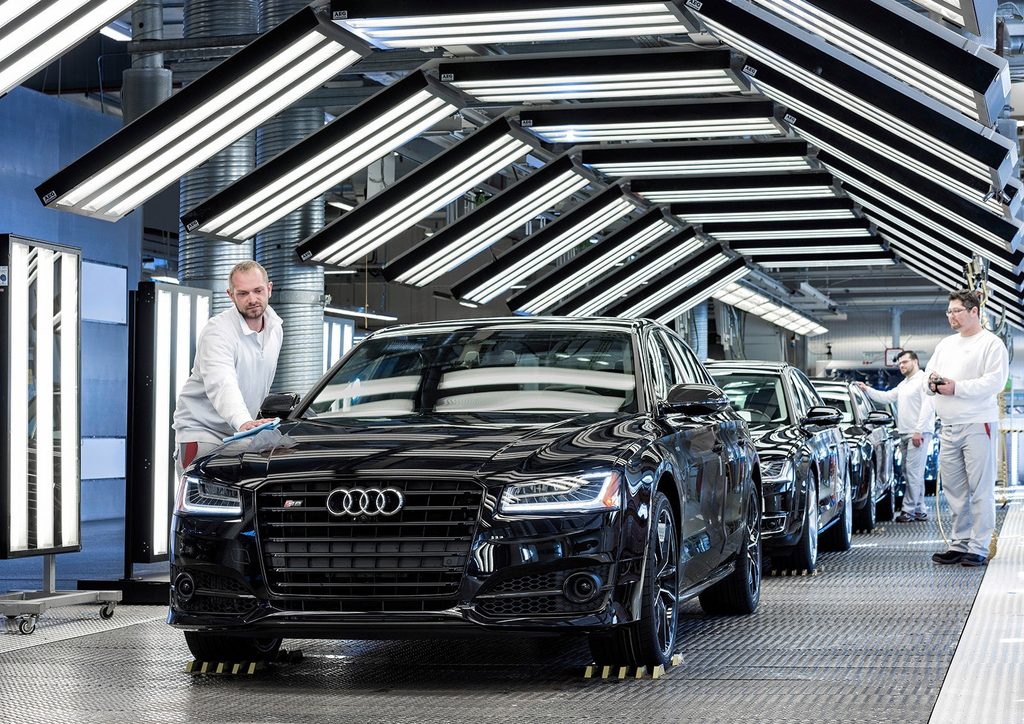
Neckarsulm's Future Plan Problem
Here is what does not add up. VW Group's Future Plan 2030, approved by the Supervisory Board and publicly referenced in November 2024, acknowledges that Neckarsulm cannot currently be guaranteed competitive production allocations between 2031 and 2034. The plan commits to developing a sustainable production approach for European plants by June 2027. Yet the A8 successor — the one model that could anchor Neckarsulm's flagship identity — has no confirmed plant assignment. If the successor arrives "towards the end of this decade," a 2029 reveal implies a 2030 or 2031 production start. That timeline collides directly with the period for which Neckarsulm has no secured allocation. Audi has not confirmed whether the next A8 would be built at Neckarsulm, at another VW Group European site, or abroad. The plant that built every A8 since 1994 may not build the next one. That question has not been answered.
The D2-generation A8 debuted at the 1994 Geneva Motor Show, where Audi publicly demonstrated that aluminium Space Frame construction could support a full-size luxury body at scale — a claim no German competitor had made in production form at that point. Neckarsulm has built Audi vehicles since 1958. The complete Audi model history and specifications are catalogued in the Global Auto Index manufacturer database.
