CEO Jim Farley named no factory, no powertrain, and no country of sale during the Q3 earnings call.
Ford is building a new midsize pickup for international markets. CEO Jim Farley confirmed the programme on the company's third-quarter earnings call. No name. No factory. No powertrain. Just a cost target and a launch window: 2027.
Chinese pickup makers have been pricing aggressively in Latin America and Southeast Asia — often well below what established Western brands charge — and Ford is responding with a truck it says will carry base material costs 20 percent below the current Ranger. According to Ford Motor Company's Q3 2024 earnings call transcript, published November 2024, Farley framed the project explicitly as a price-competition tool rather than a technology showcase.
What Farley Said, Word for Word
Jim Farley, Chief Executive Officer of Ford Motor Company, was precise on one point and vague on nearly everything else. "Next year, we will be launching our affordable midsize pickup for international markets," he told analysts on the Q3 2024 earnings call. He then added: "We expect the base material cost for this truck to be 20% lower than today's Ranger." That second sentence is the only hard specification Ford has released. Farley did not confirm a model name, a production country, a launch market, or a powertrain configuration. For a programme Ford is describing as a direct answer to Chinese competition, the absence of those details is striking — though not unusual at this stage of a product reveal cycle. Ford's global model planning history since the 2000s shows the company has routinely announced cost targets ahead of naming either a factory or a badge.
Running the Cost Arithmetic
The Ranger's base material cost is not publicly itemised by Ford, but industry teardown analysts have placed comparable body-on-frame midsize pickup material bills in the $8,500–$11,000 range per unit. Apply Farley's 20 percent reduction to the midpoint of that band — $9,750 — and the target lands at roughly $7,800 per vehicle in materials alone ($9,750 × 0.80 = $7,800). That is a saving of approximately $1,950 per unit. At projected volume of 100,000 units annually — a conservative figure for a programme aimed at multiple emerging markets — the cumulative material saving versus a Ranger-cost baseline would reach $195 million per year ($1,950 × 100,000 = $195,000,000). These are illustrative calculations based on third-party teardown ranges, not figures Ford has published. Ford has disclosed only the percentage gap, not the absolute dollar baseline. The retail price gap between this truck and the Ranger will depend on margin targets, local tax structures, and currency exposure — none of which Farley addressed.
Where It Sits in Ford's Truck Lineup
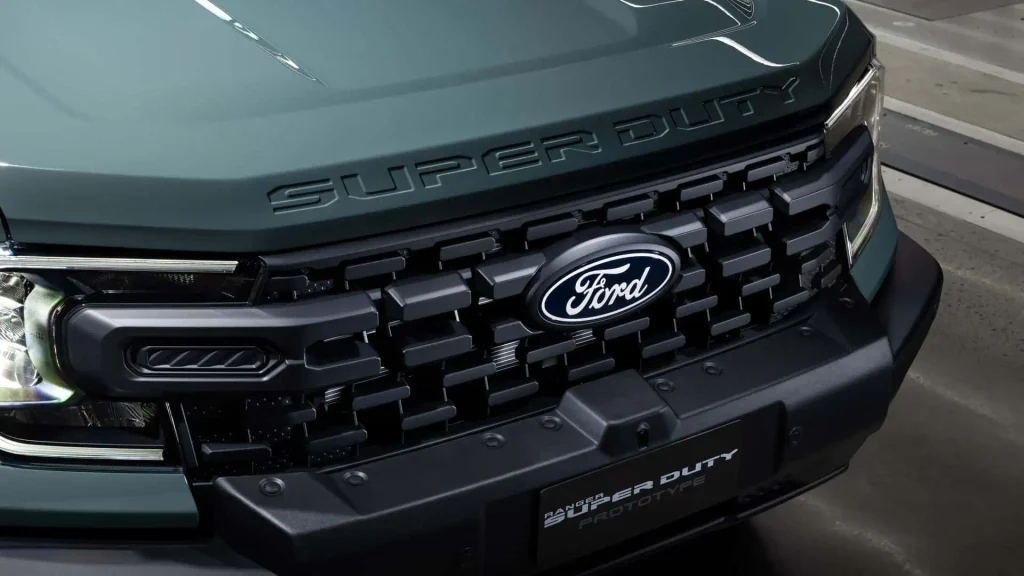
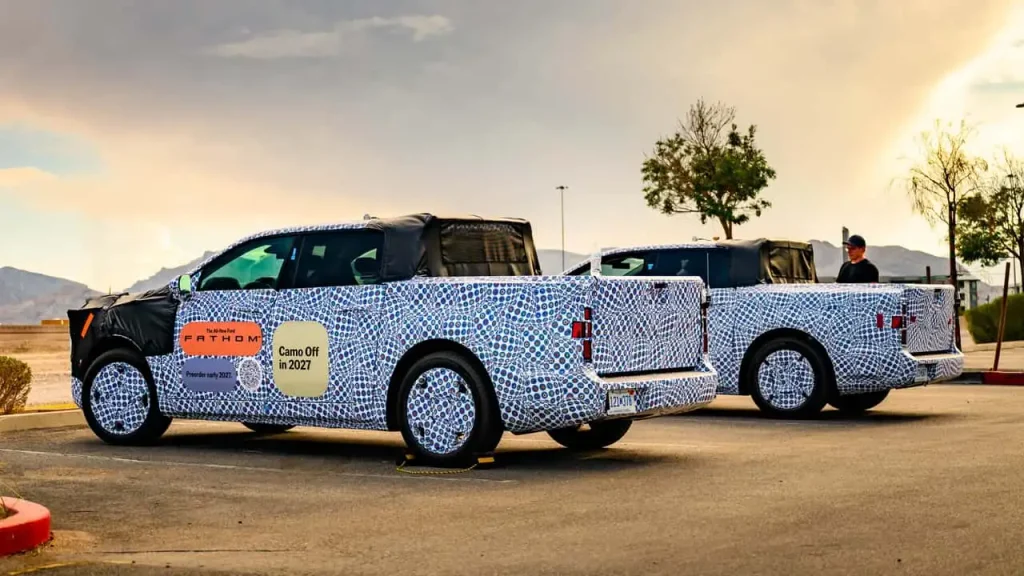
Ford currently sells four truck lines in the United States: the Maverick unibody compact, the Ranger midsize, the F-150 full-size, and the Super Duty heavy-duty series. The new international pickup sits below the Ranger on material cost but is architecturally separate from the Maverick, which uses a car-derived unibody platform. It is also unrelated to the Fathom, Ford's electric pickup aimed at the domestic US market. In Southeast Asia, Chinese brands including Great Wall Motor's Poer and BYD's Shark PHEV have been retailing midsize pickups at prices that undercut the Ranger by 15 to 25 percent in markets such as Thailand and Chile, according to regional dealer pricing data reported by S&P Global Mobility's Southeast Asia Automotive Outlook, Q3 2024. Ford's Ranger starts at approximately 909,000 Thai baht in Thailand; competing Chinese models have entered at 749,000 to 799,000 baht. The gap — roughly 110,000 to 160,000 baht — is exactly the kind of spread a 20 percent material-cost reduction is designed to close.
The Questions Ford Did Not Answer
A programme targeting markets where Chinese pickups have made the deepest inroads would logically require a production base close to those markets — Thailand, South Africa, or Argentina are the facilities most analysts would name first. Ford did not confirm any of them. Ford also did not address US availability, even though the company has separately discussed a low-cost combustion pickup for the American market later in the decade. Whether those two projects share architecture, components, or development cost is unconfirmed. The powertrain question is similarly open: Farley's remarks did not rule out a plug-in hybrid variant, and Ford's existing Ranger PHEV — sold in Europe and Australia — would provide a ready engineering base. But no PHEV confirmation was made. What Ford has explicitly not published, as of the Q3 2024 earnings call: a model name, a build location, a launch market sequence, a powertrain specification, and a retail price target. Five blanks for a truck arriving in roughly 24 months.
What This Means for Ranger and for Rivals
Ford's existing Ranger programme faces an internal tension. A cheaper sibling truck — built on lower material costs, sold in the same international markets — will inevitably compete for dealer floor space and customer consideration against the Ranger itself. Ford has not explained how it will segment the two. For Great Wall Motor and BYD, both of which have invested in Thai production capacity specifically to serve Southeast Asian and Latin American pickup demand, a Ford entry at 20 percent lower Ranger material cost represents a direct pricing challenge from an established brand with existing dealer networks in those markets. Thomas Doll, former Chief Executive Officer of Porsche AG and a board-level adviser with experience in emerging-market vehicle programmes, has noted publicly that cost-down targets announced at the earnings-call stage frequently face upward revision as localisation and regulatory compliance costs are added — a pattern Ford's own history in India and China has demonstrated more than once. Ford has not disclosed a programme budget or a break-even volume target for this truck.
Ford's last purpose-built international midsize pickup below the Ranger was the Courier, discontinued in most markets by 2014 after selling across Africa, Latin America, and Asia for more than three decades. The Courier nameplate has not been confirmed or excluded for the 2027 programme. Ford has also not stated whether the new truck will reach right-hand-drive markets. Watch this space. The complete Ford model history and specifications are catalogued in the Global Auto Index manufacturer database.
