Leaked supervisory board documents name Emden, Zwickau, Hanover, and Neckarsulm for closure across a three-year window.
Four plants. One decade. Gone. Leaked supervisory board documents obtained out a closure schedule that would strip Volkswagen Group of nearly its entire German electric-vehicle manufacturing base by 2034, with roughly 140,000 jobs tied to the broader restructuring.
The scale has no modern parallel in European automotive history. When General Motors shuttered Bochum in 2014, it cut around 3,300 jobs. VW's rumored figure is more than forty times that. According to WirtschaftsWoche's reporting, published September 2024, CEO Oliver Blume carried the plan into a supervisory board meeting on 4 September — though no closures have been formally approved and Blume has said publicly that cost targets set for 2027 could alter the outcome.
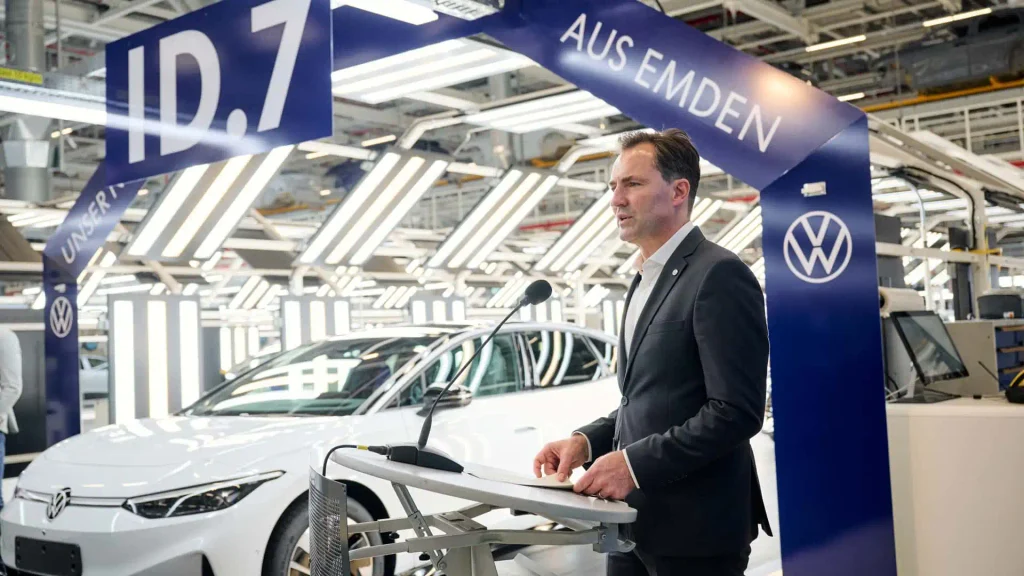
What the Leaked Supervisory Board Documents Actually Say
The WirtschaftsWoche documents — described as internal supervisory board planning materials circulated ahead of the 4 September meeting — assign a specific closure year to each site. Emden and Zwickau are scheduled to end production in 2031. Hanover follows in 2032. Audi's Neckarsulm facility, including its Böllinger Höfe sub-campus, is listed for 2034. The ten-year spread is not accidental: German co-determination law and the group's own employment protection agreement, which runs until 2029, make faster action legally and contractually difficult. Reuters separately confirmed that Blume has already said on the record that VW cannot guarantee competitive capacity utilisation at these four sites through the 2030s. That is not a denial. This article is part of GlobalAutoIndex's ongoing coverage of industry restructuring in 2026 and beyond.
The Output These Four Plants Represent Today
Zwickau employs approximately 8,000 workers and runs six nameplates simultaneously: the ID.3, ID.4, ID.5, Audi Q4 E-Tron, Cupra Born, plus body production for the Bentley Bentayga and Lamborghini Urus. Emden switched entirely to MEB-platform electric assembly in 2022, adding the ID.7 sedan to the ID.4 line shortly after. Hanover has built the ID.Buzz — both passenger and cargo variants — since 2022 following a modernisation programme that added dedicated body and paint shops. Neckarsulm produces the A5, A6, and A8 alongside the E-Tron GT at Böllinger Höfe. Taken together: four sites, at least ten distinct nameplates in current production, and output that covers every price tier from a €39,000 ID.3 to an A8 that lists above €100,000. Losing all four between 2031 and 2034 means an average of one major German EV or flagship plant closing every 0.75 years across that window — calculated as three closures across the 2031–2034 span with the fourth opening that sequence in the same year as the first.
Czech Republic and Slovakia Absorb the Work Germany Loses
The reassignment logic in the leaked plan is consistent across every model. The ID.4 successor moves to Skoda's Mladá Boleslav plant in the Czech Republic — a facility where average hourly labour costs run well below those at Emden or Wolfsburg, according to Eurostat's Labour Cost Survey 2023. The next Audi Q4 E-Tron transfers to Bratislava, Slovakia, where Volkswagen Group already operates a high-volume SUV plant. Hanover's electric van work, reportedly rebranded internally as B-Space, relocates to Poznań, Poland. The Audi A8 successor moves to Leipzig — still Germany, but a site the group consistently rates as more cost-efficient than Neckarsulm. The pattern echoes decisions already taken elsewhere in the sector: Changan's rejection of shared European production reflects the same cost calculus from the other direction, with Chinese OEMs unwilling to absorb Western labour overheads even when floor space is scarce.
The Plants at Risk Are the Ones VW Bet the EV Transition On
Here is what does not add up. Emden did not hedge. The plant abandoned internal-combustion assembly entirely in 2022 to become a dedicated MEB hub — a commitment made at significant capital cost. Zwickau completed a similar full conversion, earning recognition inside the group as its flagship electric site. Hanover received a targeted modernisation specifically for ID.Buzz production. These are not legacy combustion plants awaiting natural retirement. They are the facilities VW publicly cited as proof that its electric transition was real and German. If the closure schedule holds, VW will have dismantled its German EV manufacturing base within roughly twelve years of building it. The group has not explained — publicly or, based on available documents, internally — how it squares that capital write-off against the cost savings from moving production east. That gap in the accounting has not been addressed in any published communication from Volkswagen AG as of the date of this report. Separately, U.S. tariff pressure and European regulatory tightening are compounding the demand-side problems that made these plants unviable in the first place.
Suppliers, Regions, and the IG Metall Reckoning
Neckarsulm is among the largest single employers in the Heilbronn-Franken region of Baden-Württemberg. Plant closure there would trigger Sozialplan negotiations — statutory German severance and retraining programmes — at a scale the regional labour office has no recent template for. Zwickau's 8,000 direct jobs sit in Saxony, a state that has seen recurring political turbulence linked to post-reunification deindustrialisation. IG Metall, the metalworkers' union that holds seats on VW's supervisory board under German co-determination rules, will have sight of these documents before any vote. Bernd Osterloh, who served as VW's works council chief during previous restructuring rounds, was replaced by Daniela Cavallo — and her public position since taking the role has been explicit opposition to any German plant closures. The supply-chain effect extends further: Tier 1 and Tier 2 component suppliers clustered around Emden, Zwickau, and Neckarsulm collectively employ tens of thousands of additional workers whose contracts are indexed to VW production volumes, not to VW's own headcount. Kia's experience in the UK market — where Kia UK reached 100,000 EVs but flagged mandate pace as unrealistic — illustrates how demand-side uncertainty amplifies manufacturer-side production risk across the whole European market.
Volkswagen's German workforce stood at approximately 120,000 employees across its domestic plants as of the group's 2023 Annual Report — meaning the 140,000 figure cited in the restructuring documents exceeds VW's own reported German headcount, suggesting the total encompasses VW Group subsidiaries including Audi AG staff. No figure for projected severance costs has been published. The complete Volkswagen model history and specifications are catalogued in the Global Auto Index manufacturer database.
