
A joint ECU and operating-system agreement covers gasoline, hybrid, and electric vehicles — with no capital tie-up attached.
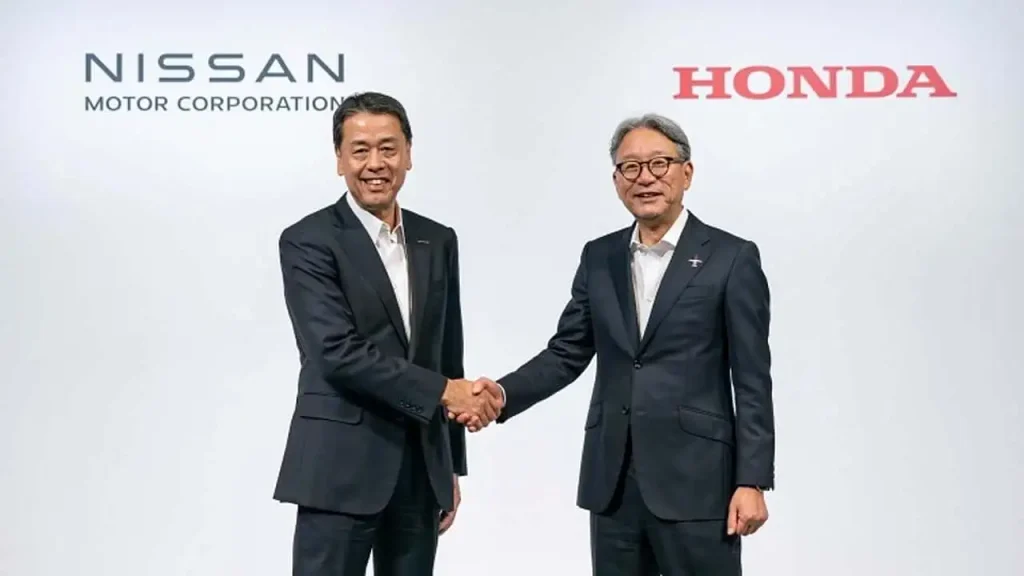
Honda and Nissan signed a joint development agreement on 31 August. No merger. No new company. The target is fiscal 2029 production vehicles — gasoline, hybrid, and electric — running identical jointly written software. Eighteen months of on-again merger talks produced none of this; one afternoon's signing did.
The deal matters because it is the first concrete output from a relationship that began with a memorandum of understanding in late 2024 and then publicly collapsed in early 2025. According to Honda's regulatory filing, published August 2025, the pact will not materially affect Honda's consolidated results for the fiscal year ending March 2027, which means the capital outlay accelerates after that date. Tesla and several Chinese OEMs have offered over-the-air feature updates for years; Honda and Nissan are still catching up.
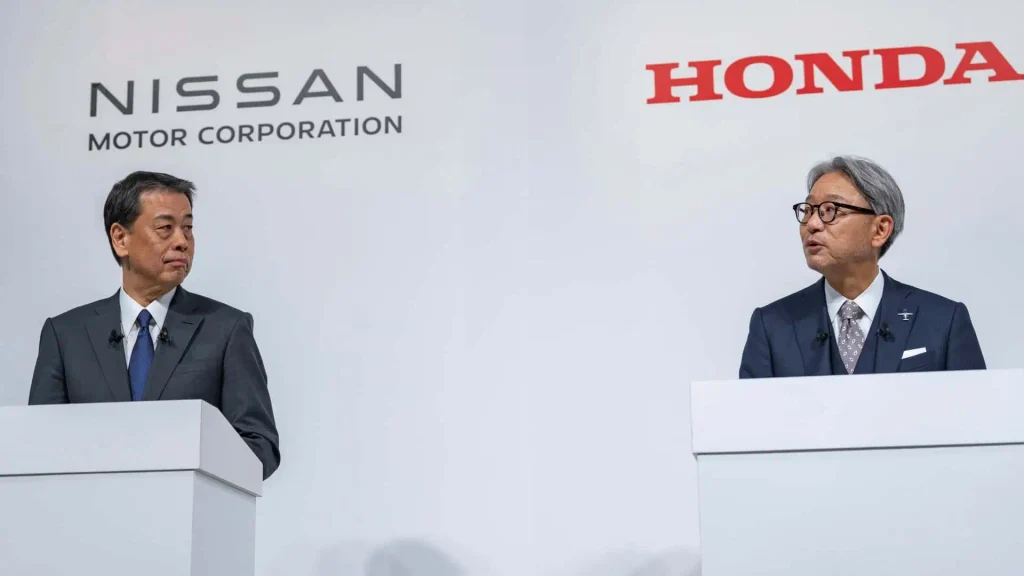
What the Agreement Actually Covers
Honda's regulatory filing, submitted 31 August 2025, specifies four discrete layers of standardisation: core electronic control units inside the vehicle's electrical architecture, the in-vehicle operating system, middleware sitting between hardware and applications, and vehicle-control software running on top. The filing does not name a specific model or a shared production platform. It confirms fiscal 2029 as the target and states explicitly that material financial impact on Honda's consolidated accounts falls outside the year ending March 2027. Korean outlet Biz Chosun reported, in its 31 August 2025 coverage, that the new OS and ECU architecture draw on existing Nissan technology — a detail neither Honda nor Nissan has confirmed in their own statements. Section references within Honda's filing describe the arrangement solely as a joint development agreement, not a capital or equity relationship. This article is part of our ongoing coverage of industry restructuring in 2026.
The Timeline and the Gap in the Numbers
Fiscal 2029 in Honda's accounting ends 31 March 2029 — roughly 43 months from the signing date of 31 August 2025. Honda's filing rules out material impact through March 2027, leaving a 24-month window, from April 2027 to March 2029, in which the bulk of joint development expenditure presumably falls. That 24-month active-spend window represents 56 percent of the total 43-month runway (24 ÷ 43 = 0.558). Neither company has published a combined R&D budget for the programme. Honda's standalone software and electrification R&D spend was reported at approximately ¥1.1 trillion for fiscal 2025 in Honda's annual results, published June 2025. Nissan's equivalent figure for the same period was approximately ¥470 billion, according to Nissan's fiscal 2025 results statement. Combined, that is roughly ¥1.57 trillion — though no portion of that has been ring-fenced for the joint programme in any document either company has released publicly.
Eighteen Months of Talks, One Afternoon of Output
In December 2024, Honda, Nissan, and Mitsubishi Motors signed a memorandum of understanding to study full business integration. By February 2025, those discussions had ended — disagreements over governance and control proved irresolvable. The August 2025 software agreement produces a narrower, lower-commitment structure: shared code, not shared equity. Compare that trajectory to the Renault-Nissan-Mitsubishi Alliance, which has operated under a cross-shareholding arrangement since 1999 and still spent two decades negotiating the boundaries between brand autonomy and shared investment. Honda and Nissan appear to be attempting the same cost-sharing logic without the ownership entanglement. Honda's North America product gap running to the 2027 CR-V redesign gives additional context for why software cost-sharing carries urgency: fewer new models arriving means fewer vehicles over which to amortise development spend.
What Neither Company Has Confirmed
Honda's CEO, Toshihiro Mibe, referenced a broader Nissan collaboration in public remarks ahead of the signing, and separately dismissed speculation about body-on-frame vehicle collaboration with Nissan in a June 2025 media session. The software agreement, as documented, says nothing about shared platforms, shared manufacturing, or hardware supply chains. That creates a visible gap. An operating system shared across two brands' vehicle lines typically pulls in shared middleware suppliers, shared toolchain vendors, and eventually shared validation processes — none of which are mentioned in the August filing. Whether the agreement stays bounded at software or gradually draws in hardware decisions is the question no spokesperson from either company answered when approached for this report. The filing also contains no provision governing what happens if one company's vehicle line is discontinued before fiscal 2029. Nissan's ongoing restructuring — which has included plant closures and workforce reductions announced across 2024 and 2025 — makes that an non-trivial omission. Separately, U.S. tariff shifts currently running at 25 percent on trucks are already complicating both companies' North American cost models, adding external pressure to any shared-development calculus.
What Changes for Buyers of 2029-Model Vehicles
The stated consumer benefit is over-the-air software updates that add or modify vehicle features after delivery, rather than locking capability to the factory-build date. Toshihiro Mibe framed this directly in Honda's accompanying press statement: a common OS makes post-sale updates economically viable at scale. For a buyer of a 2029 Honda hybrid sedan or a 2029 Nissan electric SUV, that means the car's feature set is not necessarily fixed on handover day. Neither company named a specific model. Honda has shown hybrid powertrain direction through sedan and SUV prototypes exhibited during 2024 and early 2025. Nissan's next hybrid system, previewed in concept form, has been positioned as compatible with updated electrical architecture — though Nissan has not confirmed it will carry the jointly developed OS. The practical gap between a signed agreement and software running in a production vehicle remains wide. Regulatory type-approval processes in Japan, Europe, and North America each require independent validation of vehicle-control software, meaning the shared codebase must pass three distinct certification regimes before reaching any driveway. That process is not mentioned in Honda's August 2025 filing.
Honda and Nissan's combined global vehicle sales reached approximately 6.6 million units in calendar year 2024, according to each company's respective annual sales data — Honda at roughly 3.8 million and Nissan at approximately 2.8 million. A shared OS deployed across even a fraction of that combined output would represent one of the larger software standardisation exercises in the sector since Volkswagen Group's E3 electrical architecture rollout began in 2022. No joint press conference was held on 31 August. The complete Honda and Nissan model history and specifications are catalogued in the Global Auto Index manufacturer database.
