Platform count drops from 13 to seven -decade as Nissan shrinks its global lineup from 56 to 45 models.
Nissan issued a survival warning. The Japanese OEM is slashing model development cycles from 52 months to 37 — or shorter. Seven factories face closure. Twenty thousand jobs are going. The pressure is existential, not rhetorical.
The admission came via Automotive News in late July 2025, when Kazuyuki Yamaguchi, corporate vice president of Product Development No. 1 in Nissan's R&D division, stated the company can no longer afford slow development cycles. Toyota's then-CEO Koji Sato made a near-identical warning to suppliers earlier this year. Two of Japan's three largest passenger car makers have now used the word 'survive' in formal communications — a coincidence that deserves scrutiny, not reassurance. This broader rupture across Japanese OEMs sits within the industry restructuring pressures reshaping global OEM operations in 2026.
The Exact Words: 'We Won't Survive'
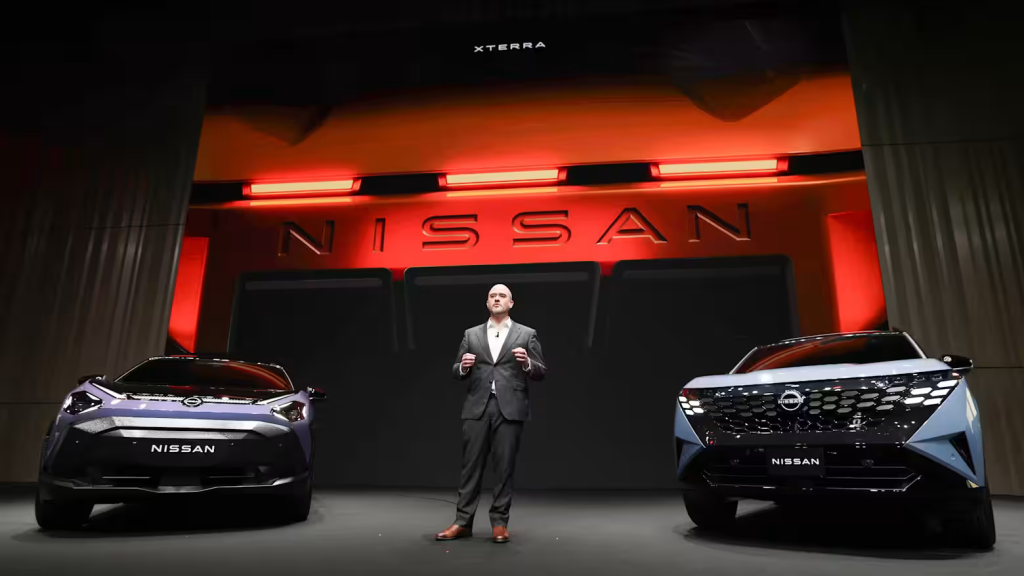
Kazuyuki Yamaguchi, corporate vice president of Product Development No. 1 at Nissan's R&D division, told Automotive News — published July 31, 2025 — that the company's old process was too slow to sustain it. His words were unambiguous: 'We need to introduce attractive products into the market more quickly. Otherwise, we won't survive. It's a very simple message.' He described the previous product development culture as 'very democratic' but 'very time-consuming,' adding that Nissan 'no longer has the luxury of time.' The new approach, he said, is 'more clean and lean, without inefficient back-and-forth.' What Yamaguchi did not confirm — and Nissan has not published — is any target date for when the accelerated pipeline will restore profitability. The timeline for financial recovery remains absent from all public disclosures reviewed for this article.
The Numbers Behind the Overhaul
Nissan's restructuring plan is unusually quantified for a company in distress. Development time for all-new models drops from 52 months to 37 months — a reduction of 15 months, or roughly 29% faster (15 ÷ 52 × 100 = 28.8%). Derivative models fall from 50 months to 30 months, a 40% cut. The platform count contracts from 13 to 7 by the middle of the next decade: 13 − 7 = 6 platforms eliminated, a 46% reduction. Parts complexity is targeted to fall by 70%. The model lineup shrinks from 56 to 45 nameplates: 56 − 45 = 11 models cut, roughly 20% of the portfolio. Annual production capacity is being reduced by one million vehicles across seven factory closures. The workforce reduction stands at 20,000 positions. These are not aspirational targets buried in a press deck — Yamaguchi's statements to Automotive News treat them as operational commitments already in execution.
Speed as Survival — But the EV Gap Isn't Closed
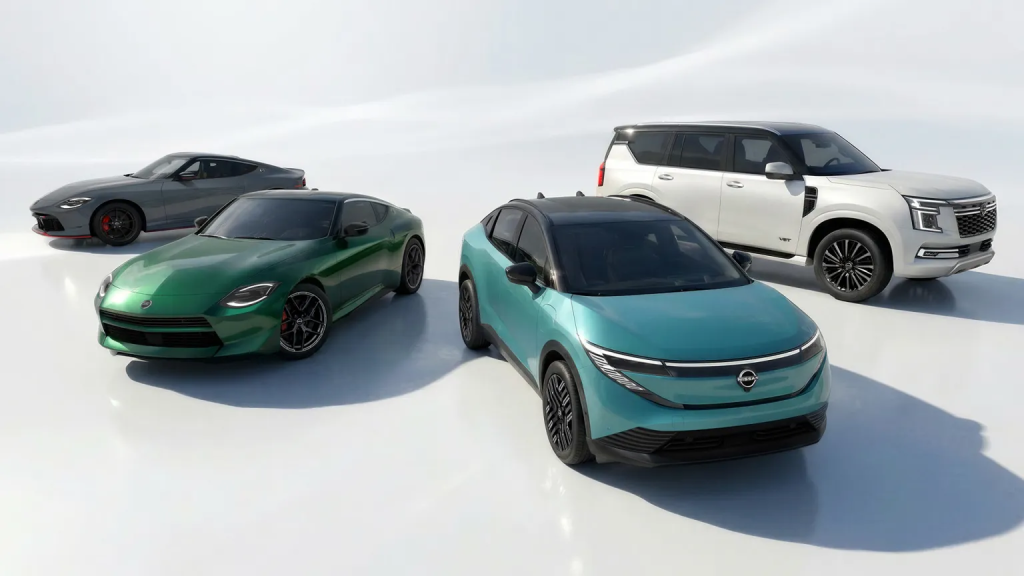
Here is the tension no one at Nissan addressed directly: accelerating internal combustion and hybrid model cadence does not automatically fix an EV pipeline that remains thin relative to competitors. Nissan's next-generation Skyline sedan — debuting winter 2025, developed in just 26 months under the new R&D regime — is a rear-wheel-drive petrol car. The Xterra return is a body-on-frame SUV priced below $40,000, also combustion. A new GT-R with an internal combustion engine is confirmed but described as 'many years' from market. The next-generation Z will not arrive before 2030, per Nissan's own statements. That trajectory means Nissan's accelerated product cadence, at least through 2027-28, leans almost entirely on non-electric vehicles — precisely the segment where Chinese OEMs are applying the 'China speed' pressure Yamaguchi cited. Kia reached 100,000 EVs in the UK while flagging ZEV mandate pace as unrealistic, illustrating how even EV-forward brands find the transition schedule punishing. Nissan's combustion-first acceleration raises a different question: speed toward what, exactly?
China Speed vs. Nissan Speed
Yamaguchi named 'China speed' explicitly as the benchmark Nissan is chasing. The comparison is instructive and damaging in equal measure. BYD, according to its own investor materials from Q1 2025, has taken certain derivative models from concept sign-off to production in under 18 months. SAIC's R&D disclosures reference 24-month full-cycle targets for new platforms. Against those figures, Nissan's new 37-month target for all-new models — however improved versus the prior 52 months — still represents a gap of 13 to 19 months versus the leading Chinese benchmark. Derivative models at 30 months sit closer but not level. Changan's refusal to share European production facilities is a separate signal of how Chinese OEMs are operating with a confidence that contrasts sharply with Nissan's current posture. The gap is narrowing. It has not closed.
What the Restructuring Means for Infiniti, Dealers, and the Skyline
The consequences are already attaching to specific products and entities. Infiniti, Nissan's near-luxury division, will receive a twin of the new Skyline sedan as a potential replacement for the Q50 — a model that has not received a full generational change since its 2013 debut. That is a twelve-year product cycle, precisely the failure mode Yamaguchi's restructuring is designed to prevent. The Xterra nameplate will return as a body-on-frame SUV positioned below $40,000, targeting a segment Nissan vacated in 2015. The four product categories replacing the current model architecture — labelled Heartbeat, Core, Growth, and Partner — were not defined in granular terms in Yamaguchi's Automotive News interview, and Nissan has not released a document mapping existing nameplates to the new categories. Nissan dealers in North America, who were shown the new Xterra early and described it as 'radical-looking' according to reporting cited in the source material, are now waiting on a product cadence that the OEM itself admits has been too slow to sustain the business. Honda faces a comparable North America product gap through the 2027 CR-V redesign, suggesting the cadence problem is not unique to Nissan — though Nissan's financial position makes the stakes more acute.
Nissan's global market share in the United States fell to approximately 5.4% in the first half of 2025, down from a peak above 8% in 2017, according to Ward's Automotive data. The company has not released a public schedule for returning to profitability. CEO Ivan Espinosa acknowledged in separate remarks that volume-chasing was an error. That admission came after the fact. The complete Nissan model history and specifications are catalogued in the Global Auto Index manufacturer database.
