


Off-lease Tesla, Nissan, and Kia stock is drawing cost-focused shoppers away from forecourts faster than new-car registrations.
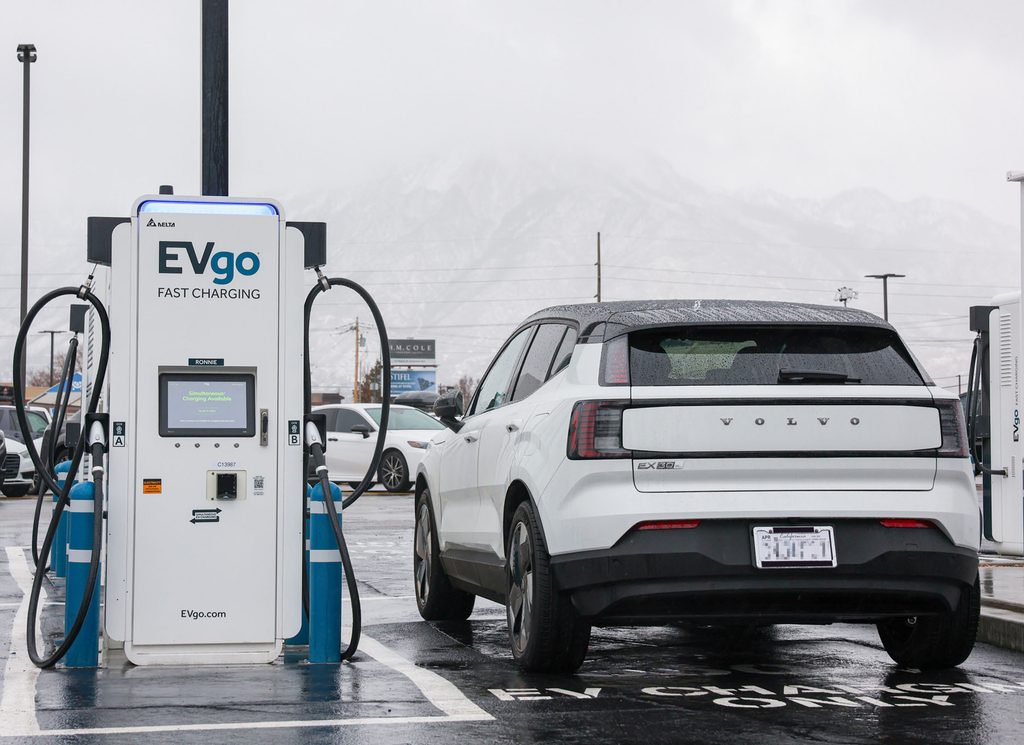
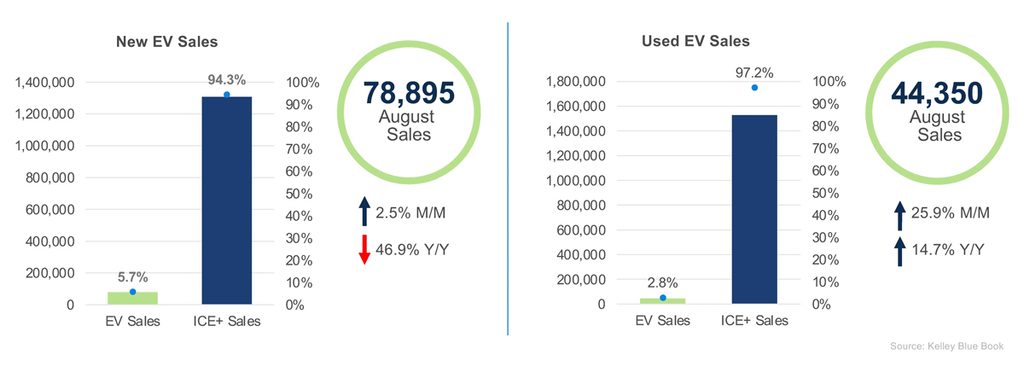
Fuel prices went up. EV sales followed. Cox Automotive recorded 44,350 used electric vehicles sold in August — up 25.9 percent on July. New EVs added 2.5 percent. Two different markets, same direction.
The simultaneous rise in both new and used EV registrations during a period of climbing pump prices is not coincidental, according to Cox Automotive's monthly sales data, published September 2024. August 2023 posted far higher new-EV volume — buyers then were racing ahead of the federal tax credit deadline — making August 2024's 2.5 percent monthly gain look modest against a depressed baseline. The used segment faces no such distortion.
The August Numbers, Laid Out
Cox Automotive's September 2024 monthly report logged 78,943 new battery-electric vehicles sold in August. Tesla accounted for just under 41,000 of those — call it 51.9 percent of the total (40,943 ÷ 78,943 × 100). Toyota landed second at 4,964 units, a 34.9 percent surge month-on-month. The average new-EV transaction price fell 1.3 percent in August and 2.8 percent year-on-year to $54,754, compared with $49,907 for an equivalent combustion vehicle — a gap of $4,847. At a decline rate of roughly $1,560 per year, that spread closes in just over three years at current trajectory. On the used side, 44,350 units sold at an average listing price of $37,441, down 1.0 percent from July. Year-on-year, however, that average is 8.2 percent higher, meaning returning off-lease stock has not collapsed residuals — it has merely softened them. Tracked against new-EV pricing, a used EV lists at 31.6 percent less than a new one. For a household watching a $4-per-gallon fuel bill, that arithmetic is hard to ignore. This article sits within our broader EV regulation and demand tracking coverage for 2026.
August 2023 vs August 2024: A Distorted Baseline
New EV sales are still down 46.9 percent compared with August 2023, according to Cox Automotive's September 2024 report. That collapse is almost entirely a function of what happened twelve months ago: shoppers rushed purchases ahead of changes to federal tax credit eligibility, inflating last year's figures artificially. Strip that distortion and August 2024 looks less alarming. Month-on-month, sales grew. The used market tells a cleaner story because it carries no equivalent policy spike in its comparable period — used-EV sales are up 14.7 percent year-on-year, against the new market's 46.9 percent year-on-year decline. That 61.6-percentage-point divergence between the two segments is the real signal. Kia's UK operation, which crossed 100,000 cumulative EVs while simultaneously calling the ZEV mandate pace unrealistic, illustrates how volume growth and policy unease can coexist — a dynamic visible in the U.S. August data too.
Tesla's Grip Loosens — But Only Slightly
Tesla held roughly 52 percent of August's new-EV market while simultaneously posting a 3.8 percent month-on-month sales decline. It then captured nearly 30 percent of used-EV sales on top. No other brand comes close in either segment, yet the gravitational pull is visibly weakening at the edges. Nissan's used-EV sales rose 45.1 percent month-on-month. Kia's climbed 32.1 percent. Neither figure carries a denominator from Cox Automotive's published summary, which means the absolute unit counts behind those percentages remain undisclosed — a gap in the public dataset that prevents independent verification of whether Nissan or Kia crossed four-digit monthly used-EV volumes. Cox Automotive did not publish brand-level unit counts for non-Tesla used EVs in the September 2024 release reviewed for this article. That omission matters because percentage gains off a small base can mislead. What Cox did confirm: the Tesla Model 3, Tesla Model Y, and Ford Mustang Mach-E recorded the largest month-on-month volume increases among all new-EV models in August.
Off-Lease Supply Is Reshaping Buyer Access
The used-EV surge is not organic demand alone. A wave of off-lease vehicles — predominantly Tesla Model 3 and Model Y units originally registered in 2021 and 2022 — is returning to dealer lots and expanding inventory that was scarce twelve months ago. For Maria Chen, remarketing director at a multi-franchise dealer group in Phoenix, Arizona, the shift showed up in August floor traffic: shoppers arriving with fuel receipts and leaving with lease-return EVs. Cox Automotive's data confirms the supply side: average used-EV listing prices fell 1.0 percent month-on-month in August, consistent with inventory rising faster than demand — but not fast enough to reverse the 8.2 percent year-on-year price increase, which reflects how thin the pool was in 2023. The consequence for new-EV volume is pressure from below: a $37,441 used EV undercuts the $54,754 new-EV average by $17,313. Policy levers being debated in Brussels around the EU Industrial Accelerator Act may eventually influence U.S. supply chains, but for August 2024, the driver was simpler: cheaper cars existed, and people bought them.
What the Data Is Actually Saying
Cox Automotive's September 2024 monthly commentary described used EVs as "the perfect car for cost-conscious buyers looking to wean themselves off the pump" — a phrase that doubles as both analysis and a signal about who is now entering the EV market for the first time. These are not early adopters drawn by technology. They are households running a cost calculation against a fuel bill that rose through the summer. That shifts the demand argument away from range anxiety and toward payback period — a very different conversation for dealers, lenders, and charge-point operators. The data does not show whether August's used-EV buyers had previously owned an EV. Cox Automotive did not publish conquest-versus-retention figures in the report reviewed here. What it did publish — 44,350 units, $37,441 average, 25.9 percent monthly growth — is enough to confirm that the used segment is now larger in unit terms than new-EV sales, and accelerating faster. Tariff and tax pressures building across both the U.S. and European markets suggest affordability will remain the dominant purchase variable into 2025.
Hybrid registrations also climbed through August, according to Cox Automotive's broader market summary — petrol-electric models drew shoppers who stopped short of full electrification. The Ford Mustang Mach-E, one of August's top-three volume gainers among new EVs, carries a base MSRP of $42,995 for the 2024 model year, sitting $11,759 below the segment average. Numbers move markets. The complete Tesla and Ford model history and specifications are catalogued in the Global Auto Index manufacturer database.
