
The majority of redundancies will fall on UK soil, where JLR employs most of its global headcount.
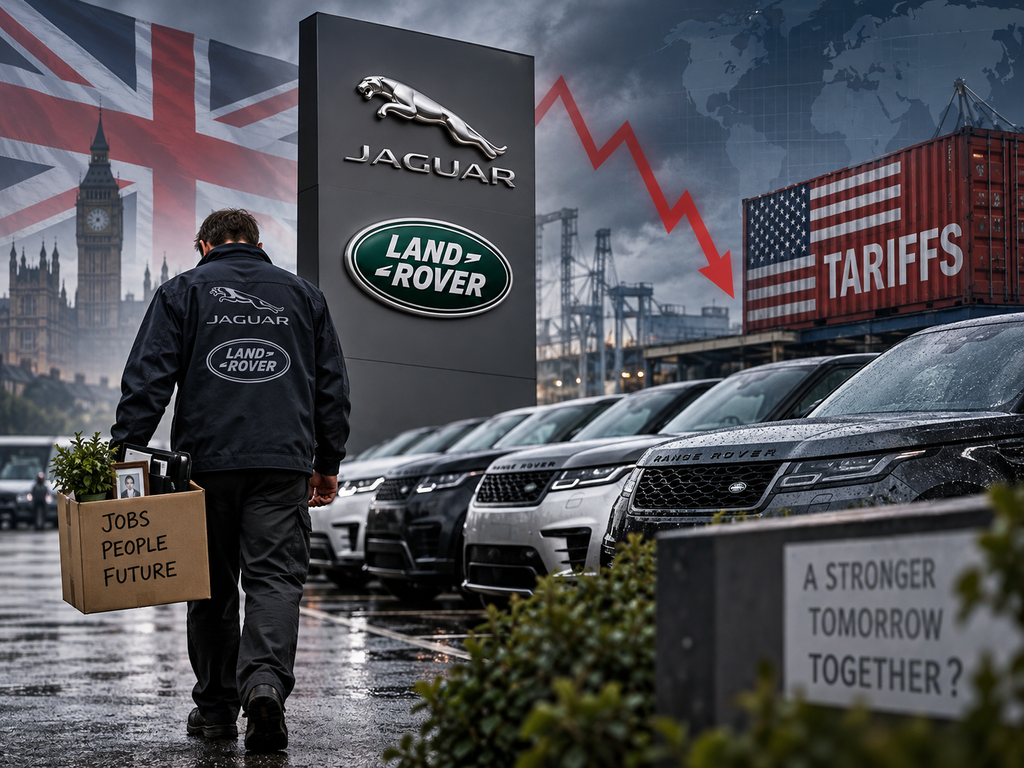
JLR has confirmed it will eliminate 4,000 roles worldwide. That is roughly 9% of a 44,000-person workforce. The cuts land hardest in Britain. No timetable for individual site closures has been published.
The announcement lands as the British luxury vehicle sector faces a squeeze from three directions at once: softening demand in China, tightening emissions targets in Europe, and fresh tariff exposure in the United States. JLR's own internal communication, cited in May 2025, confirmed the redundancy figure without specifying which UK plants absorb the largest share. That gap matters. In 2023, Ford's Halewood restructuring — 1,300 roles cut from a single site — showed how unevenly these programmes land across a region.
The Arithmetic of a 9% Reduction
JLR's stated workforce stands at 44,000 globally. A 9% reduction equals 3,960 roles on a straight calculation — the company rounds this to 4,000, implying the figure carries a small buffer or accounts for natural attrition already counted in. The remaining workforce after cuts: approximately 40,000. UK operations account for the majority of JLR employees across plants in Solihull, Castle Bromwich, and Halewood. If the UK share of the global headcount sits at roughly 60% — consistent with JLR's published site data — that implies somewhere between 2,200 and 2,500 domestic roles at risk. JLR has not confirmed a site-by-site breakdown. This kind of restructuring sits inside a broader pattern of automotive industry restructuring in 2026, where manufacturers across Europe have announced workforce reductions totalling tens of thousands of positions since January.
How JLR's Cut Compares to Rivals Under Similar Pressure
Stellantis shed 1,100 UK workers at its Vauxhall Ellesmere Port facility in late 2023 before that plant converted to van production. Volkswagen Group announced cuts of up to 35,000 roles across its German plants in late 2024, per statements reported by Handelsblatt in November 2024 — a reduction of roughly 10% from its then-workforce of around 300,000. JLR's 9% sits in that same band. The difference is scale and speed. Volkswagen's programme stretched across a multi-year negotiation with IG Metall; JLR's announcement arrived without a published phasing schedule. Honda's product gap in North America — where the company faces a manufacturing drought until the 2027 CR-V redesign — illustrates how delayed product cycles amplify headcount pressure. JLR faces a comparable lag: its fully electric Jaguar relaunch has slipped from 2024 targets.
What JLR's Own Communication Said — and Didn't
Autocar Business, reporting in May 2025, quoted JLR's internal communication as confirming the company will pursue "a simplified, more effective organisation" as the rationale for the job losses. That phrase — eight words doing a great deal of work — tells you almost nothing about which functions go first. Engineering? Corporate overhead? Retail support? The statement did not say. Adrian Mardell, JLR's Chief Executive Officer, has previously described the company's Reimagine plan as targeting £3 billion in cumulative cost reductions by 2026. Whether this redundancy round counts against that figure or runs alongside it remains unconfirmed. A spokesperson for the Unite union, which represents workers at JLR's UK plants, had not issued a formal public response at the time of Autocar Business's initial report.
Profitable on Paper, Cutting in Practice
Here is what does not quite fit. JLR posted its best-ever annual profit in the financial year ending March 2024 — £2.2 billion pre-tax, according to JLR's Annual Report 2023-24, published June 2024. That followed years of losses. The turnaround was real. Range Rover and Defender waitlists ran into months. So why cut 4,000 people during a period of reported profitability? Two possible readings. First, the savings are forward-looking: management sees the China slowdown and US tariff exposure — the 25% US truck tariff and European IVA tightening represent direct margin threats — and is cutting costs before revenue falls. Second, the EV transition itself requires a different kind of workforce: fewer combustion-engine calibration engineers, more software developers. Neither reading is comfortable for the workers involved. JLR has not publicly stated which explanation applies.
Solihull, Castle Bromwich, Halewood: Who Absorbs What
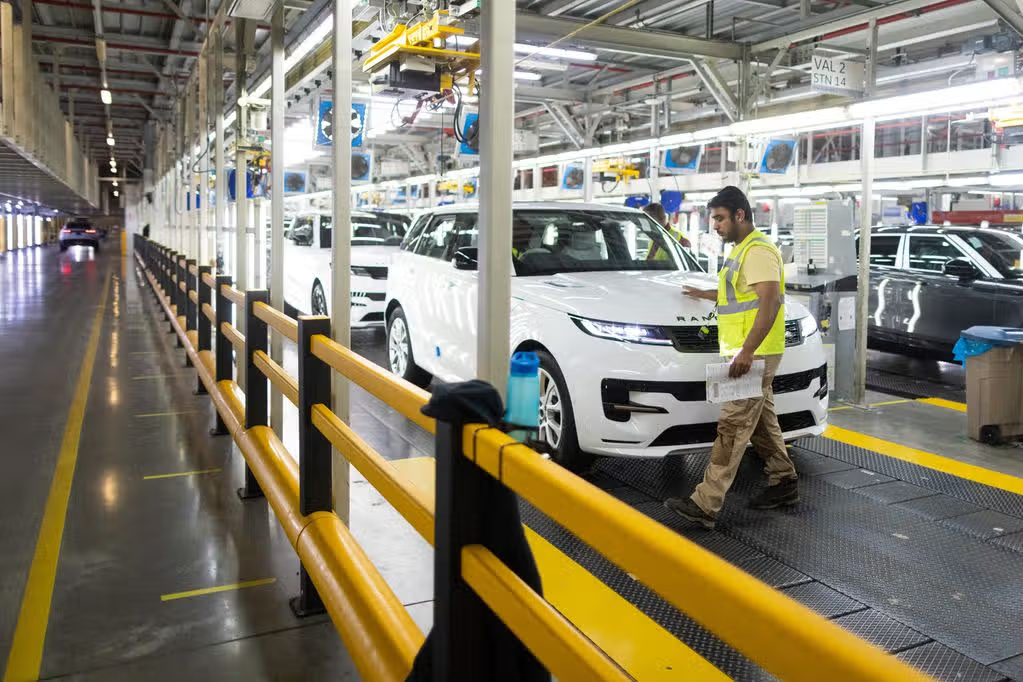
The three UK sites are not interchangeable. Solihull builds Range Rover and Range Rover Sport — JLR's highest-margin vehicles. Castle Bromwich has already undergone partial repurposing and was slated for Jaguar EV production before the model timeline slipped. Halewood assembles the Range Rover Evoque and Defender 90, products with stronger near-term volume than the Jaguar line. Workers at Castle Bromwich face the sharpest exposure: a site in transition, with its anchor product delayed and no confirmed replacement volume announced. The Unite union's West Midlands regional office, which covers both Solihull and Castle Bromwich, will be the first point of formal consultation under UK collective redundancy law — a process that legally requires a minimum 45-day consultation period for redundancies exceeding 100 roles. JLR has not confirmed whether that process has formally begun.
JLR's UK workforce has fluctuated between 38,000 and 46,000 over the past decade, reaching its peak in 2017 before a series of diesel-demand shocks triggered earlier rounds of reductions. The company employed approximately 40,000 people in Britain as of its last published headcount in 2023. Watch the Castle Bromwich site specifically. The complete JLR model history and specifications are catalogued in the Global Auto Index manufacturer database.
