
Engineers are targeting a curb weight of 1,000–1,200 kg without carbon fibre, setting a hard constraint on any battery pack.
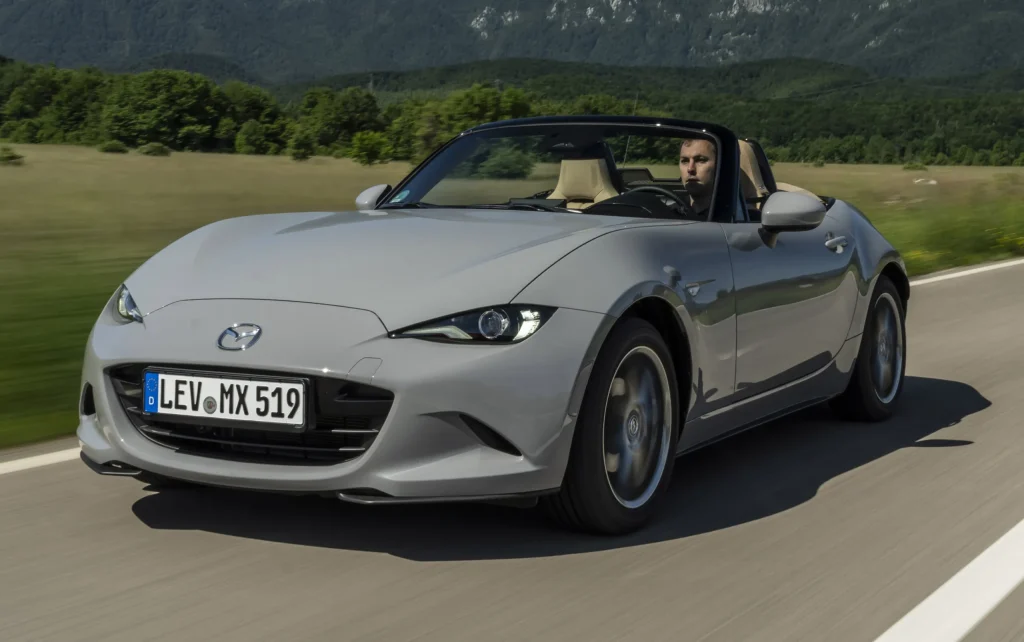
Masahiro Moro said it plainly. The next-generation MX-5 Miata "must also be ready for a scenario without a combustion engine." He told Auto Motor und Sport that. No date for an EV model was given. The combustion car comes first.
The conditional commitment matters because European Union CO₂ fleet targets, which require zero-emission sales from 2035 under the European Commission's revised regulation published February 2023, leave open-topped sports cars with almost no room to avoid electrification. Compare that with Mazda's own position in 2024, when company executives told media the ND-generation battery technology was still incompatible with the brand's weight targets — a position Moro's latest remarks only partially revise.
What Moro Actually Said — and What He Didn't
Speaking to Auto Motor und Sport in an interview published July 2025, Moro's exact framing was that the next roadster "must also be ready for a scenario without a combustion engine." The conditional phrasing is load-bearing. He did not say Mazda will build an electric MX-5. He did not say when. The negative space is telling: no production timeline, no battery-capacity figure, no charging specification, no confirmation that the EV variant reaches dealerships before any regional combustion ban takes effect. For context on how other manufacturers are threading the same needle between brand identity and EV regulation mandates in Europe, the pattern is becoming familiar. Moro's statement is best read as regulatory hedging dressed in engineering language — a signal to Brussels and Sacramento, not a product announcement.
The Weight Budget That Constrains Every Battery Decision
Moro set a target curb weight band of 1,000 to 1,200 kilograms for the next MX-5. The current ND-generation soft-top in RF trim weighs approximately 1,089 kg in base specification, according to Mazda's published technical data sheet, 2023 edition. That puts the mid-point of Moro's target band at 1,100 kg — a delta of just +11 kg above the existing car's base weight. A usable battery pack of 40 kWh, which is near the minimum credible range for a sports car priced above €35,000, weighs roughly 280–320 kg before thermal management hardware. Subtract that from the 1,200 kg upper limit: 1,200 − 300 = 900 kg remaining for chassis, motor, suspension, body, interior, and safety structure. The Mazda MX-5 ND body-in-white alone weighs approximately 185 kg. The arithmetic does not leave much slack. Moro explicitly ruled out carbon fibre as a mass-saving tool, which closes the one obvious exit from that constraint.
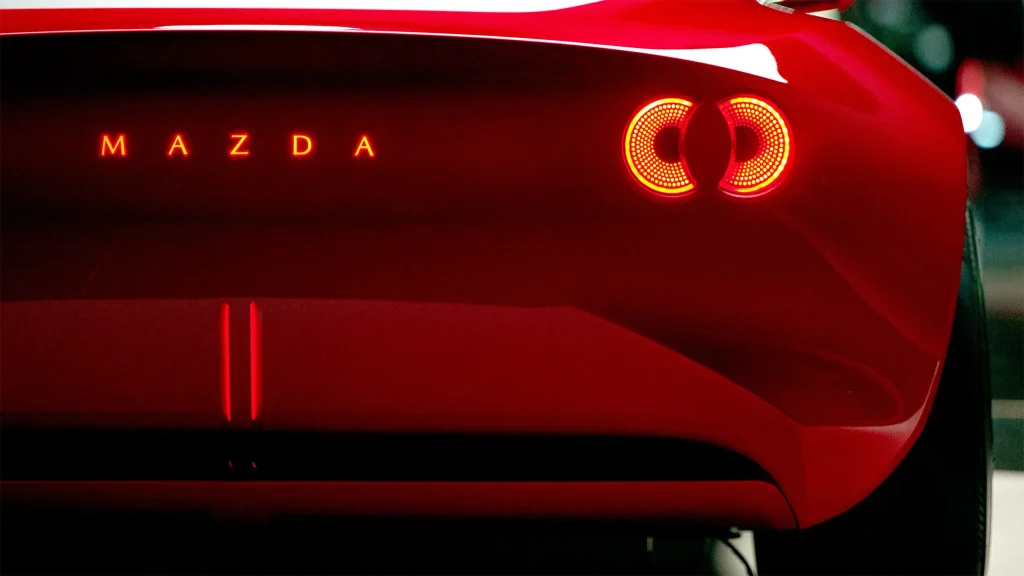
The Patent That Preceded the CEO's Words
Before Moro spoke to Auto Motor und Sport, Mazda had already filed a patent for an unconventional electric powertrain layout. The filing, surfaced by patent-tracking services in 2024, describes a configuration in which the primary battery cells occupy the transmission tunnel rather than a flat skateboard platform beneath the floor. Secondary modules sit behind the occupant seats and ahead of the passenger compartment bulkhead. The document describes retention of rear-wheel drive via a single electric motor. The engineering rationale is front-to-rear weight balance: Mazda's 50:50 distribution target, a figure the company has cited in MX-5 product documentation since the NA generation launched in 1989, demands that mass stay centred and low. A skateboard platform would lower the centre of gravity but would also widen the car's footprint and add unsprung complexity incompatible with the weight ceiling Moro described. The patent does not guarantee a production vehicle, but it confirms the engineering study predates the CEO's public conditional commitment by at least twelve months.
How Mazda's Approach Compares to Rivals Facing the Same Constraint
Set Mazda's conditional roadmap against two direct comparators. Lotus completed the transition of its entire range to electric-only with the Emira as the final internal-combustion model, sold from 2022. The Emira weighs 1,405 kg — roughly 316 kg above Moro's 1,089 kg baseline reference point. Alpine confirmed its A110 successor will be electric but has not published a target weight for the replacement. Neither brand imposed a sub-1,200 kg ceiling without exotic materials. Mazda's constraint is therefore stricter than either European peer. Kia's UK operation, which crossed 100,000 EVs while publicly questioning ZEV mandate pace, illustrates the broader tension: volume OEMs with far larger engineering budgets are describing the same regulatory timeline as difficult. For a low-volume sports car where platform costs cannot be amortised across an SUV family, the economics are considerably tighter. Mazda sold approximately 22,000 MX-5 units globally in the 2023 calendar year, according to Mazda Motor Corporation's annual report published April 2024 — a base too narrow to absorb a bespoke EV platform without significant price increases.
The Gap Between the CEO's Signal and the Engineering Reality
Here is what does not add up. Moro says the car must be ready for electrification. The patent exists. The weight target is set. But Mazda has simultaneously said, repeatedly, that current battery technology is not suitable for a lightweight sports car — a position the company's own executives stated to media in early 2025. If the technology is not ready, and the weight ceiling is fixed, and carbon fibre is excluded on cost grounds, the conditional EV commitment is currently unsupported by any disclosed battery chemistry or cell-format that fits within the constraints. The gap between the strategic signal and the available engineering solution is not a criticism — it reflects where solid-state and sodium-ion development actually sits in mid-2025. But it does mean Moro's "eventually" carries real uncertainty. Separately, shifting trade conditions across major markets add cost pressure to any low-volume EV development programme. Mazda has not published a named document confirming the next-generation MX-5 launch window, platform designation, or battery supplier. Those three items remain unconfirmed as of the date of this report.
The MX-5 nameplate turns 36 in 2025, having entered production at Mazda's Hiroshima plant in 1989 at a launch weight of 940 kg for the NA roadster — 60 kg below the lower bound of Moro's next-generation target range. Four generations have since added mass incrementally: NA to NB added roughly 45 kg, NB to NC added roughly 90 kg, NC to ND recovered approximately 100 kg through a dedicated diet programme. That recovery programme cost Mazda three years of engineering effort. The complete Mazda model history and specifications are catalogued in the Global Auto Index manufacturer database.
