
Together the two Japanese brands build 76 percent of all vehicles assembled in Canada, leaving nowhere to hide.
Fifty percent. That is the tariff rate President Trump has set on Canadian-built cars, trucks, and auto parts, effective January 1, 2027. Toyota and Honda bear the sharpest exposure. They build more vehicles in Canada than any other manufacturer. Neither has told investors what it will do about it.
The scale of the problem is structural, not incidental. Toyota and Honda together account for 76 percent of all vehicles assembled in Canada, according to Reuters reporting on company filings published August 2025. , when the existing 25 percent tariff came into force, US-Canada negotiators had been working toward a reduced 15 percent rate—a deal that collapsed before signature, leaving both companies exposed to a rate more than three times higher than the floor they had been planning around.
How a Collapsed Trade Deal Doubled the Exposure
US and Canadian negotiators spent much of the summer of 2025 trying to close a deal that would have pulled the existing 25 percent tariff down to 15 percent on cross-border vehicle shipments. Both sides signalled progress. Then talks broke down. Trump did not split the difference; he went the other way. On August 31, 2025, he announced the 50 percent rate covering cars, trucks, and parts alike, starting January 1, 2027. Canada responded within days, matching with retaliatory tariffs on approximately $20 billion of US exports—mirroring the $20 billion in Canadian imports Washington had already targeted with steel and other levies earlier in the dispute. The back-and-forth left automakers without a stable planning baseline for either model-year pricing or capital allocation across North American plants. For Toyota and Honda, whose Canadian operations are woven into a parts flow that crosses the US-Canada border multiple times before final assembly, the uncertainty compounds at every crossing, not just the last one. Our ongoing coverage of Honda's North America production and product decisions for 2026–27 tracks how those plant-level choices are evolving in real time.
The Arithmetic of a 50% Rate on Canadian Assembly
Toyota and Honda together produce approximately 76 percent of the roughly 1.4 million vehicles assembled annually in Canada, which implies a combined Canadian output of around 1.06 million units per year. At an average US transaction price of $48,000 for a new vehicle in 2025 (per the Cox Automotive Dealertrack data cited in Reuters' August 2025 market summary), a 50 percent tariff applied to the full landed value would add roughly $24,000 per vehicle at the border—though tariffs are applied to the declared import value, not the retail price. Even at a conservative import valuation of $28,000 per unit, the per-vehicle tariff burden reaches $14,000. If either manufacturer absorbs just 30 percent of that cost to hold sticker prices, the margin hit per Canadian-built unit approaches $4,200 before any downstream dealer or logistics adjustments. Multiply that across 1.06 million units and the annual combined exposure runs to roughly $4.5 billion in absorbed costs—before a single price increase reaches a showroom. That calculation assumes zero production shift; the actual number will be smaller if either company redirects volume, but redirection takes years and capital neither has sitting idle.
What Toyota's Investor Filing Actually Said
Toyota Motor Corporation's formal securities filing for the fiscal year ending March 2025, referenced in Reuters' August 2025 dispatch, lists North American tariff exposure explicitly as a material risk to investors. The specific language flags Canadian production volumes as a variable that regulators and trade policy changes could render adverse with limited notice. That is not boilerplate. Automakers typically include tariff risk in filings as a generic hedge; naming a production geography and quantifying the volume exposure—as Toyota's filing does by referencing its Canadian plant output—signals that the company's legal and finance teams regard the threat as probable, not merely possible. Honda's equivalent disclosure, reviewed in the same Reuters report, did not break from that position but offered no additional specificity on mitigation. Section 3 of Toyota's annual securities report, published April 2025, details the Canadian assembly operations at the Cambridge and Woodstock plants in Ontario, which together produce the RAV4 and RAV4 Hybrid for the North American market—two of the highest-volume nameplates in either company's portfolio. Neither plant has been publicly earmarked for relocation or retooling ahead of the 2027 deadline.
The Tacoma Pivot Shows the Clock Is the Real Problem
Toyota has been quietly increasing the US-made content of its Tacoma pickup, shifting assembly work to its San Antonio, Texas, facility to reduce Canadian parts dependency. That move is directionally correct—but it took roughly four years of planning and over $800 million in plant investment to execute, according to Toyota's North American manufacturing disclosures from 2023. The 2027 tariff deadline gives neither Toyota nor Honda four years. It gives them roughly 16 months from the announcement date. Relocating a full assembly line—tooling, supplier contracts, workforce agreements, regulatory sign-offs—typically requires 36 to 60 months under normal conditions. So the Tacoma precedent does not offer a template for rapid escape; it demonstrates precisely why rapid escape is impossible. The anomaly is that the administration's timeline appears to treat a structural manufacturing constraint as a negotiating variable. It may be. But until a renegotiated deal is signed—and the last one collapsed at the final stage—Toyota and Honda have no operational alternative to absorbing cost, raising prices, or both. Honda's already-thin North American product pipeline through the 2027 CR-V redesign makes the timing particularly uncomfortable for the brand.
CR-V and RAV4 Buyers Are the End of the Line
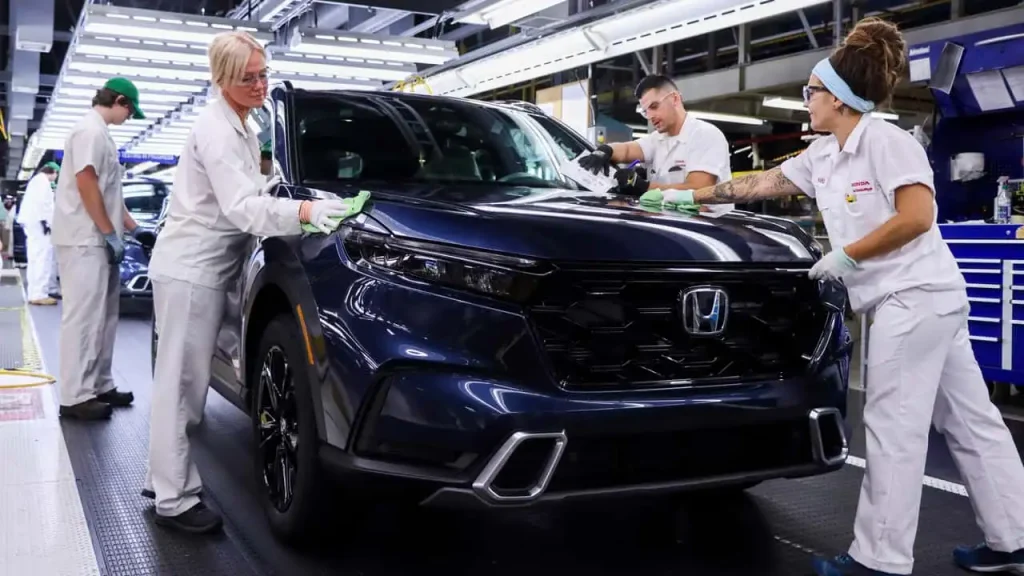
The Canadian plants most exposed are Honda's Alliston, Ontario, facility—which produces the CR-V, one of the top-three selling passenger vehicles in the United States—and Toyota's Cambridge and Woodstock plants, which together build every North American RAV4 and RAV4 Hybrid sold into the US market. Combined, those three nameplates represent well over 700,000 units of annual US sales volume. If the 50 percent tariff triggers even a $3,000 average price increase on those models, and demand elasticity holds to the -0.8 coefficient the Federal Reserve Bank of Chicago applied to mid-size crossover segments in its 2024 tariff impact working paper, US sales of those specific vehicles could fall by roughly 5 to 6 percent in the first full year—before manufacturer incentives enter the equation. The incentive question is where margin pressure becomes visible. The 25 percent truck tariff already reshaping North American commercial vehicle economics offers a parallel: manufacturers there absorbed between 40 and 60 percent of the cost in the first twelve months rather than risk volume collapse. Toyota and Honda are likely to face the same calculus on their Canadian crossover lines.
Toyota employs approximately 8,500 workers at its two Ontario plants; Honda employs around 4,200 at Alliston. Ontario's provincial government has publicly estimated that a sustained 50 percent tariff could put up to 35,000 direct and indirect auto-sector jobs at risk across the province, according to a statement from Ontario's Ministry of Economic Development released September 2025. No federal US mitigation fund for affected workers has been announced. The complete Toyota and Honda model history and specifications are catalogued in the Global Auto Index manufacturer database.
