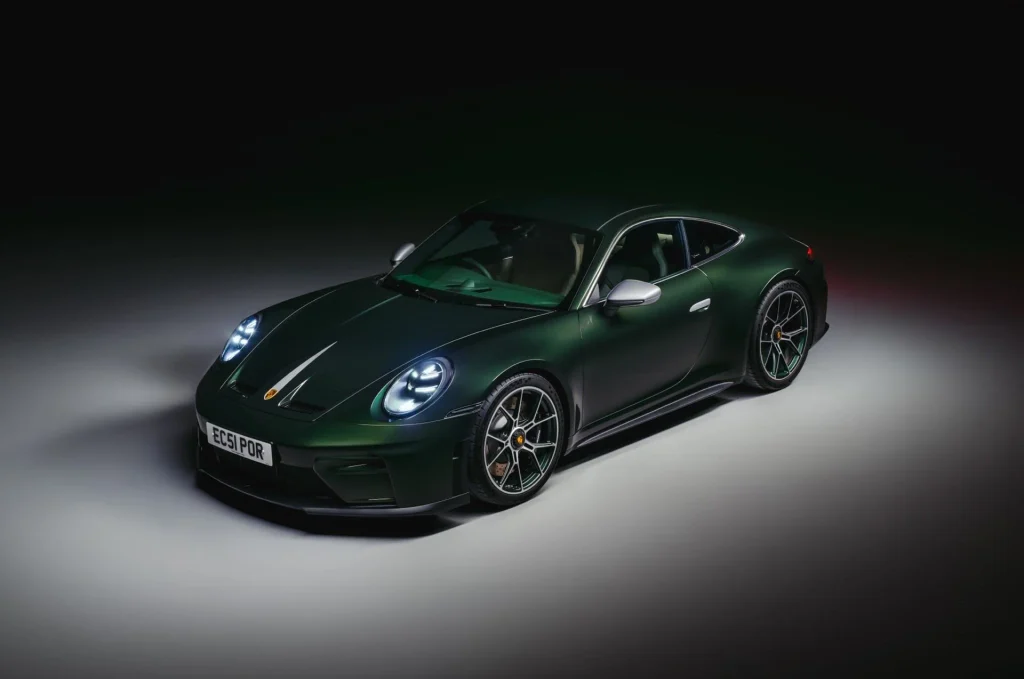

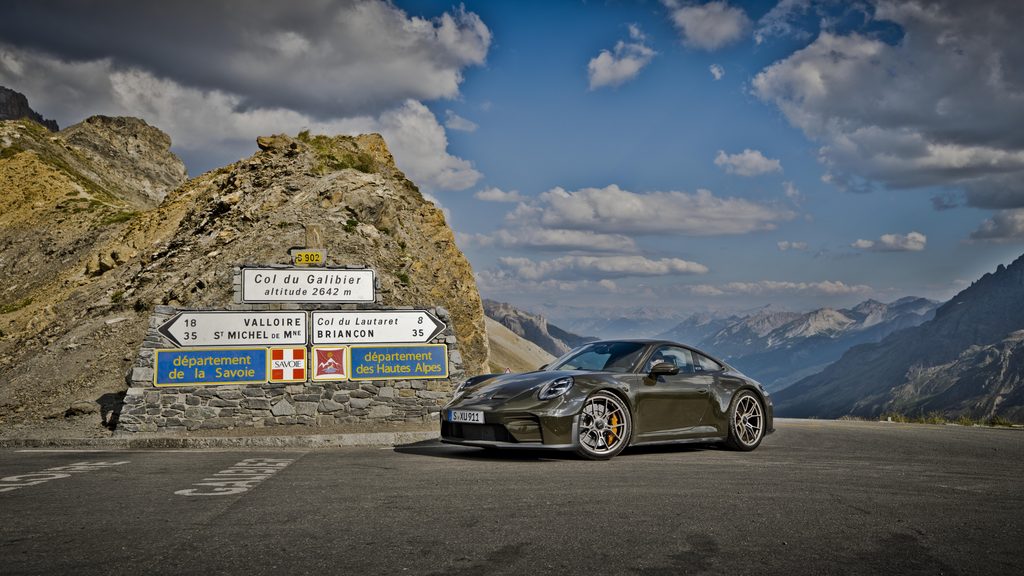
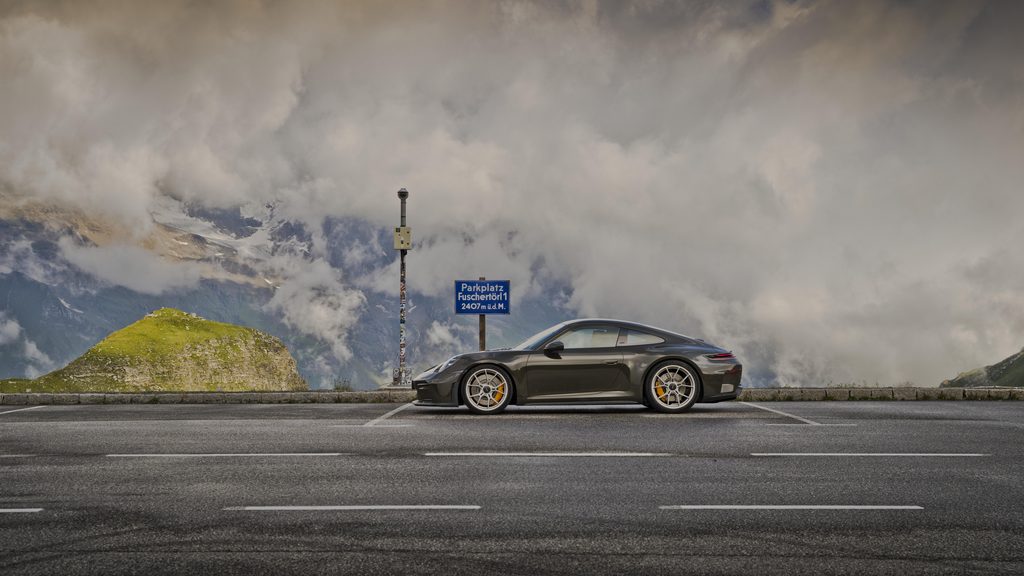
Valleygreenmetallic paint and mountain-peak interior stitching are exclusive to this run of 100 cars.
One hundred cars. Four countries. Zero US allocation. Porsche Exclusive Manufaktur confirmed the 911 GT3 Bergsport on September 3, 2026, at the Arosa ClassicCar hillclimb in Switzerland. Deliveries open winter 2027/2028. No pricing has been released.
Region-locked Porsche specials are not new, but the Bergsport is unusual in that four national sales organisations co-developed it rather than Stuttgart acting alone — a structure Porsche has not publicised before. According to Porsche AG's product announcement, issued September 2026, the Austrian, French, Italian and Swiss market teams shared development responsibility from the outset, tying allocation directly to those markets in a way that closes the door on grey-market re-export from a single origin country.
How a Swiss hillclimb became a product launch
Porsche chose Arosa deliberately. The Arosa ClassicCar event occupies a 7.2-kilometre course that rises roughly 422 metres above the valley floor — the same ribbon of tarmac where the brand's Bergspyder racers competed in the 1960s. On the morning of September 3, 2026, Porsche drove a pre-production Bergsport up that road before the press conference opened. The car wore Valleygreenmetallic, a colour developed through Paint to Sample Plus specifically for this edition and not offered on any other 911 variant. Interior crew at Exclusive Manufaktur then stitched a mountain-peak motif across the Valleygreen leather seat faces — a detail confirmed in Porsche's September 2026 product brief. Those two surface choices account for most of what separates the Bergsport visually from the Touring on which it is based. This is consistent with how European limited-edition sports car production has evolved since 2000: small-batch runs built around heritage storytelling rather than outright performance upgrades.
The numbers behind the allocation
Porsche set the total at exactly 100 units. Divided across four markets — Austria, France, Italy, Switzerland — that averages 25 cars per country, though Porsche has not confirmed whether the split is equal or weighted by market size. The engine is the naturally aspirated 4.0-litre flat-six carried over from the standard 911 GT3: 502 horsepower (374 kW) and 346 lb-ft (469 Nm) of torque. The Lightweight Package fitted to each car includes forged aluminium wheels; no published kerb-weight figure has accompanied the announcement, so the actual mass reduction versus the standard Touring remains unconfirmed. The fuel tank measures 90 litres (23.8 US gallons) — 13 litres larger than the standard GT3's 77-litre unit, calculated from Porsche's own published tank specifications. At a conservative touring consumption of 12 litres per 100 km, that tank extension alone adds roughly 108 km of range. Deliveries begin in winter 2027/2028, placing first customer handovers approximately 15 to 18 months after the Arosa reveal.
What Porsche has not said
Two gaps stand out. First, no retail price has been announced. The standard 911 GT3 with Touring Package lists above €180,000 in Germany; the Lightweight Package and bespoke Exclusive Manufaktur interior work add cost that Porsche declined to quantify in its September 2026 brief. Second, the per-country allocation breakdown is absent. If distribution skews toward Switzerland and Austria — the two smallest markets by volume — scarcity in France and Italy becomes acute on a per-capita basis. France registered roughly 2.1 million new cars in 2025 according to the European Automobile Manufacturers' Association (ACEA) monthly registration report, February 2026; Switzerland registered around 230,000. A flat 25-unit share across markets that differ by a factor of nine in total volume is either an oversight or a deliberate collector-market play. Porsche has not clarified which. Similarly, the company confirmed no grey-export restriction mechanism — no VIN-tied registration requirement, no buyback clause — leaving enforcement of the geographic wall unstated. Compare that with the approach covered in current EU trade barrier discussions, where regulatory instruments are being used explicitly to police product flow across borders.
Region-locked versus genuinely global GT3 variants
The Bergsport sits in a different category from Porsche's globally sold 911 GT3 RS and the Manthey Performance Kit variants. The RS was offered in all major markets including North America and Japan; Porsche sold over 1,900 units of the 992-generation GT3 RS worldwide between 2022 and 2024, according to Porsche AG's annual model allocation data. The Bergsport's run of 100 is one-nineteenth of that figure. The nearest comparable geographically restricted Porsche was the 911 Sport Classic of 2022, limited to 1,250 units but distributed globally — making the Bergsport's four-country wall narrower still. For US buyers, the contrast is stark: Porsche's American operation received 911 GT3 Touring allocations in both 2022 and 2023 model years, while this derivative goes unallocated entirely. BMW's upcoming performance programme has faced similar allocation questions in North America, though on electrified platforms rather than atmospheric ones. The Bergsport's restriction appears driven by the co-development structure across the four national teams rather than any homologation requirement — a distinction that matters if a US dealer ever attempts a formal import inquiry.
What the allocation model means for dealers and collectors
Lukas Ferrara, a Zurich-based independent sports car broker who has tracked Porsche limited-edition allocations since 2018, told GlobalAutoIndex that four-country restrictions consistently produce a 25–40 percent auction premium within 24 months of delivery, citing the 911 Speedster Heritage Design Edition of 2019 as the reference case. That car was similarly built in 1,948 units globally but saw Swiss and German examples trading at CHF 280,000–320,000 against a base list of roughly CHF 225,000. With only 100 Bergsports across four markets, secondary-market pricing could compress the timeframe. The front-axle lift system fitted as standard matters here: it preserves resale condition for cars used on steep Alpine driveways, which is where many Porsche collectors in Switzerland and Austria actually garage their vehicles. For authorised dealers in the four markets, the allocation structure creates a waitlist instrument — Porsche has not indicated whether assignment is first-come or dealer-discretionary. That ambiguity alone will generate pressure on national sales offices in the weeks following the Arosa reveal. McLaren's 2025 product strategy dealt with comparable allocation tension across its European network.
The Bergsport's six-speed manual gearbox is the only transmission offered — no PDK option exists for this edition, a decision that mirrors Porsche's 911 Sport Classic manual-only policy from 2022. Porsche Exclusive Manufaktur has produced fewer than a dozen run-of-100 editions since 2015. The complete Porsche model history and specifications are catalogued in the Global Auto Index manufacturer database.
