An Oreca-supplied chassis will house the hybrid drivetrain as on-track testing in Europe begins next.
Ford Racing fired the engine. It ran. That is the milestone. A 5.4-litre V8, derived from the road-going Coyote unit, completed its first start as part of the hybrid powertrain destined for the 2027 FIA World Endurance Championship season.
The timing matters because the WEC LMDh grid is already crowded. According to the FIA World Endurance Championship entry list, published January 2026, confirmed manufacturers include Aston Martin, Alpine, BMW, Cadillac, Genesis, and Ferrari. Ford is the newest arrival in a class that rewards reliability over raw output in the first season. A first-year car from any programme historically accumulates mechanical failures before it accumulates podiums.
From sim lab to first ignition
Ford Racing's engineering team ran the engine through bench testing before the public first-fire moment. The programme has moved in distinct phases: simulation work, dyno runs, and now initial combustion testing. Next comes on-track testing in Europe, after which the car relocates to the United States for further development before the team commits to a full WEC calendar. The sequence mirrors what Toyota Gazoo Racing ran in 2021 ahead of its GR010 Hybrid campaign and what Peugeot Sport used before the 9X8 made its debut at Monza in 2022. Ford has not confirmed a specific European test circuit, and no date for the first rolling shakedown has been published. What Ford has confirmed: the driver roster is already participating in sim sessions alongside the hardware development. That dual-track approach — sim and physical testing in parallel — is now standard across all LMDh programmes. The broader industry restructuring context shaping manufacturer motorsport investment in 2026 runs through every spending decision Ford Racing makes here.
What 5.4 litres means on the LMDh grid
The LMDh class operates under a Balance of Performance framework, meaning outright peak power is regulated to equalise competition. The FIA and ACO jointly cap Hyperclass output at 500 kW (670 hp) at the wheels. Ford's 5.4-litre Coyote-derived V8 is larger by displacement than the 4.0-litre twin-turbo flat-six in the Porsche 963 and the 3.4-litre twin-turbo V6 in the Acura ARX-06. Displacement advantage is partly neutralised by BoP, but engineers note that a larger-displacement naturally aspirated base unit typically produces more usable torque at lower revs before the hybrid motor fills gaps. The hybrid system itself must conform to ACO technical regulations: a single MGU delivering no more than 200 kW (268 hp) on boost. Add the two figures: 500 kW total system output is the ceiling. Ford has not published a standalone ICE output figure. That calculation — 500 kW total minus up to 200 kW MGU — implies a minimum ICE contribution floor of 300 kW (402 hp) to remain competitive at the top of the BoP window.
Ford's own framing of where development stands
Ford Racing's programme statement, released alongside footage of the first engine start in July 2025, described development as "on track" for the 2027 WEC season opener. The eight-word confirmation is deliberate understatement from a manufacturer that lost its last factory Le Mans campaign — the GT programme — at the close of the 2019 season. Mark Rushbrook, Global Director of Ford Performance Motorsports, told media in a briefing documented by Ford Motor Company's press office that the team is "building toward Le Mans with everything we have." The Oreca chassis supply — Oreca is the same French constructor behind the IMSA and WEC LMP2 platform used by dozens of customer teams — gives Ford a proven structure. Oreca's engineering base in Signes, France, has supplied rolling chassis to BMW M Team WRT and other LMDh entrants. Ford's task is integrating the Coyote hybrid powertrain into that structure without the torsional and thermal compromises that plagued at least two rival programmes in their debut seasons.
The gap between the engine noise and the missing data
Ford published video of the engine running. It did not publish a dyno sheet, a power figure, a torque curve, or a fuel consumption number. No technical specification document has been filed in the public domain as of the date of this article. That absence is worth noting because rival programmes have been more forthcoming at equivalent development stages. BMW M Hybrid V8, which debuted at Daytona in January 2023, had published a partial power specification — in excess of 500 hp combined — before its shakedown footage circulated. Cadillac released a torque figure for the V-Series.R before its first public test. Ford's communications team has confirmed the 5.4-litre displacement and the Coyote lineage. Everything else — redline, peak power, hybrid recuperation rate, dry weight — remains unconfirmed. Whether that reflects genuine confidentiality discipline or a programme still finalising its calibration is not clear. Honda's own product timing pressures through 2027 show how manufacturer calendar commitments can compress development windows in ways that force communication choices.
What the 2027 debut means for Ford's commercial calendar
A 2027 WEC entry places Ford's hypercar at Le Mans in June 2027. That is the same twelve-month window in which Ford Motor Company's North American product cycle faces its own scheduling pressure — a point underscored by programme funding discussions at the Dearborn level. Motorsport programmes at LMDh scale cost between $50 million and $80 million annually, according to estimates published in Autosport's LMDh cost analysis, February 2024. Ford has not disclosed its annual budget. A Le Mans podium — not a win, just a podium — in year one would be an outlier result. The 2023 Porsche 963 debut produced a class win at Sebring in March of that year, but Porsche re-entered with decades of recent endurance infrastructure. Ford's last factory prototype programme was the GT40 lineage, which ended before the current technical generation of engineers at Ford Racing was employed. The commercial return, however, is not purely motorsport-grade: Le Mans exposure maps onto road-car brand equity in European markets where Chinese OEM expansion is compressing Ford's market share in the C and D segments.
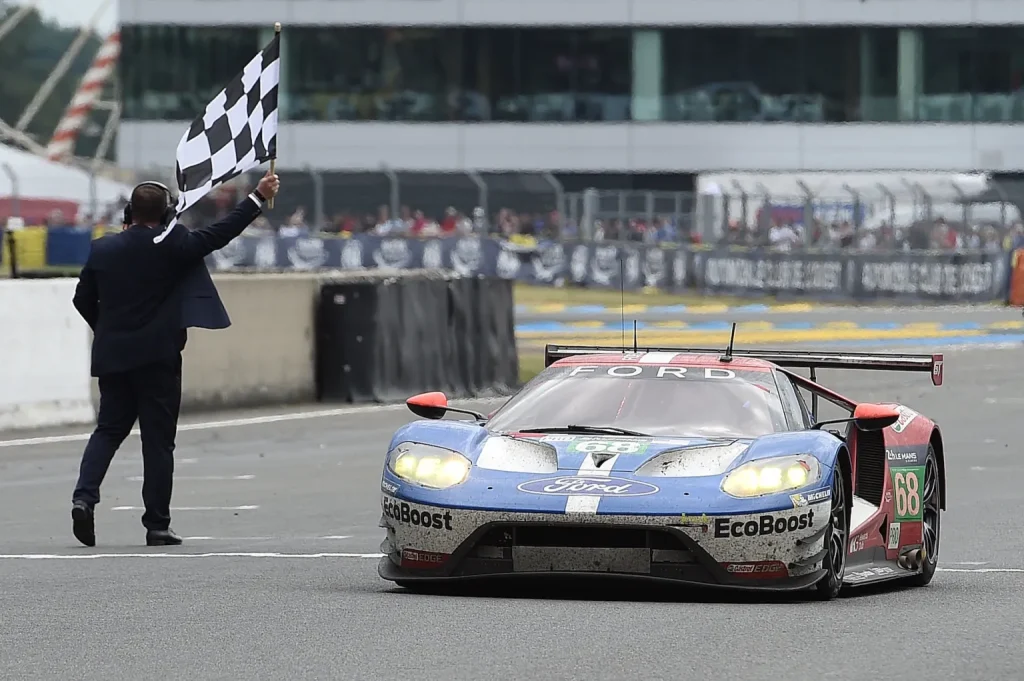
Ford's last outright Le Mans class victory in the GT category came in 2016, when the GT programme returned after a 50-year gap. The 2027 LMDh entry will be the first time Ford competes in the Hypercar class specifically. Thirteen manufacturers are expected on the 2027 WEC grid. The complete Ford model history and specifications are catalogued in the Global Auto Index manufacturer database.
