Production shifts from Munich to Dingolfing for the first time in the nameplate's 48-year history.
Tuesday night, US time. That is when BMW pulls the cover off the G50. Eight generations in. A new plant. A new interior. And the M340d is already confirmed dead.
The G50 matters because the D-segment saloon is not what it was. Mercedes-Benz C-Class and Audi A4 both migrated heavily toward electrified drivetrains after 2022, and BMW held the line longer than either rival on combustion. According to BMW AG's official model-year planning briefing, published September 2025, the G50 retains CLAR architecture for internal combustion variants while the parallel i3 runs on Neue Klasse — the same platform confirmed for the iX3.
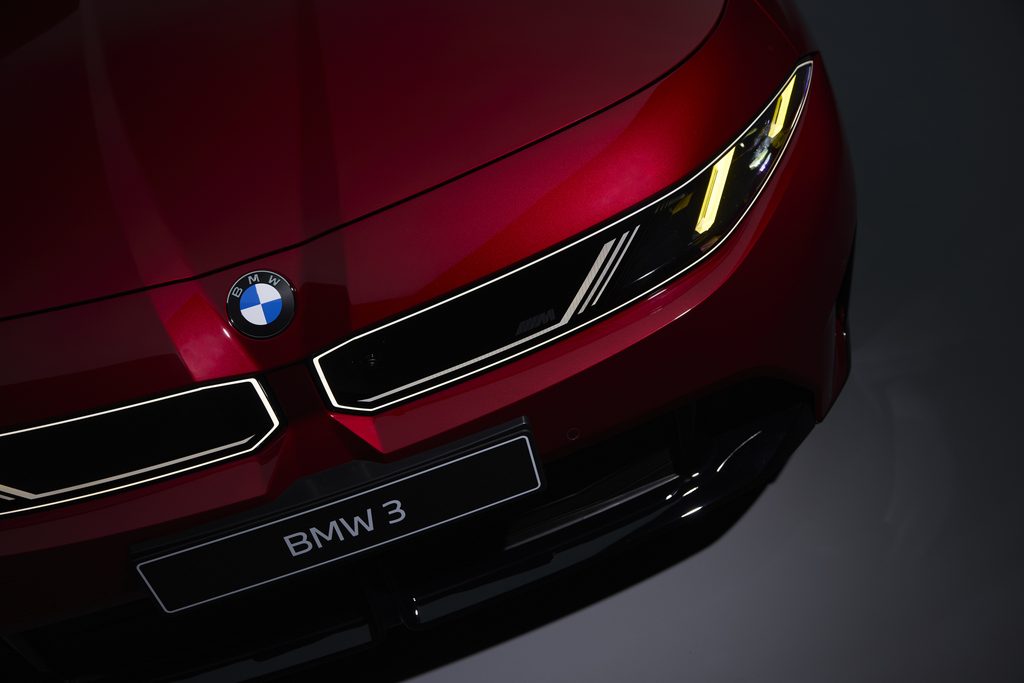
G50 Arrives With Neue Klasse Face, Old-School Bones
BMW's communications team released a final teaser image on the morning of 28 September. The reveal window opened that same evening in the United States — specifically 29 September local time — rolling into the early hours of 30 September in Germany. The G50's exterior borrows its surfacing language directly from the fully electric i3, narrowing the visual gap between combustion and battery variants. Inside, physical switchgear has been cut further, and a large-format screen architecture similar to the i3's cabin takes over the centre fascia. BMW has not disclosed exact screen dimensions ahead of the premiere, but pre-reveal documentation circulated to press confirmed the instrument cluster and infotainment share a single uninterrupted panel. Whether that read well in person is a question the Munich showroom floor will answer Wednesday morning European time. Follow BMW's full platform shift across petrol, hybrid and electric models in our BMW performance and EV transition coverage.
Recycled Content, New Address: The Production Numbers
BMW confirmed ahead of the reveal that recycled materials account for 25 percent of the G50's total construction by weight. The outgoing G20 generation launched in 2018 carried no published recycled-content figure — placing the delta at a minimum of 25 percentage points against its direct predecessor. Production moves entirely to Dingolfing, BMW's largest single plant by volume, which produced approximately 340,000 vehicles in calendar year 2024 according to BMW Group's Annual Report 2024, published March 2025. Munich's historic Plant 1 produced the 3 Series continuously from the E21 generation in 1975 through the G20 — a run of roughly 49 years. Dingolfing already handles the 5 Series, 7 Series and i7. Adding the 3 Series raises that facility's model complexity by one nameplate across an estimated three body styles: saloon (G50), wagon (G51, codename confirmed), and the existing M3 replacement cycle. The Munich plant's freed capacity has not been publicly allocated as of publication.
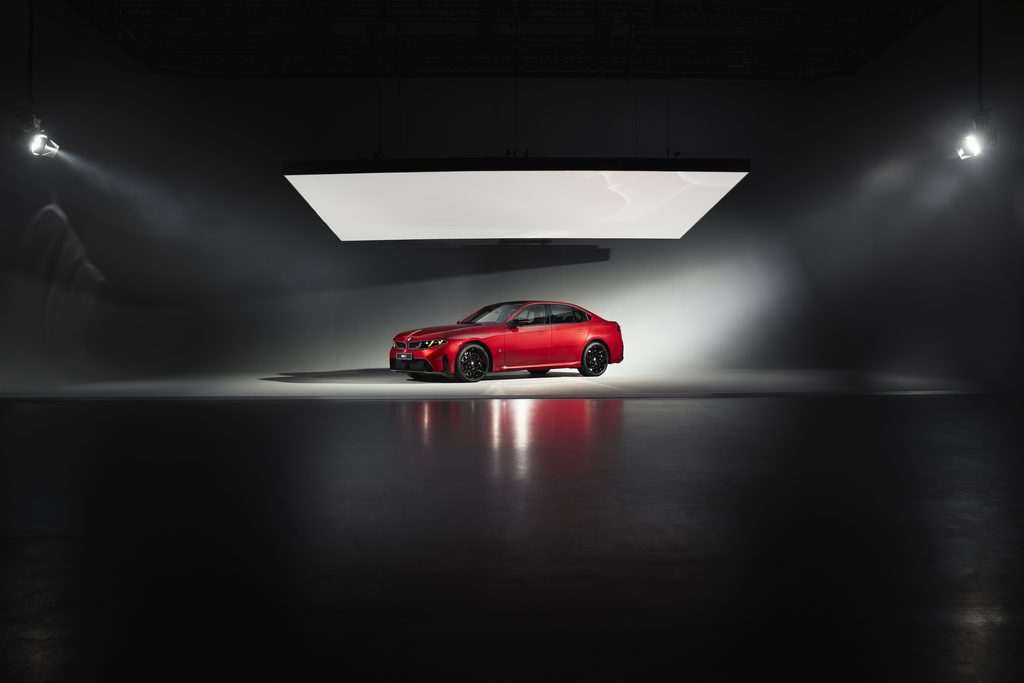
M350 xDrive Steps In Where M340i Leaves Off
BMW's pre-reveal materials describe the M350 xDrive as equipped with "a more powerful inline-six engine and a rear-wheel-drive mode" — a direct quote from the September 2025 product briefing document distributed by BMW Group Communications. The rear-wheel-drive function will not be present at launch. An over-the-air software update is scheduled for 2027 to unlock it. That 24-month gap between market introduction and full capability is unusual for a performance-flagged variant. BMW has separately confirmed no other six-cylinder petrol variant will sit below the M3 in the G50 range, which eliminates the M340i nameplate entirely. The M340d — the diesel six-cylinder variant popular in European fleet channels — is also discontinued. Lower trims will use four-cylinder petrol engines and plug-in hybrid combinations. BMW has not confirmed output figures for the M350 xDrive ahead of the premiere; the quad-motor M3 confirmed for 2027 at 1,300 hp sits above it in the hierarchy.
CLAR vs Neue Klasse: One Family, Two Foundations
The G50 and the i3 share a grille shape and a cabin philosophy. They share nothing underneath. BMW's G50 runs on CLAR — the modular combustion architecture that has underpinned 3 Series variants since the F30 arrived in 2012. The i3 uses Neue Klasse, BMW's purpose-built battery-electric architecture, the same platform that underpins the iX3. That separation has a practical cost for rear-seat passengers. CLAR requires a transmission tunnel to route the driveshaft and exhaust on rear-wheel-drive and xDrive variants; Neue Klasse does not. The i3's floor is flat across all three rear seat positions. The G50's floor is not. In the C-Class, Mercedes-Benz made the same trade-off on its W206 generation, launched 2021: combustion and plug-in hybrid variants retained the tunnel, while the all-electric EQC occupied a separate platform entirely. BMW's approach mirrors that split almost exactly. The difference is BMW is marketing both cars under a single 3 Series family identity, which Mercedes-Benz did not attempt with EQC.
What BMW Has Not Said About Diesel, Manuals, or Munich's Future
Three things are conspicuously absent from BMW's pre-reveal disclosures. First: no diesel powertrain has been confirmed for the G50 range beyond the deletion of the M340d. BMW has not stated whether any oil-burning option survives in the lineup — an omission that matters in markets where diesel still accounts for more than 30 percent of D-segment registrations, according to the European Automobile Manufacturers' Association (ACEA) registration data report, published February 2026. Second: no manual gearbox option has been mentioned. BMW's own pre-launch commentary, as reported by the September 2025 product briefing, suggests even the next M3 may arrive without a third pedal — making a manual G50 implausible. Third: BMW has published nothing about what replaces the 3 Series on Munich Plant 1's production schedule. The plant employs approximately 6,000 workers on 3 Series-related lines. The capacity question sits unanswered. Kia's experience managing ZEV transition costs against production commitments — documented in the Kia UK ZEV mandate dispute — illustrates how quickly plant allocation decisions carry political weight.
The G50 is the eighth 3 Series generation and the first to launch without a manual gearbox option even rumoured at reveal. BMW has produced more than 15 million 3 Series units since 1975 across all body styles globally, according to BMW Group historical production records. The wagon variant, carrying internal codename G51, has no confirmed launch date. The complete BMW model history and specifications are catalogued in the Global Auto Index manufacturer database.
