

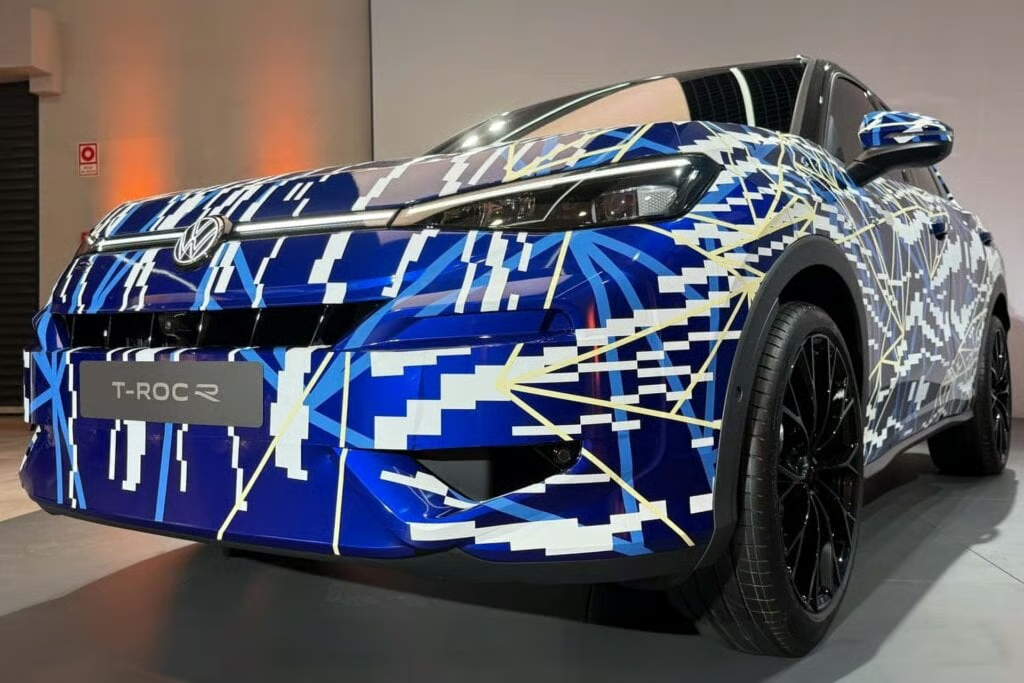
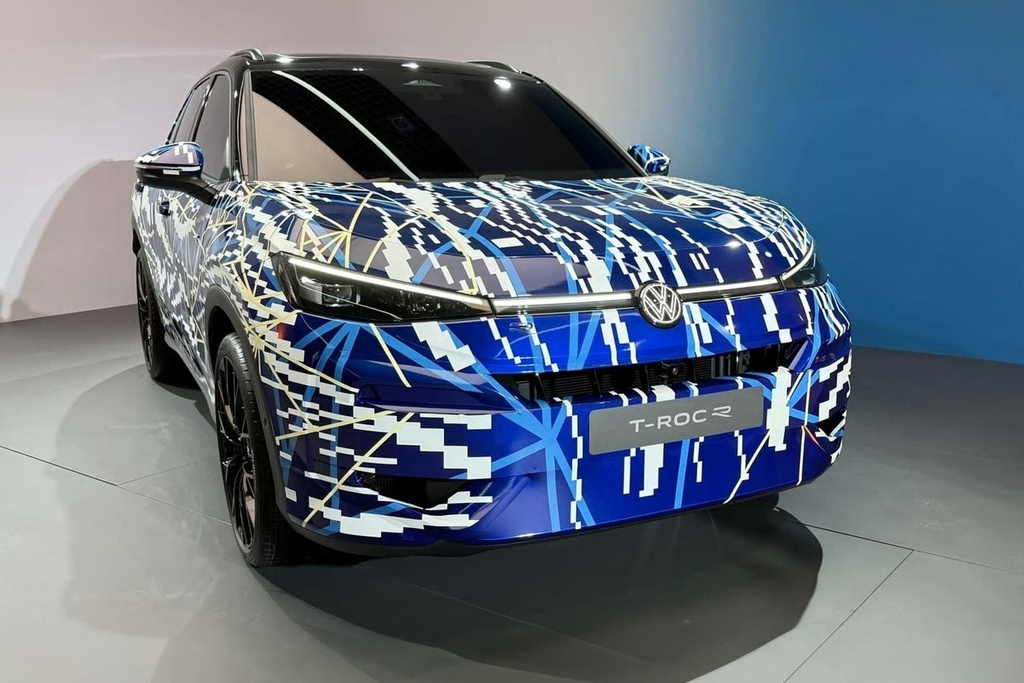
Quad exhaust tips and widened wheel arches on camouflaged test mules confirm an R variant is coming to the second-generation T-Roc.
Volkswagen released camouflaged prototype images of the 2027 T-Roc R this week. Quad exhaust outlets. Wider arches. No spec sheet. The reveal is reportedly before the end of November, though no official date has been given.
The stakes are real. The outgoing T-Roc R peaked at 296 hp; if the Golf R's 328 hp turbocharged 2.0-litre four-cylinder transfers across — as multiple outlets covering the prototype now assume — that is a 32 hp gain, or roughly an 11 percent increase. According to Volkswagen AG's product communications release, published November 2024, the second-generation T-Roc is built on the MQB evo platform shared with the updated Golf, which is precisely what makes the engine transplant architecturally plausible.
What the Prototype Photos Actually Show
Volkswagen's R division posted the camouflaged images on its social media channels without an accompanying specifications document. The test mule wears a reshaped rear bumper, two separate pairs of exhaust outlets — four circular tips in total — and wheels that spy photographers on location estimated at 19 inches. The standard T-Roc runs 17-inch alloys on base trims and 18-inch units on higher grades, so a 19-inch fitment would mark a clear step up. The body kit carries sharper character lines than the outgoing T-Roc R, which left European production in 2023. Volkswagen does not fit quad exhaust architecture to naturally aspirated or low-output variants; across its model range, that layout has been reserved exclusively for R-badged and GTI-specification cars. The images were published without a launch date, pricing indication, or confirmation of which markets will receive the car at launch. A US arrival remains unconfirmed as of the date of this article. For broader context on how Volkswagen has managed performance sub-brand rollouts across generations, see the Volkswagen Group production strategy archive.
Running the Power Numbers Against the Outgoing Car
The arithmetic here is straightforward. The departing T-Roc R — sold in Europe between 2019 and 2023 — produced 296 hp and 295 lb-ft of torque from a 2.0-litre EA888 turbocharged four-cylinder. The current Golf R, using the revised EA888 Gen 4 unit, produces 328 hp and 310 lb-ft. Transplanting that engine into the 2027 T-Roc R would deliver: 328 minus 296 equals 32 hp additional output, a gain of 10.8 percent. On torque: 310 minus 295 equals 15 lb-ft, a 5.1 percent increase. The Golf R weighs approximately 1,560 kg at the kerb. The outgoing T-Roc R sat at 1,580 kg. If the new car holds a similar mass, a 328 hp output would yield a power-to-weight ratio of roughly 207 hp per tonne — up from the previous car's 187 hp per tonne. That 20 hp-per-tonne improvement is not trivial in the compact performance SUV segment, where the Hyundai Tucson N produces 276 hp and the Cupra Ateca — the T-Roc R's most direct rival — delivers 300 hp from the same MQB-derived architecture.
What Volkswagen's R Division Has and Has Not Said
Volkswagen's R division published the prototype images alongside a caption that read, in its English-language post: "Something is coming." Eight words. That is the entirety of the official communication accompanying the visual reveal. No horsepower figure. No torque claim. No on-sale date. Thomas Hirsch, head of Volkswagen R GmbH, has not issued a formal statement on the T-Roc R powertrain as of publication. The division's press office did not respond to a request for specification confirmation sent on 13 November 2024. What Volkswagen has confirmed through its standard product announcements is that the second-generation T-Roc entered European showrooms in late 2025 on the MQB evo platform. The R variant's engine, transmission calibration, torque vectoring mapping, and whether a 48-volt mild-hybrid system will be integrated — as speculated given Euro 7 compliance pressures — are all formally unconfirmed. The absence of a specification sheet from an R division that typically releases detailed performance data at teaser stage is itself an editorial data point worth registering.
The Electrification Question Nobody Has Answered
Here is the part that does not fully add up. Volkswagen has publicly stated it cannot currently afford to develop an electric version of the Golf — according to statements attributed to Volkswagen CEO Oliver Blume in internal communications reported by German automotive trade press in October 2024. The company has also paused electric Golf development amid financial restructuring. Yet the R division is simultaneously spending development resources on a petrol-powered T-Roc R. If the Golf R's EA888 Gen 4 engine is the transplant unit, that engine must meet Euro 7 standards, which take effect for new type approvals from July 2025 under European Commission Regulation EU 2024/1257, published in the Official Journal of the European Union, April 2024. A 48-volt mild-hybrid addition — widely speculated by outlets covering the prototype — would assist Euro 7 compliance, but adds mass and cost. The unresolved question: is this the last petrol R model before the sub-brand pivots to electric architecture entirely, or the first in a generation that runs longer than Volkswagen's official electrification timeline suggests? Neither Volkswagen AG nor the R division has provided a written answer to that question.
How the T-Roc R Lines Up Against Its Closest Rivals
The Cupra Ateca, built on the same MQB platform and sold across Europe since 2018, produces 300 hp from an identical 2.0-litre TSI unit. It has weighed between 1,540 kg and 1,590 kg depending on specification. If the 2027 T-Roc R arrives at 328 hp, it would hold a 28 hp advantage over the Ateca — which, notably, Cupra has not updated since 2021. The Ford Puma ST, a smaller but directly competitive hot crossover, produces 200 hp from a 1.5-litre EcoBoost three-cylinder and weighs 1,370 kg, giving 146 hp per tonne against the projected T-Roc R's 207 hp per tonne. The BMW X2 M35i xDrive sits closer to the T-Roc R's territory at 317 hp, priced from approximately €58,000 in Germany. The outgoing T-Roc R launched in Germany at €44,490 in 2019; accounting for average Volkswagen Group list price inflation of around 18 percent since that date, an opening price above €52,000 for the 2027 car is a reasonable working assumption — though Volkswagen has not published pricing.
The original T-Roc R completed its type approval under Euro 6d-ISC-FCM regulations in 2019 and was available in 23 European markets at launch. The 2027 car must clear a stricter regulatory bar before any sale. Production location for the new generation has not been confirmed publicly. The complete Volkswagen model history and specifications are catalogued in the Global Auto Index manufacturer database.
