
First customer delivery is not expected until 2030, giving the small team years to validate a driving position borrowed from motorcycle racing.
Santiago Sánchez Rivero pulled the covers off his Sanrivatti One in November 2024. The driver lies flat. Arms forward, legs back. An 800-hp Judd V10 sits behind them. No production date before 2030.
Track-only hypercars are not new. Prone driving positions, outside motorcycle racing, essentially are. Sánchez Rivero's project sits in the ultra-low-volume coachbuilt tier — a space where a handful of European ateliers have operated since the early 2000s, documented across the European low-volume manufacturer expansion record. Every performance figure the team has released carries a caveat: targets only, subject to change.
How the Apex Position Became the Whole Car
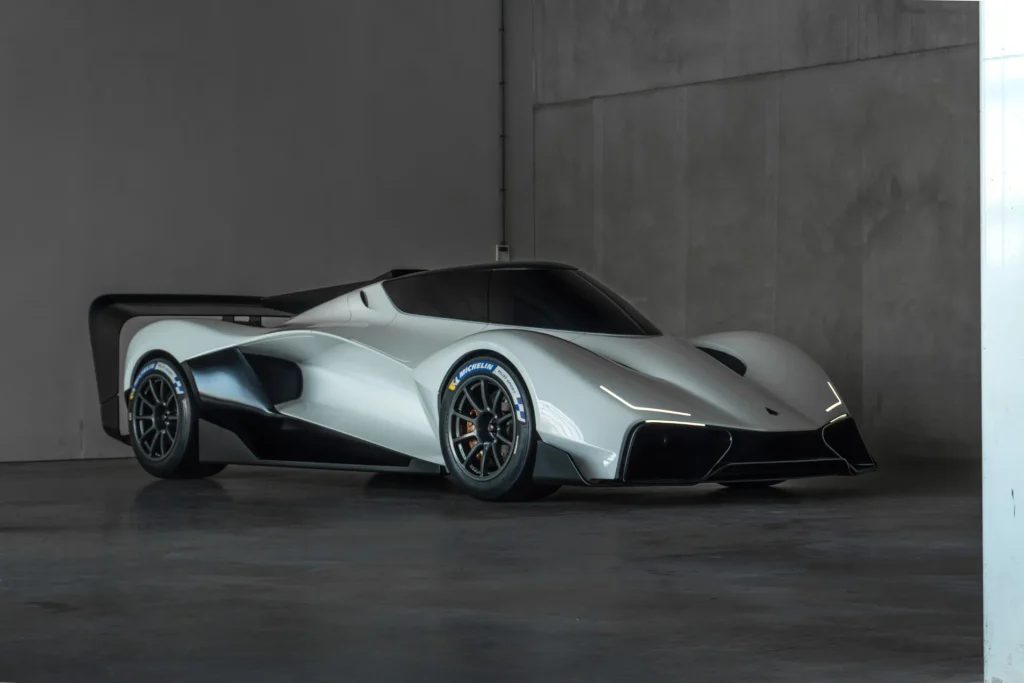
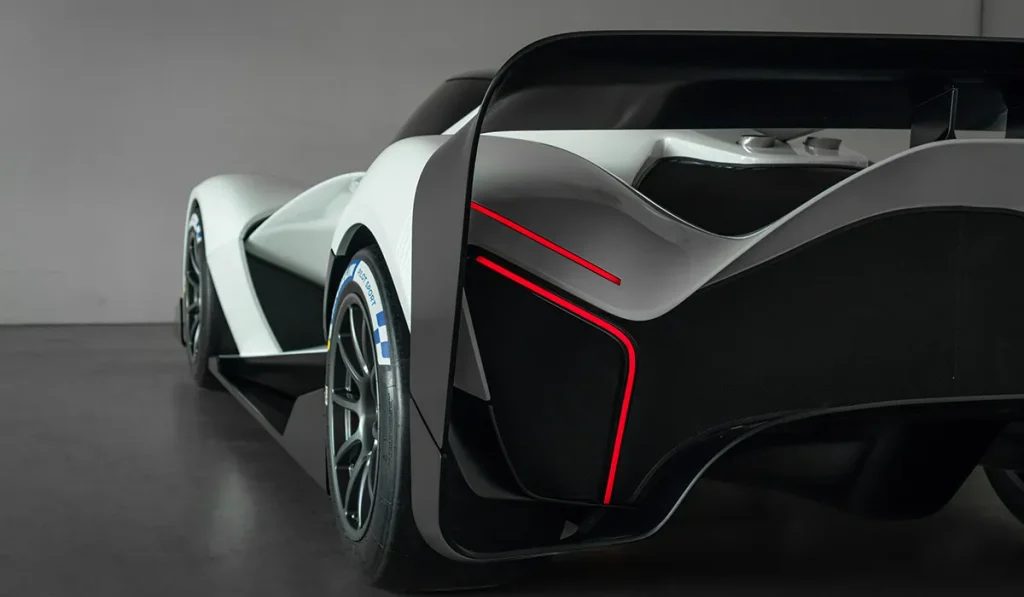
Sánchez Rivero did not arrive at the prone layout by accident. He watched the hypercar field chase output numbers through the 2010s and decided the experience of driving had been edited out. His response was to design a seating position first, then build a machine around it. The result — which he named the Apex Position — places the driver face-down, head pointed at the windscreen, arms extended toward a conventional steering wheel, feet resting on conventional pedals mounted aft of the hip line. The posture mirrors what a motorcycle racer adopts at speed on a MotoGP circuit, though nothing road-legal or track-only had previously translated it to a four-wheeled chassis. Sánchez Rivero's team then wrapped aircraft-inspired bodywork around that human geometry, citing the hunting stoop of a peregrine falcon as one reference point for the nose profile. The carbon-fibre tub carries the structure.
Visibility Numbers, Weight Targets, and What the V10 Has to Deliver
Sánchez Rivero benchmarked the One's forward visibility against an unnamed current hypercar. His figures: 28 degrees of vertical field of view in the Apex Position versus 15.5 degrees in the reference machine. That is a difference of 12.5 degrees — an increase of roughly 81 percent over the benchmark (calculation: (28 − 15.5) ÷ 15.5 × 100 = 80.6%). The powertrain is a naturally aspirated 5.5-litre Judd V10 — the same manufacturer that supplies engines to Formula 2 and endurance programmes — targeting 800 hp at 9,000 rpm and approximately 516 lb-ft of torque. Drive routes through a six-speed sequential Hewland transmission. Dry weight is targeted at 2,425 lb (approximately 1,100 kg), which would place the power-to-weight ratio at around 727 hp per tonne (calculation: 800 ÷ 1.1 = 727 hp/t). Top speed target is 200 mph. Every one of those figures is explicitly labelled a target by the development team, not a certified result.
Sánchez Rivero on Why the Hypercar Sector Lost the Point
Sánchez Rivero has been direct about the motivation behind the project. In a statement released alongside the November 2024 reveal, he said: 'I did not agree or like the way that the industry was going in the hypercar sector. It was going more towards spec sheets and numbers, and I feel that we forgot the essence of why do people drive?' That framing puts the One in explicit opposition to cars built primarily around drag-strip figures and lap-time press releases. The same statement addressed the absence of any existing driver training template for the Apex Position: 'We are doing something that no one has done before, so no one has experience in driving this type of vehicle.' His answer is a structured owner programme — described as closer to a club than a handover checklist — that will teach buyers to operate a vehicle with no established convention. The programme has no published curriculum or accreditation body attached to it as of the reveal date.
The Gap Between the Concept and the Clock
Here is what does not quite line up. Sánchez Rivero's team is asking future owners to commit to a car with an unproven driving position, unvalidated performance targets, and a delivery window six years out — all without a named regulatory homologation body, a confirmed production count, or a base price on record as of November 2024. The Hewland sequential gearbox and Judd V10 are both proven racing components with established supply chains, so the powertrain risk is bounded. The chassis and ergonomic validation are not. No independent biomechanics assessment of sustained prone driving loads at 200 mph has been published. No named testing facility has been confirmed for the Apex Position validation programme. The dedicated driver club is described in concept only. Whether Sánchez Rivero's small team can resolve all three open questions before the first car turns a wheel in anger by 2030 is the central uncertainty the project has not yet answered.
Where the One Sits Among Track-Only Specials
The Dallara Stradale — road-registered in several European markets but designed around circuit use — launched in 2017 at approximately €155,000 in bare spider form, with a 2.3-litre turbocharged four producing 400 hp. The Sanrivatti One targets twice the output from a naturally aspirated unit twice the displacement, in a chassis that has not yet completed validation. Gordon Murray Automotive's T.50, another naturally aspirated V12 machine pitched at driver engagement over electronic intervention, carried a £2.36 million base price at launch in 2020 and was capped at 100 road cars. The Sanrivatti One is track-only — avoiding European road-car type-approval entirely — which removes one significant regulatory burden but also removes the resale market that road registration opens. No production cap has been confirmed by Sánchez Rivero's team. No pricing has been released. At this stage the One occupies a tier defined less by a number than by the absence of one.
Judd Engineering, the Oxfordshire-based engine manufacturer whose V10 unit Sánchez Rivero selected, has supplied racing powerplants continuously since 1983. Hewland, the Berkshire-based gearbox maker providing the six-speed sequential unit, has been in motorsport transmission manufacture since 1960. Both suppliers have more documented racing history than the Sanrivatti marque has years of existence. The complete Sanrivatti model history and specifications are catalogued in the Global Auto Index manufacturer database.
