

A four-part docuseries on HRC US YouTube reunites Roger Penske, Zak Brown, and Rick Mears around the untouched mark.
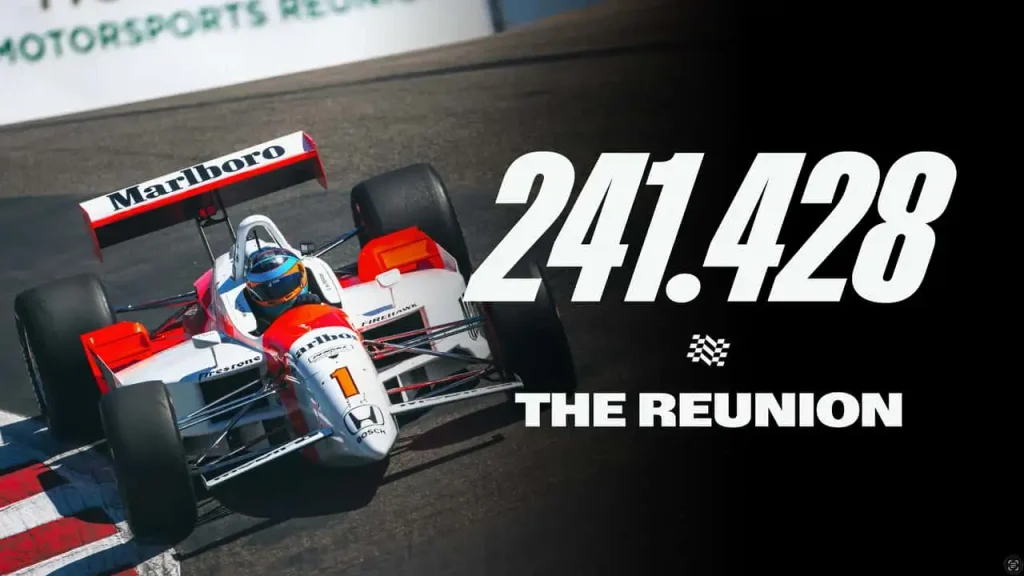
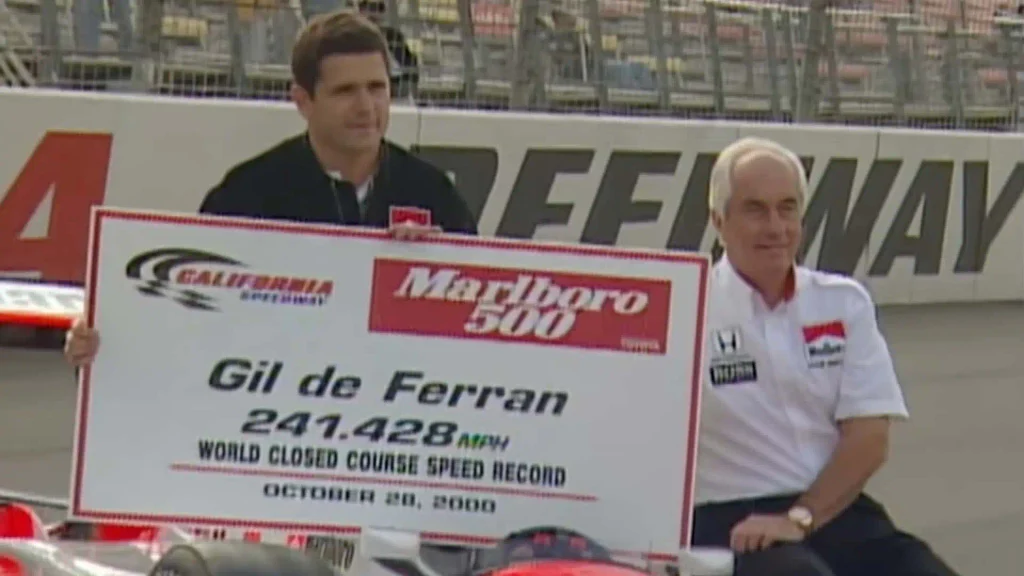
Twenty-five years. Nobody has touched it. Gil de Ferran's 241.428-mph closed-course lap at California Speedway in Fontana, set in October 2000 in a Honda-powered Reynard, still stands as the official world record for a race car on an enclosed circuit. Honda Racing US dropped a four-part docuseries this week to say exactly that.
The record matters because it did not come from a straight-line run. Sustained cornering loads at triple-digit speeds on an oval demand something qualitatively different from a drag pass — more power is only part of it. According to Honda Racing Corporation US's official series release, published September 2025, no Formula 1, IndyCar, or NASCAR machine has equalled 241.428 mph under closed-course conditions since that October afternoon. De Ferran, a two-time CART champion and 2003 Indianapolis 500 winner, died in December 2023.
How the Docuseries Came Together
Honda Racing US built the series, titled 241.428, around the people who shared the Fontana pit lane with de Ferran rather than around archive footage alone. Roger Penske, Zak Brown, Rick Mears, Helio Castroneves, Dario Franchitti, and Tony Kanaan all appear on camera. Each contributed to a paddock reputation that extended well past de Ferran's own race wins. The production launched on the HRC US YouTube channel in the final week of September 2025. Kelvin Fu, president of HRC US, approved the project and framed it as a tribute rather than a marketing exercise — an internal distinction that shaped which contributors the production team approached first. The series also makes use of the restored Reynard 01I-Honda, the championship-winning 2001 Team Penske CART car that Zak Brown now owns. Honda's Heritage Racing Program carried out that restoration, the same programme the company activated in August 2025 during Monterey Car Week. For broader context on how Honda's racing history intersects with its current corporate direction, see our industry restructuring 2026 analysis.
The Numbers Behind an Untouched Record
De Ferran's official mark is 241.428 mph. Convert that to kilometres per hour and it sits at approximately 388.5 km/h — calculated here as 241.428 × 1.60934 = 388.47 km/h, rounded to two decimal places. The lap was completed in October 2000 at California Speedway, Fontana, a 2.0-mile tri-oval. At 241.428 mph over a 2.0-mile loop, each lap took roughly 29.8 seconds: (2.0 miles ÷ 241.428 mph) × 3,600 seconds = 29.82 seconds per lap. That 29.82-second cycle required sustained lateral loads through banked turns, not a single flat-out blast down a runway. Twenty-five years elapsed between October 2000 and October 2025 — zero tenths of a mile per hour has been added to the closed-course record in that window. IndyCar's current Dallara DW12 chassis, running Honda or Chevrolet twin-turbo 2.2-litre V6 units, operates under boost regulations that cap peak output well below what the Reynard's Honda engine produced that day. The gap between then and now is not marginal.
Fu Describes the Project as Personal
Kelvin Fu, president of Honda Racing Corporation US, spoke directly to why the company funded the production. "Gil de Ferran was a big part of the Honda racing family, and he holds a special place in our hearts beyond his major championships and race victories, but 241.428 was an extraordinary achievement," Fu said, according to Honda Racing Corporation US's series announcement, September 2025. The phrasing is deliberate. Fu separated the number from the man's championship résumé, which itself included back-to-back CART titles in 2000 and 2001 plus the 2003 Indy 500. The implication is that the record carries its own identity — one Honda believes still needs explaining to an audience that was not watching oval racing at the turn of the millennium. Whether a YouTube docuseries reaches that audience is a separate question Fu did not answer publicly. What the series does confirm is that Honda Racing US treats the CART era as load-bearing history, not nostalgia.
Why Modern Cars Cannot Simply Go Faster
The obvious question is why nobody has broken the record. The answer is not straightforward, and the 241.428 series addresses it without fully resolving the tension. Modern IndyCar aero packages generate more downforce than the Reynard 01I at most circuits, yet the current rulebook caps turbo boost pressure in a way that limits peak power on superspeedways specifically to control speeds after a sequence of fatal and near-fatal crashes from the early 2000s onward. So the very conditions that produced 241.428 mph — a particular alignment of boost ceiling, aero configuration, and tire compound — were regulated out of existence partly because of the dangers that ceiling implied. Honda has not published any internal estimate of what a modern IndyCar could theoretically achieve without those restrictions. That figure was not included in the docuseries press materials, and HRC US did not respond to a request for clarification before publication. The record therefore exists in a category that current rules make structurally unreachable, which is different from saying the engineering cannot get there. Honda's current North America product timeline shows a company leaning heavily into hybrid road-car development — a context that makes the CART-era record feel even more distant from the present engineering brief.
CART 2000 Against the Current Oval Rulebook
In 2000, CART's turbocharged 2.65-litre Honda engines ran at boost pressures that produced well over 900 bhp in qualifying trim on superspeedways — figures that series historians and team engineers cited contemporaneously, though Honda has not published an official peak number for that configuration. IndyCar's current Dallara DW12 uses a 2.2-litre twin-turbo V6, with Honda and Chevrolet both supplying homologated units producing approximately 550 bhp in race trim and closer to 700 bhp in qualifying on ovals, according to IndyCar's published technical regulations, 2024 edition. That is a reduction of roughly 200 bhp at the crank compared to CART-era superspeedway qualifying output. Downforce levels are also tightly controlled to hold top speeds at Indianapolis below 240 mph — a threshold that sits fractionally below de Ferran's Fontana mark. Separately, Chinese OEMs navigating European production constraints face a different kind of regulatory ceiling, but the mechanism is the same: rules written after a crisis lock in the performance envelope for a generation. The 25-year gap in the closed-course record is, in part, a gap written into a rulebook.
De Ferran's record was ratified States Auto Club, the sanctioning body that held closed-course speed record authority at the time — a detail absent from Honda's docuseries promotional materials. USAC's records registry lists the mark under the "Championship Car" category, distinct from land-speed records governed . Gil de Ferran won the 2003 Indianapolis 500 driving for Team Penske alongside teammate Helio Castroneves. The complete Honda model history and specifications are catalogued in the Global Auto Index manufacturer database.
