







A license-plated prototype carries Porsche 911 GT3 RS-style fender louvers and front bumper canards not seen on the standard car.
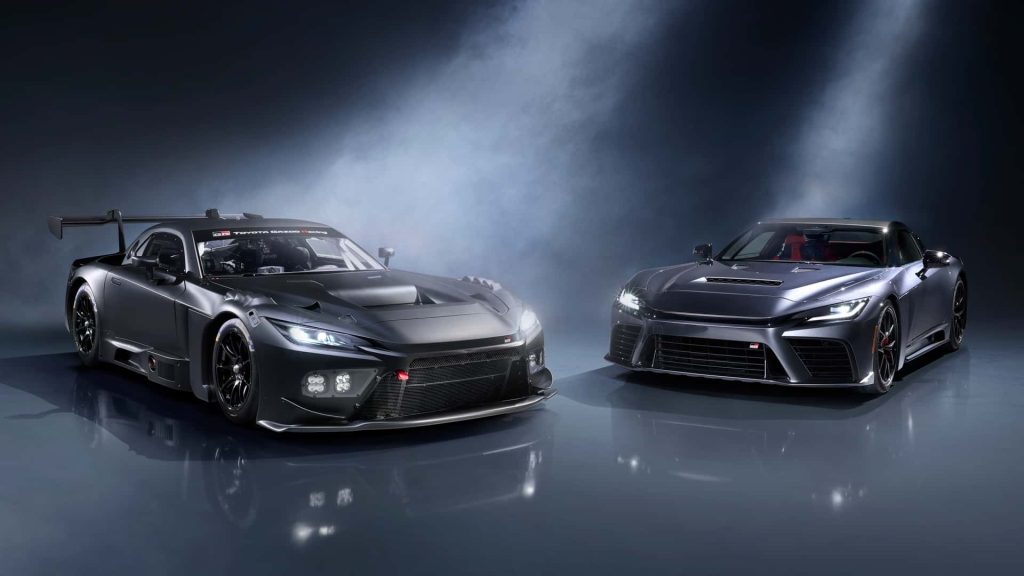
Toyota is back at the Nürburgring. A second, more extreme GR GT prototype — license-plated, street-legal — was caught on video running alongside the standard development car. The aero hardware is not subtle. Launch is still slated for sometime next year.
The sighting matters because it arrives before Toyota has even shipped the base GR GT to showrooms. When Ferrari released the 488 Pista and McLaren the 720S Spider, both variants came roughly 18 months after the standard car; Toyota is apparently compressing that timeline. Spy footage published by Nürburg Automotive in July 2025 shows the two prototypes running back-to-back on the Nordschleife, making visual differences easy to read.
What the Cameras Caught on the Nordschleife
The prototype emerged from the Nordschleife's forest section and held pace with the standard GR GT development mule ahead of it. Nürburg Automotive's camera operator tracked both cars through several corners, giving a clean comparison shot. The wilder car wore full body camouflage except for two areas Toyota's engineers left deliberately uncovered: the front fender vents and the outer bumper edges. A swan-neck rear wing — the type that mounts to the boot lid rather than the rear diffuser, keeping airflow below the wing undisturbed — rose visibly higher than anything on the standard car. The footage, posted in mid-July 2025, circulated quickly among GR enthusiasts who had been tracking the model's development since its December 2024 debut. This is part of a broader wave of manufacturer testing at Germany's famous circuit; our ongoing coverage of 2026 industry restructuring has documented how several OEMs are accelerating product timelines under regulatory and competitive pressure.
641 hp and 1,750 kg — The Numbers Behind the Hardware
Toyota's own development figures for the standard GR GT put combined system output at 641 horsepower (478 kW) and 627 lb-ft (850 Nm) of torque. The powertrain pairs a twin-turbocharged 4.0-litre V8 with an electric motor. Toyota has stated the car will weigh 1,750 kg or less — a figure worth interrogating. A Porsche 911 Turbo S, for reference, scales at 1,640 kg with its PDK transmission. The GR GT therefore carries a 110 kg penalty over Porsche's benchmark, or roughly 6.7 percent more mass (110 ÷ 1,640 × 100 = 6.7%). The hardcore variant is unlikely to recover all of that through aero hardware alone. Carbon-fibre-reinforced plastic body panels, already used on the standard car alongside its all-aluminium frame, could trim 15–25 kg in a best-case rework — narrowing but not closing the gap. Toyota has not confirmed revised weight targets for the performance variant, and the development-spec power figures carry a caveat: Toyota's own programme documentation states they are subject to change before production.
The Variant That Shouldn't Exist Yet
Here is what does not add up. Toyota has not yet given the base GR GT a production date firmer than 'sometime in 2026.' The car has been in public testing since at least early 2025. Normally, a manufacturer runs the standard model to sign-off before committing engineering resources to a track-biased variant — the cost of two concurrent development programmes is not trivial. Yet both prototypes were on the Nordschleife the same week, burning tyres and track time in parallel. One possibility: the aero package is an optional bolt-on, developed alongside the car rather than after it, and will ship as a dealer-fitted or factory-order item from launch. A second possibility is that Toyota is targeting a simultaneous reveal of standard and performance-spec cars to maximise press coverage — a tactic BMW used when it confirmed the four-motor M3 for 2027 alongside its standard successor. Toyota has not addressed either reading publicly. No trim name, no separate model designation, no pricing signal has been published as of the date of the Nürburg Automotive footage.
Yellow Sticker, High-Voltage Rules
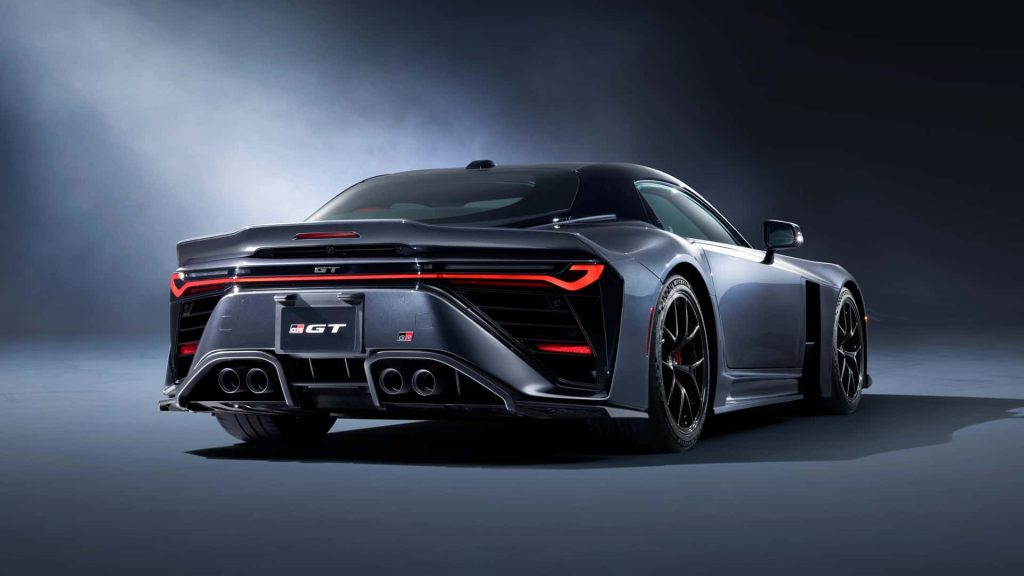
The hardcore prototype carries the yellow high-voltage identification sticker mandated by Nürburgring circuit regulations for all electrified vehicles — a detail that appeared clearly in the Nürburg Automotive footage published July 2025. The sticker's presence confirms the performance variant retains the hybrid drivetrain rather than, say, swapping to a pure-combustion setup for weight reduction. Nürburgring circuit regulations, updated for the 2024 season, require the yellow marker 'to allow track marshals and emergency responders to identify high-voltage systems rapidly in the event of an incident,' according to the circuit's official testing protocol documentation. That the aero-heavy car keeps the hybrid stack should settle speculation that Toyota might offer a stripped, combustion-only version. It also signals that the electric motor's torque-fill function — particularly relevant on corner exit at a circuit that punishes throttle hesitation — is considered part of the performance equation, not ballast to be discarded. Electrification as a performance tool rather than a regulatory concession is a thread running through several recent supercar programmes.
What This Means for Lexus LFA and the Shared Platform
Toyota confirmed at the GR GT's December 2024 reveal that the car's all-aluminium body frame will underpin at least one further model: a revived Lexus LFA, planned as a fully electric supercar for 2027. That shared platform arrangement is already under strain from the GR GT's own weight targets. The electric LFA will carry a battery pack that no amount of solid-state chemistry is likely to bring below 400 kg at the energy density required for supercar range and power delivery — a figure that pushes total vehicle weight well past the GR GT's 1,750 kg ceiling. If Toyota now engineers additional carbon-fibre reinforcement and aerodynamic downforce into the GR GT performance variant, the LFA's development team faces a moving reference point: the platform's structural loads and suspension pick-up points may need revision to handle the extra aero forces. That is an engineering cost Toyota has not quantified publicly. Shared platform economics have tripped up other manufacturers recently, most visibly when platform-sharing assumptions failed to survive contact with separate model requirements. The LFA timeline of 2027 leaves limited runway for late-stage structural revisions.
Toyota's Gazoo Racing division has homologated the GR GT3 race variant under FIA GT3 regulations for the 2026 competition season — a separate programme from the road car but one that shares suspension geometry data fed back into the street prototype's development. The GR GT will be Toyota's first road car in over two decades to carry a factory-quoted output above 600 hp. The complete Toyota GR GT model history and specifications are catalogued in the Global Auto Index manufacturer database.
