






Both EVs carry an identical 75 kWh pack, yet the Leaf's base trim delivers 21 more miles of range.
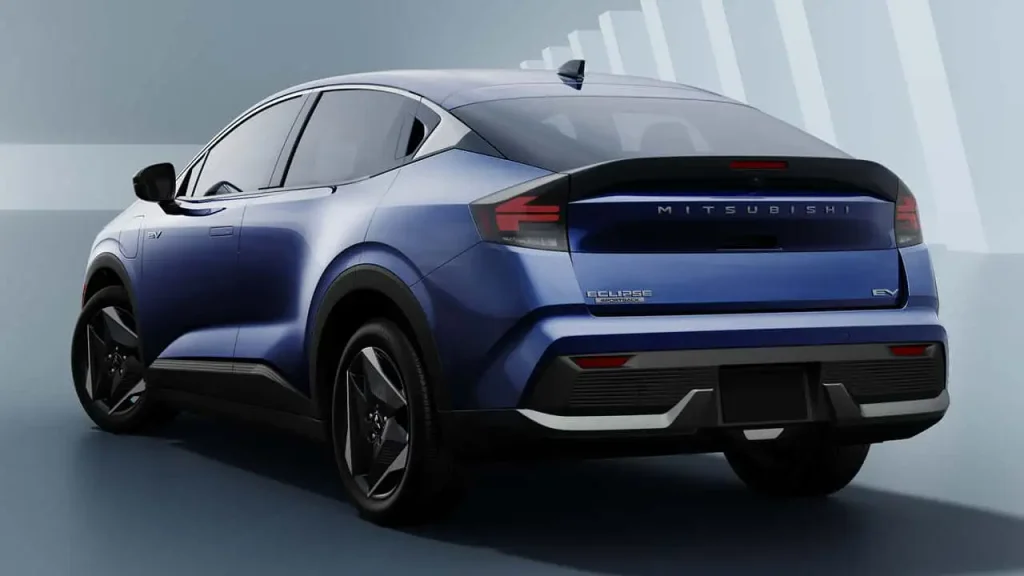
Mitsubishi set the 2027 Eclipse Sportback's US price at $37,745 before destination. The redesigned Nissan Leaf starts at $29,990. Same battery. Eight thousand dollars apart. That gap deserves scrutiny.
Both vehicles share 75 kWh lithium-ion packs within the Renault-Nissan-Mitsubishi Alliance's common EV architecture — a point Mitsubishi Motors North America confirmed in its October 2025 product release. According to that document, the Eclipse Sportback's shared underpinnings were chosen explicitly to accelerate time-to-market. Yet the Leaf's base S+ trim not only costs $7,755 less, it also returns an EPA-rated 303 miles against the Eclipse Sportback's 282. The cheaper car goes farther. That is the uncomfortable arithmetic sitting at the centre of this launch.

The Price Stack, Line by Line
Start with the numbers Mitsubishi Motors North America published on 7 October 2025. The Eclipse Sportback's base MSRP is $37,745. Add the $1,995 destination charge and the as-delivered figure reaches $39,740. Nissan prices the Leaf S+ at $29,990, the SV+ at $34,230, and the Platinum+ at $38,990. The gap between the Eclipse Sportback and the cheapest Leaf is $37,745 − $29,990 = $7,755. Even the fully loaded Leaf Platinum+ sits $750 below the Mitsubishi's pre-destination sticker. Layer in the $2,600 Technology Package — the only factory option Mitsubishi offers — and the Eclipse Sportback crosses $42,000 before any federal or state incentives are applied. That package bundles a ten-speaker Bose audio system, a hands-free power liftgate, roof rails, and a two-section electrochromic panoramic sunroof. Useful, but none of it changes the battery. For readers tracking the EV regulation and pricing developments reshaping the 2026 model year, the Alliance's willingness to carry an $8,000 spread on identical hardware is a data point worth filing.
The Car That Costs More and Goes Less Far
Here is what does not add up. Mitsubishi is charging a meaningful premium for a vehicle that, on the one metric EV shoppers consistently rank first — range — trails its cheaper stablemate. The Leaf S+ carries a 303-mile EPA rating. The Eclipse Sportback is rated at 282 miles. The delta is 21 miles in favour of the Nissan, and the Nissan costs $7,755 less at base. Move up to the Leaf SV+ — $34,230, still below the Mitsubishi — and the range estimate is 288 miles, still six miles ahead of the Eclipse Sportback. Only the range-compromised Leaf Platinum+, fitted with larger wheels and heavier equipment, drops to 259 miles and falls below the Mitsubishi's figure. Mitsubishi's one-trim approach eliminates the wheel-size variation that costs the Platinum+ those miles, which is a genuine structural advantage in terms of configurational simplicity. But it does not explain why the Eclipse Sportback's single quoted figure sits below the Leaf's two lower trims. Mitsubishi has not published a public explanation for the range discrepancy. That answer was not in the October launch materials.
What Mitsubishi's Own Roadmap Says
Mitsubishi's product cadence document, circulated ahead of the Eclipse Sportback's October 2025 US launch, describes a commitment to delivering "at least one new or refreshed model every year through fiscal 2030." The shared Alliance platform is presented not as a compromise but as the mechanism that makes that pace possible — a shortcut to market that lets a manufacturer with limited standalone R&D budget compete on launch frequency rather than exclusive engineering. Koji Ikeya, chief financial officer at Mitsubishi Motors Corporation, told analysts during the fiscal year 2024 results briefing that platform consolidation across Alliance members was a "non-negotiable condition" for the company's recovery plan. That framing makes commercial sense. The problem is that platform consolidation only generates consumer goodwill when the shared product is priced as if it is shared. The Eclipse Sportback is priced as if the platform is proprietary. Whether that holds once Nissan's own three-tier Leaf ladder sits on the same showroom floor is the question Mitsubishi's North American sales team will be answering through the end of 2025.
Charging Hardware: Where the Eclipse Sportback Pulls Ahead
Strip out price and range and the Eclipse Sportback does find one area of genuine differentiation. The vehicle accepts DC fast charging at up to 150 kW through a NACS port — the connector format Tesla opened to third-party manufacturers and which has since been adopted across most US fast-charging networks. Mitsubishi claims a 10-percent to 80-percent charge in approximately 35 minutes at that rate. Nissan has not published equivalent NACS adoption details for the redesigned Leaf lineup as of the October 2025 launch window; the charging specification gap between the two vehicles on this point was not resolved in Nissan's publicly available trim documentation at that date. For a driver who regularly uses public DC infrastructure, 150 kW acceptance and native Supercharger compatibility without an adapter represents a tangible daily advantage over a vehicle limited to slower charging tiers. That advantage does not close the $7,755 base-price gap on its own, but it is the clearest place where the Mitsubishi earns part of its premium over its Alliance sibling on specification rather than trim content alone.
What the Pricing Gap Means for Mitsubishi's US Dealers
David Sargent, vice president of automotive quality at J.D. Power, noted in the organisation's 2025 US Electric Vehicle Experience Study, published June 2025, that purchase consideration for EVs in the $35,000–$42,000 band is acutely sensitive to per-dollar range delivery. A shopper who walks into a Mitsubishi dealership and checks the Leaf's EPA sheet on their phone before signing paperwork will find that the $7,755 they are paying above the Leaf S+ buys them 21 fewer miles per charge. Mitsubishi's North American dealer network — 338 franchised points as of the Alliance's 2024 annual report — carries a smaller footprint than Nissan's. That makes conquest sales from non-Alliance shoppers harder to manufacture. The single-trim structure simplifies the sales conversation: there is nothing to upsell and nothing to discount selectively. But it also removes the negotiating room that Nissan's three-tier Leaf gives its sales force. If the Eclipse Sportback's October 2025 launch volume trails internal projections, the one-trim architecture will be the first variable examined — not the platform it shares with a cheaper, longer-range alternative sitting one floor away.
Mitsubishi sold 49,645 vehicles in the United States during calendar year 2024, according to Mitsubishi Motors North America's full-year sales release published January 2025 — a market share of roughly 0.3 percent. The Eclipse name last appeared on a US model in 2011. Reactivating it on shared Alliance hardware is a calculated bet that brand recall converts to transaction volume. The math on that bet closes in Q1 2026. The complete Mitsubishi model history and specifications are catalogued in the Global Auto Index manufacturer database.
