






The four-seat grand tourer's 118 kWh battery runs an 850-volt architecture — no price or sale date confirmed.
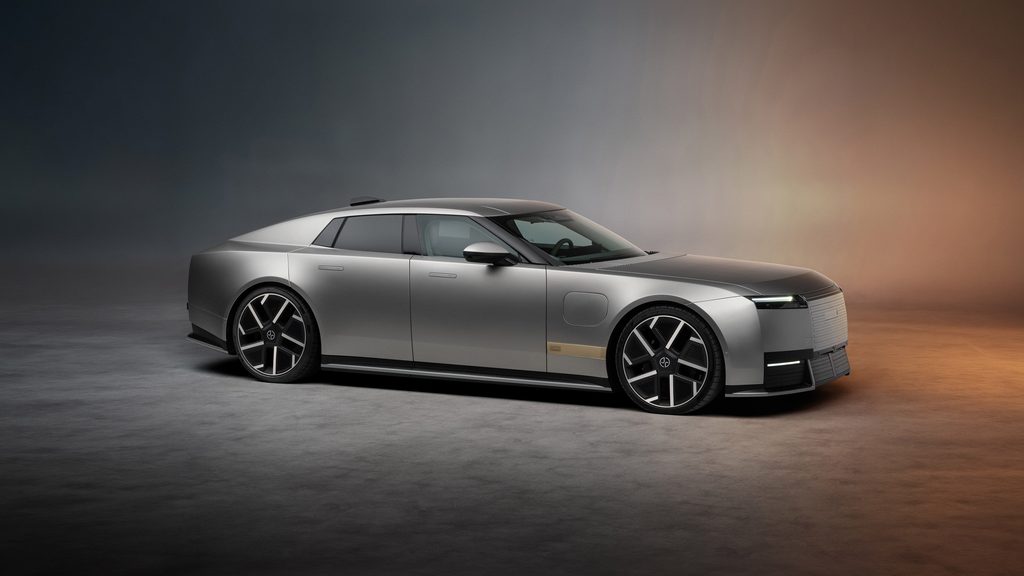
Three motors. 1,016 horsepower. No price. Jaguar unveiled the Type 01 on 6 October, billing it as the most powerful road car the British marque has ever built. It is also fully electric. The four-seat grand tourer replaces nothing — Jaguar has no current production car — which makes the stakes here unusually bare.
Jaguar Land Rover paused all passenger-car production in late 2024 to retool for an all-electric model range. The Type 01 is the first car out of that silence. , Porsche's Taycan Turbo GT — the closest rival on headline power — produces 1,092 hp from a 105 kWh pack, according to Porsche AG's technical specification sheet published January 2025. Jaguar's 118 kWh pack is 12.4 percent larger. Whether that translates into a real-world range advantage is a question the brand has not yet answered on a test route.

The Numbers Behind the Powertrain
One motor sits on the front axle; two share the rear. Combined peak output: 1,016 hp and 1,007 lb-ft of torque. Jaguar's own figures, published in the Type 01 technical briefing document released alongside the 6 October world premiere, put the sprint to 62 mph at 3.2 seconds. The battery capacity is 118.0 kWh on an 850-volt architecture — 13 volts higher than the 800-volt systems used by Hyundai's E-GMP platform. WLTP range is claimed at 450 miles; sustained highway range drops to 320 miles, a differential of 130 miles, or roughly 29 percent. Weight distribution is quoted at exactly 50:50. In Dynamic mode, up to 87 percent of available torque is directed rearward. The active rear spoiler generates up to 165.3 lb of downforce above 96.3 mph, at which point the car also lowers by 0.59 inches. Those are engineering choices with a clear priority: rear-biased, driver-focused, aerodynamically loaded at speed. This sits at the core of what Jaguar is arguing the Type 01 represents within the European grand tourer segment's electric transition.
Turning Circle, Wheelbase, and the Physics Problem
At 206.4 inches long and 55.24 inches tall, the Type 01 is a large car by any measure. Jaguar quotes a 37.7-foot turning circle — achieved partly through all-wheel steering that can turn the rear wheels up to 6.0 degrees at low speed. For context: the 2026 Mazda MX-5 Miata, a two-seat roadster weighing roughly half as much, manages a 30.1-foot circle. The Ford Expedition full-size SUV requires 41.0 feet. The Type 01 lands between them, which is a meaningful engineering result for a car this long. Seventeen percent of the car's 17.2-foot length falls between the front axle and the door — a proportion Jaguar's chassis engineers used to push mass toward the centre. The centre of gravity sits 2.4 inches below the driver's hip point. Yaw centre is positioned between the four occupants. These are deliberate layout decisions, not packaging compromises. Whether they survive contact with an urban car park remains, as of publication date, untested by any independent reviewer.
What Jaguar Says the Car Should Feel Like
Jaguar's technical briefing document, distributed to press on 6 October, includes a direct design intent statement: the Type 01 should feel as though it "wraps around the driver." That phrase appears in the section covering chassis geometry and steering calibration, not in the marketing preamble. It is a specific engineering claim rather than a brand aspiration. The 24.0-inch OLED display behind the steering wheel and the 7.0-inch central touchscreen were described by Jaguar's design team — in the same document — as a "driver-centric architecture" that reduces physical switchgear without removing direct function access. The ClearSight Rear View system, embedded in a panoramic soundbar at the base of the windshield, replaces the conventional rearview mirror entirely. Jaguar says it is positioned at the same height as the exterior mirrors. That is a claim worth testing: digital rearview systems have drawn criticism in real-world use, including from Transport Research Laboratory findings published in the United Kingdom in 2022, for introducing parallax and adaptation time in emergency braking scenarios.
The One Thing Jaguar Has Not Said
No production start date. No retail price. No confirmed market allocation by country. Jaguar's press release, the Type 01 technical briefing, and the accompanying image package — all distributed on 6 October — contain no reference to when the car goes on sale, what it will cost, or which markets receive it first. The brand's own communications team, reached after the premiere, declined to confirm even a quarter for first deliveries. The expected range of low-to-mid six figures in US dollars is an estimate circulating among analysts; Jaguar has not endorsed that figure publicly. This is not unusual for a world premiere — pricing often follows months later. But the absence is sharper here because Jaguar Land Rover confirmed voluntary redundancy consultations affecting up to 4,000 positions in 2025, according to internal documents reported by multiple UK trade publications that month. A brand restructuring its workforce while revealing its flagship car without a price tag is a combination that invites scrutiny. Gerry McGovern, JLR's Chief Creative Officer, has spoken publicly about the brand's direction but has not addressed the commercial timeline in any post-premiere statement reviewed for this article.
What the Type 01 Means for JLR's EV Product Plan
Jaguar Land Rover's EV roadmap, outlined by Chief Executive Adrian Mardell at the company's annual investor briefing in March 2025, commits to a fully electric Jaguar range by 2026 with subsequent models following on JLR's own electric-native platform. The Type 01 is model one of that sequence. If it reaches customers on the timeline Mardell described, the brand will need to move from zero current production cars to a delivered flagship within roughly eighteen months. That is an aggressive compressed window. JLR's Solihull and Castle Bromwich facilities have been retooled; Castle Bromwich, which built the XE, XF, and F-Type until production ended, is now designated for the new electric Jaguar line. The Type 01's 23-inch standard wheel fitment will require specific tyre sourcing agreements — no supplier has been publicly named. Its headlights, at 3.31 inches tall and containing 20,000 LEDs per unit, will need homologation in each market. Neither detail has been addressed in public documentation released by Jaguar as of 7 October.
Jaguar last held the title of most powerful road car with the XE SV Project 8, which produced 592 hp from a supercharged 5.0-litre V8 and was built in a run of 300 units between 2018 and 2019. The Type 01's 1,016 hp figure is 71.6 percent higher. Production volume for the new car has not been disclosed. The complete Jaguar model history and specifications are catalogued in the Global Auto Index manufacturer database.
