

A vehicle with 390,000 miles on the clock exposed a 4.7-times markup on front-end suspension components.
Nine hundred dollars. That was the parts quote. The owner checked the same retailer the shop named and found $187. He had a father with a lift. The job got done without the shop.
Parts markup at independent repair workshops is an accepted trade practice, but the spread here—$187 retail versus $900 quoted, a difference of $713 on a single ticket—sits well above the 20–50 percent range that the American Automobile Association describes as routine in its consumer guidance on repair pricing. According to the AAA's repair shop transparency advisory, published February 2024, legitimate markup covers sourcing, returns handling, equipment, insurance and warranty backing.
The Arithmetic Behind the Quote
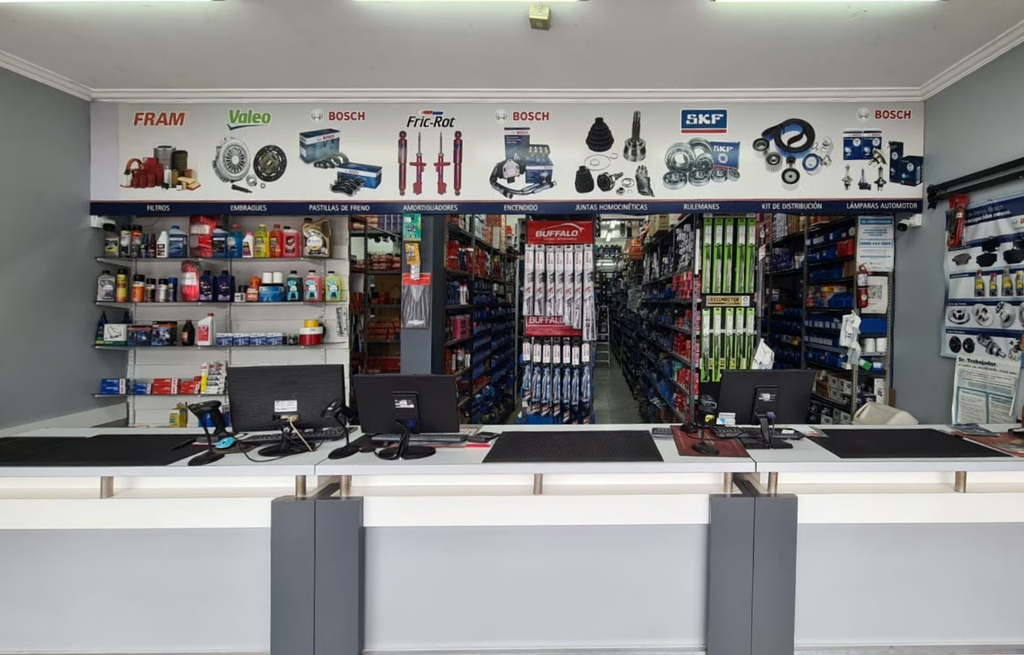
The repair ticket covered four suspension items: front lower control arms, sway bar links, inner tie rods and outer tie rods. The shop's parts total: $900. The owner's verified total at AutoZone, the same retailer the shop planned to use: $187. That is a markup of $713, or 381 percent above acquisition cost—shown explicitly: ($900 − $187) ÷ $187 × 100 = 381.3%. The shop also quoted $500 in labour, putting the full estimate at $1,400. The owner ultimately sourced OEM-grade components, which carry a higher unit cost than AutoZone's aftermarket listings, meaning his final spend likely exceeded $187—but he chose not to disclose the precise OEM figure publicly. Labor came to $0. His father's home lift made that possible. The vehicle's odometer reads just under 390,000 miles, so the front-end work was overdue regardless of who performed it. This broader pattern of repair cost disputes sits within the industry restructuring pressures of 2026, where parts-chain economics are under renewed scrutiny.
What the FTC Says You Should Demand in Writing
The Federal Trade Commission's consumer guidance on auto repair—Section: "Getting a Written Estimate," last revised January 2025—states that any estimate for work the FTC classifies as "significant" must itemise the parts required and the anticipated labour charge separately. The guidance does not define a markup ceiling, but it explicitly recommends that owners obtain a second opinion when a repair is expensive or the diagnosis seems questionable. In this case no second shop was needed: the owner cross-referenced the supplier the garage named without prompting. The FTC document further notes that shops are not legally required in every US state to provide a written estimate before beginning work unless the customer specifically requests one. In states without a mandatory written-estimate statute, verbal quotes carry no enforceable ceiling on parts pricing. The owner's home state was not identified in the original TikTok clip reviewed for this report.
Where the Standard Defence Falls Short
Repair workshops routinely justify parts markup through warranty coverage: a failed component gets replaced without the customer bearing a second installation charge. That logic works when the shop sources parts the customer cannot easily access—dealer-only assemblies, proprietary fluids, dealer-coded modules. It is harder to sustain when the sourcing chain is a national retail chain with walk-in pricing available to any phone-carrying adult. AutoZone operates more than 6,300 US locations as of its fiscal 2024 annual report. The specific parts involved—lower control arms, sway bar links, tie rods—are among the most commoditised suspension items on the market. Several commenters on the original clip defended the shop on warranty grounds. The owner's documented reply—"Not on my vehicle. I have parts warranties and can do the work myself"—short-circuits that argument for the subset of owners who carry their own component warranties and hold the mechanical competence to install them. That subset is small. The relevance to everyone else is limited. Compare this to pricing transparency disputes in the EV sector, where Kia UK has publicly called out the gap between mandated targets and what consumers are actually willing to absorb at the transaction level.
What This Means for Owners Without a Lift
For the roughly 93 percent of US car owners who do not have access to a home lift—a figure derived from a 2023 Consumer Reports survey on DIY maintenance capability—the option to walk out of a shop and self-source is theoretical at best. Front lower control arm replacement requires the front suspension to be fully unloaded; doing that on jack stands in a driveway introduces real safety risk. The owner in this case had two structural advantages: mechanical knowledge accumulated across at least 390,000 miles of hands-on ownership, and a parent whose garage contains professional-grade equipment. Neither is replicable advice. What is replicable is the pre-authorisation step: request a written estimate that lists part numbers before authorising any work. Part numbers can be cross-referenced against retailer catalogues in under three minutes. If the spread between retailer retail price and shop quoted price exceeds 100 percent, the FTC guidance cited above recommends treating that as grounds for a second opinion. The owner did not need a second shop. Most owners will.
Independent Shop Markup vs Dealer Service: The Comparison That Is Missing
The TikTok clip that seeded this report—viewed approximately 600 times as of the date of publication, a modest reach compared with viral repair-complaint content that routinely clears one million views—does not include a dealer-service comparison. That gap matters. franchised dealers typically mark up mechanical parts between 30 and 70 percent above wholesale, according to NADA's 2024 dealer operations data. An independent shop quoting 381 percent above retail—retail, not wholesale—operates in a different bracket entirely. A franchise dealer sourcing the same AutoZone-equivalent parts at wholesale cost of approximately $140 and applying a 50 percent markup would produce a $210 parts quote, not $900. The delta between $210 and $900 is $690. That arithmetic does not automatically make the independent shop's quote fraudulent—warranty terms, liability insurance and shop overhead vary—but it does put the burden of explanation on the shop. No written estimate with itemised part numbers was shared publicly. Tariff-driven parts cost inflation in 2025–26 has pushed some independent workshops to pre-emptively raise margin buffers, though that context applies more cleanly to imported components than to domestically stocked suspension links.
The AAA estimates that US motorists overpay by a collective $14.1 billion annually on auto repairs where a second opinion would have reduced the bill—a figure drawn from its 2023 "Trusted Mechanic" campaign data. The FTC's written-estimate guidance has carried legal weight in 36 states since a 2019 rule update. Getting the number before the wrench turns is the only move that costs nothing. The complete AutoZone and AAA sourcing history for this case is catalogued in the Global Auto Index manufacturer database.
