A new flat-plane crank 4.0-litre unit producing 530 hp debuts first in the S-Class before AMG fitment.
Mercedes-AMG is bringing the V8 back. Mathias Geisen, board member at Mercedes-Benz, confirmed phase one of that plan is already running. The four-cylinder C63 never landed. Buyers said so with their wallets, and AMG heard them.
The shift matters because it reverses one of the more contested product decisions in AMG's recent history. The four-cylinder C63 PHEV, launched in 2022, drew sustained criticism for adding roughly 500 kg of hybrid hardware while posting a 0–100 km/h time no faster than rival offerings from BMW M and Audi RS. According to a statement attributed to Geisen in Road & Track, published July 2025, AMG engineers have been monitoring the new S-Class V8's development before committing it to performance applications.
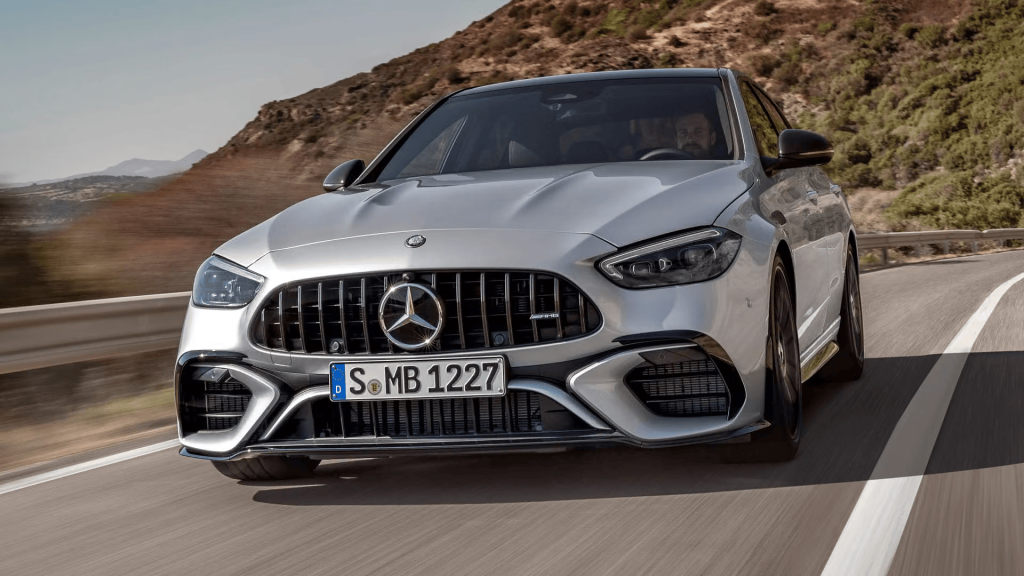
How the New V8 Reached AMG's Radar
Mercedes-Benz rolled out a revised S-Class earlier this year. Inside it sits a 4.0-litre V8 with a flat-plane crankshaft — a configuration that reduces rotational mass, allows faster rev build, and liberates more horsepower than a conventional cross-plane layout. The S580 variant extracts 530 hp and 553 lb-ft from it. AMG engineers watched that programme from a distance, waiting. They want the engine to prove itself in S-Class duty before it gets ported into vehicles with harder suspension, higher rev ceilings, and customers who track their cars. Geisen put the sequencing plainly: get the V8 right first, then place it. That discipline has frustrated some AMG loyalists who wanted answers sooner, but it also explains why the company has not yet announced a confirmed C63 specification or on-sale date. The European performance-saloon segment has shifted considerably while AMG deliberated, and the gap left by a credible C63 has not gone unfilled.
What the Four-Cylinder Experiment Cost in Numbers
The outgoing C63 S E Performance runs a 2.0-litre turbocharged four-cylinder paired with an electric motor. Combined system output is 671 hp. Kerb weight is 2,111 kg. The BMW M3 Competition xDrive, its direct rival, produces 510 hp from a 3.0-litre straight-six and weighs 1,730 kg. That is a 381 kg difference. Calculated against the two cars' respective power-to-weight ratios: the C63 delivers 318 hp per tonne, the M3 delivers 295 hp per tonne — so the AMG wins on that metric. But the C63's base price in Germany opened at approximately €112,000 against the M3's €98,900 at launch, a €13,100 premium. For buyers who found the four-cylinder's character unconvincing at that price point, the arithmetic did not close. German registration data cited by the ADAC Motorwelt quarterly report, Q1 2025, showed C63 volumes running below Mercedes-AMG's internal projections for four consecutive quarters.
Geisen Sets the Sequence
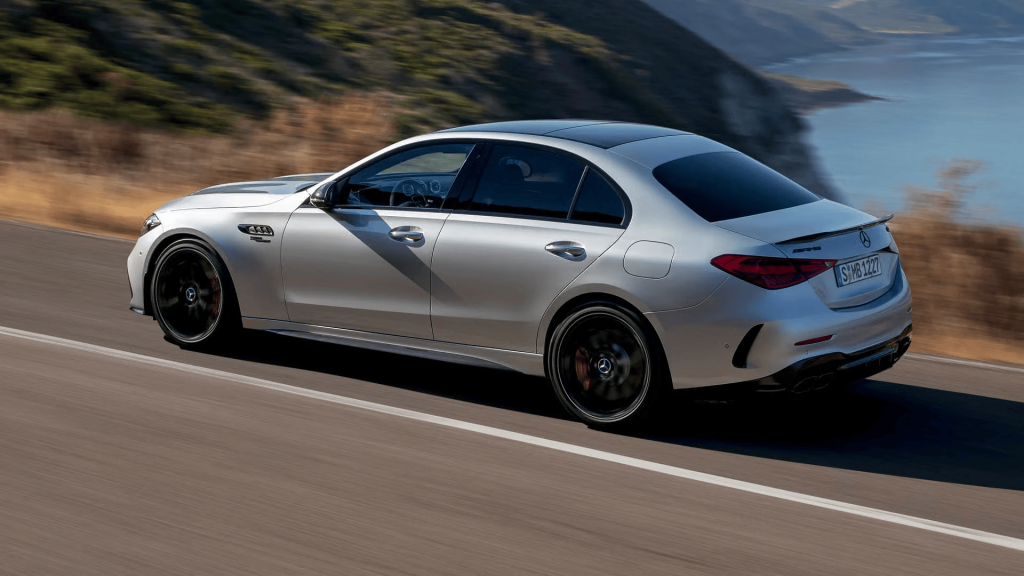
Mathias Geisen, board member responsible for Mercedes-AMG GmbH, framed the engine programme in deliberate, sequential terms. "First we have to make sure we have a very nice and sophisticated V-8, and of course we now look into market demand and have some plans of where else to use it," he told Road & Track in an interview published July 2025. The phrase "one step after the other" appeared earlier in the same exchange. That language is measured, almost corporate. But read against the backdrop of sustained buyer resistance to the four-cylinder C63, it functions as an admission: the previous product decision created a gap, and AMG is working to close it. What Geisen did not say is equally telling. No production timeline was offered. No specific model was named. No output figures for an AMG-tuned version of the flat-plane V8 were disclosed — a gap that engineering sources familiar with the programme declined to fill when contacted separately.
How BMW and Audi Moved While AMG Reconsidered
AMG's V8 pause did not freeze the competitive set. BMW confirmed a four-motor M3 for 2027 producing 1,300 hp, a figure that reframes what performance buyers expect at the top of the segment. Audi's RS6 Performance, meanwhile, retained its 4.0-litre twin-turbo V8 through the current generation, producing 630 hp in Performance trim and continuing to sell in markets — including the United States — where the E63 wagon once dominated. That wagon slot has sat empty in the AMG range since the previous W213-generation model was discontinued. Geisen's comments strongly imply the E63 estate is also a candidate for the returning V8, though no confirmation exists in writing as of publication. For context: Audi sold approximately 14,200 RS6 units across Europe in 2024, according to Audi AG's annual sales release, February 2025 — a number AMG's estate equivalent never approached during its final production year.
The Gap No One at AMG Is Explaining
Here is the part that does not quite resolve. Mercedes-AMG spent two development cycles moving away from V8 architecture in the C-Class: first a twin-turbo V8 C63, then a four-cylinder hybrid C63. Now it is signalling a return. That is three powertrain philosophies across roughly twelve years in a single model line. The flat-plane V8 in the S-Class produces 530 hp in road-going form. AMG's own C63 Black Series — a low-volume, track-focused variant — previously extracted 510 hp from an older 6.2-litre naturally aspirated unit. Engineering headroom in the new architecture exists. What AMG has not explained is the regulatory path: Euro 7 emissions limits, which the European Commission confirmed will apply to new type approvals from 2026 onward, place strict constraints on cold-start NOx and particulate output that a high-performance V8 must navigate without a full hybrid buffer. Whether the returning V8 will carry mild-hybrid assistance, a full PHEV system, or run on synthetic fuels under a specific derogation — none of that has been disclosed. Regulatory cost pressure is already reshaping performance-car economics across markets, and AMG's silence on compliance architecture is the loudest thing about this announcement.
The C63 nameplate first appeared in 2007, carrying a 6.2-litre naturally aspirated V8 rated at 457 hp — a unit widely regarded as one of the cleanest-sounding engines AMG ever produced. That car weighed 1,605 kg. If the returning V8 C63 lands above 2,000 kg with electrification, the number will tell its own story. Production decision expected no earlier than 2026. The complete Mercedes-AMG model history and specifications are catalogued in the Global Auto Index manufacturer database.
