The Turin-based outfit splits production equally between rear-engine and mid-engine variants, each individually numbered.
Fifty cars. That's the entire run. Milan-registered Angelelli Automobili announced Project 754 in July 2025, a coachbuilt supercar reworked from Porsche 911 underpinnings with a new carbon-fibre body and up to 800 hp. No commercial tie to Porsche.
Coachbuilding as a commercial segment has quietly returned. Where bespoke coachwork nearly vanished from volume production 1980s, a cluster of low-volume European specialists now consistently commands seven-figure order books. Angelelli's approach — buying a donor 911 (991 or 992 generation) and rebuilding it from the skin inward — mirrors the method used Design in California, though Angelelli targets a European clientele. According to Angelelli Automobili's Project 754 technical release, published July 2025, the firm operates with no industrial licensing arrangement with Porsche AG.
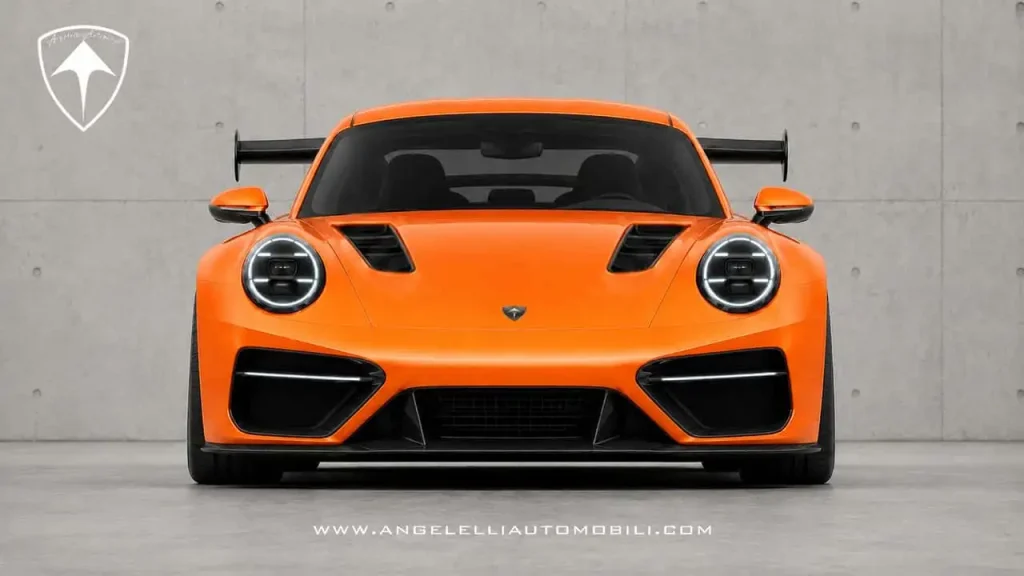
Two Layouts, One Platform
Angelelli Automobili split Project 754 into two distinct variants from the outset. The 754 R retains the 911's traditional rear-engine architecture, chasing traction off corners and outright acceleration. The 754 M relocates the powertrain to a mid-ship position, redistributing mass for higher-speed balance. Each version carries a production ceiling of exactly 25 units — 25 R, 25 M — and each car receives an individual chassis number before a single component is ordered. Customers dictate suspension calibration, aerodynamic trim levels, and material finishes before the build commences. The company describes the process as commission-driven rather than spec-driven, meaning no two cars in the run need share the same mechanical configuration. That approach sits squarely within the European coachbuilt and limited-production segment, where order customisation is now table stakes rather than a differentiator.
Power, Weight, and the 50-Unit Ceiling
Project 754's headline output sits in a 700–800 hp band. Using the published midpoint of 750 hp as a working figure, that represents a minimum uplift of roughly 155 hp over the Porsche 911 Turbo S (650 hp in 992.2 specification) — a 24 percent increase over the donor car's peak output. Carbon-fibre bodywork replaces the donor's steel-and-aluminium panels. Titanium and aluminium structural components, produced via metal 3D printing, replace cast or forged equivalents. Angelelli Automobili's July 2025 release does not publish a kerb-weight figure, but the combination of carbon skin and topology-optimised substructure points toward a target well below the 991 Turbo S baseline of 1,640 kg. The 50-unit total run — 25 R plus 25 M — places annual throughput in single figures given any realistic build timeline. At that volume, fixed costs per car are considerable; the firm has not published a list price.
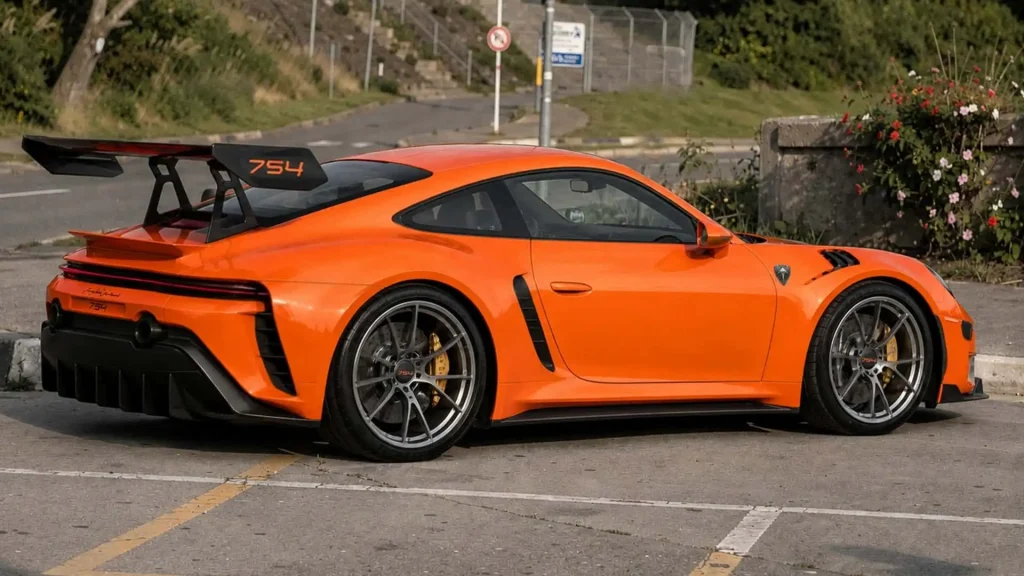
Identity Over Imitation
Angelelli Automobili's position on Project 754 is unambiguous in its July 2025 technical release. The company states the car was built to achieve "its own identity through unique proportions, a completely new body, specially developed components, and an aggressive weight-saving strategy" — a 22-word extract that reads less like a press officer's phrasing and more like an engineering brief written backwards. The insistence on identity rather than homage is a deliberate commercial signal. Coachbuilders who court direct comparison with their donor platforms frequently run into certification friction and customer confusion. By publishing explicit distance from Porsche AG — no licensing, no industrial relationship — Angelelli positions Project 754 as an original type-approved vehicle built on a purchased component base, not a Porsche variant. Whether national type-approval authorities in the EU accept that framing will determine whether cars can be registered without individual Member State exemptions.
The Numbers That Were Not Published
Three data points are conspicuously absent from Angelelli Automobili's July 2025 Project 754 release: price, kerb weight, and 0–100 km/h acceleration time. For a firm making performance claims in the 800 hp range, the omission of all three is unusual. A coachbuilder charging less than €500,000 per unit at this specification would be anomalous against the segment; Singer Vehicle Design's DLS Turbo, which also uses a 911 donor and produces around 500 hp from an air-cooled base, was quoted above $1.8 million at launch. Angelelli's 800 hp claim without a weight figure also prevents any meaningful power-to-weight comparison — the only metric that separates a fast car from a genuinely exceptional one at track speeds. Pricing, homologation status, and delivery timeline were all listed as unconfirmed as of the publication date of the source material. The firm declined to address those gaps in the release reviewed for this article. For a separate data point on high-output performance cars entering the market, BMW's confirmed four-motor M3, rated at 1,300 hp for a 2027 debut, shows how dramatically the horsepower ceiling is moving across the segment.
Coachbuilding Then and Now
In 1965, Carrozzeria Touring Superleggera produced bodies for Lamborghini at volumes that, while small, ran into the hundreds. By 2005, surviving Italian coachbuilders had largely retreated to one-off show cars or manufacturer-sanctioned special editions. Project 754 represents a third model: the independent low-volume series, built on a purchased donor without OEM sanction, targeting collectors rather than enthusiasts. That category barely existed a decade ago. Today, at least a dozen European operators — including Niels van Roij Design in the Netherlands and Ares Design in Modena — produce numbered series of 10 to 100 units annually. Ares Design's Project Panther, also 911-based, was limited to 21 units in 2020. Angelelli's 50-unit run is the largest single series among current Italian independent coachbuilders by announced production volume, though that figure remains subject to revision. The broader trade context — including tariff pressures affecting component sourcing — is covered in reporting on U.S. truck tariff developments and European IVA tightening, which affect imported donor vehicles and speciality aluminium supplies alike.
Angelelli Automobili was incorporated in Italy with a stated focus on proprietary generative-design software for high-performance vehicle development — a technology background that predates Project 754 and suggests the coachbuilt car is as much a demonstration platform as a product line. The firm has not confirmed a physical atelier address in public materials. Deliveries have no published start date. The complete Angelelli Automobili model history and specifications are catalogued in the Global Auto Index manufacturer database.
