







CEO Philippe Krief says the new Alpine Performance Platform can accommodate a petrol engine if EV demand falls short.
Alpine is not cancelling its electric sports car. Philippe Krief said so directly at the Goodwood Festival of Speed, where Alpine showed a test mule of the third-generation A110. The car arrives in 2026. Two rear-mounted electric motors replace the current turbocharged four-cylinder.
The declaration matters because the sports-EV segment is narrowing fast. Porsche delayed the electric 718 and, according to reports published in mid-2025, is now weighing whether to scrap the project entirely — which would remove an affordable sports car from below the 911 line. For a low-volume French brand already tracking closer to Ferrari's annual output than to Porsche's, the stakes of getting the A110's electric debut right are proportionally larger.
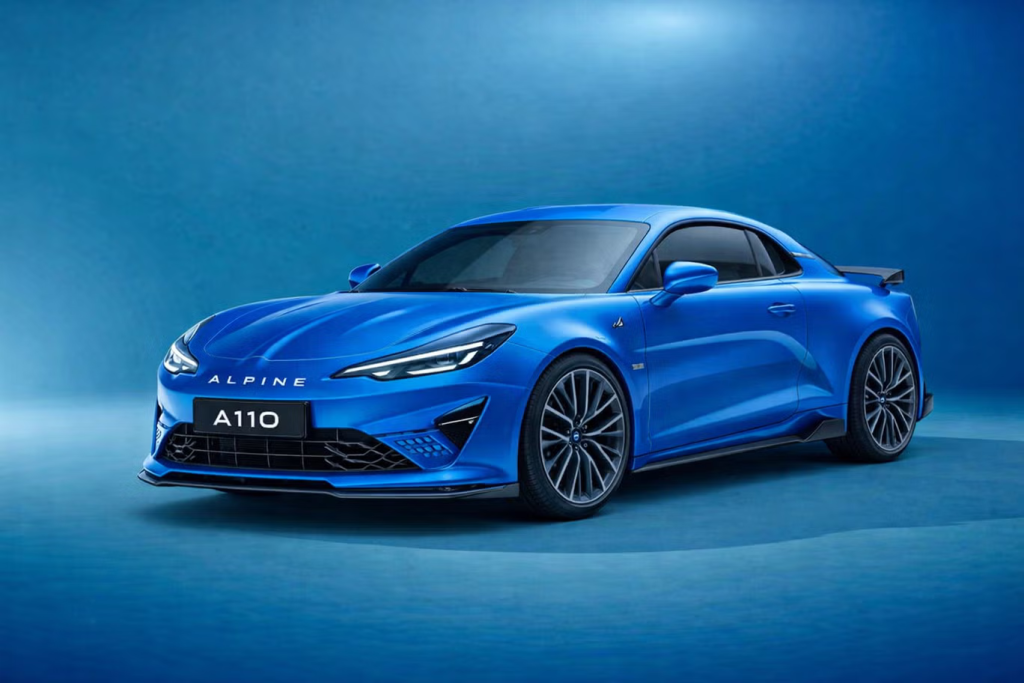
Krief's Q4 decision window
Speaking to Evo magazine at the Goodwood Festival of Speed, Krief framed the ICE fallback explicitly as an option, not an intention. "By Q4 2026, we will know. We will be ready to push the button on ICE. I don't know if we are going to push the button because we need to understand the second aspect, the markets. Because for us it's not like Porsche; this is not a de-risking plan. It's an opportunity. We're not afraid to fail in terms of the EV," he said. The admission that a petrol variant exists as a technical possibility is significant in itself — Alpine has engineered the choice into the platform rather than closing it off. But Krief's framing insists the brand's volume model is different. The A290 and A390 hatchback and crossover are adding new customers, he said, so the A110 can target a narrower, more committed sports-car buyer without needing mass-market EV take-up to justify the programme. That argument will face its first real test at customer deliveries, not at Goodwood.
Weight balance and the 20-minute rule
Krief specified one performance threshold that will appear in the A110's engineering brief: the battery must sustain at least 20 minutes of full-performance track driving before thermal or power limits intervene. That is a harder requirement than it sounds. A typical performance EV losing 15–20 percent of peak output after 8–10 minutes of hard laps would need roughly 2.0–2.5× the energy headroom to hit a 20-minute window — a calculation that pushes cell chemistry, cooling system design, and pack mass all simultaneously. The new Alpine Performance Platform (APP) uses two rear-mounted motors. A larger, three-motor derivative is planned for a model positioned against the Porsche 911, according to statements Krief made at Goodwood. That second car would sit above the A110 in the range. Alpine's current volume sits far below Porsche's roughly 320,000 annual units globally; the brand's own figures place its production closer to Ferrari's circa-14,000-unit scale, which means APP needs to serve multiple models to justify the development cost already sunk into the platform.
Porsche's retreat makes Alpine's bet sharper
The contrast with Porsche is the clearest context for reading Alpine's position. Porsche delayed its electric 718 programme after demand signals weakened, and mid-2025 reporting suggested the Zuffenhausen brand was considering cancelling the all-electric replacement for the Boxster and Cayman entirely. If that happens, as BMW moves toward a four-motor performance EV debut in 2027, the under-€100,000 pure-electric sports-car segment could be left with very few committed entrants. Alpine would be one of them. That gap is either an opening or a warning sign, depending on whether buyers show up. Kia, which has moved more EV volume than most European sports-car brands could imagine, publicly called the ZEV mandate pace unrealistic — Kia UK reached 100,000 EVs sold but still argued the regulatory timetable was too aggressive. Alpine does not operate at that volume, which insulates it from mandate pressure but also removes the data floor that a mass-market brand would use to calibrate risk.
What Alpine has not confirmed
Three things remain unspecified as of the Goodwood showing in July 2026. First, Alpine has not published a combined output figure for the twin-motor A110, so the performance claims rest on weight balance and platform engineering rather than a declared power number. Second, no range figure has been confirmed, which matters for a car being sold partly on track usability. Third, Krief referenced US market availability as a possibility — the outgoing A110 never received federal certification — but no timeline or homologation commitment was stated publicly. The platform's ability to accept a combustion engine also raises a question Alpine has not answered: whether the ICE variant, if activated, would share the same bodyshell and suspension geometry, or whether a petrol A110 would require a meaningfully different structural approach. Krief described APP as capable of accommodating a gas engine, but the engineering detail behind that claim has not been disclosed. What Alpine did not release at Goodwood: battery capacity, kerb weight targets, or a confirmed on-sale date beyond the 2026 window.
The A110 name has been in continuous production since 2017, when the reborn Alpine brand launched at the Geneva Motor Show. The original A110 Berlinette, built from 1961 to 1977, weighed as little as 620 kg in competition trim — a benchmark Krief's team is reportedly using as a reference point for the electric car's mass targets. Production of the current A110 has run at roughly 2,500–3,000 units per year across all variants. The complete Alpine model history and specifications are catalogued in the Global Auto Index manufacturer database.
