







Production at the Melfi plant starts Q4 2027, slotting the model between the Tonale and the next Stelvio.
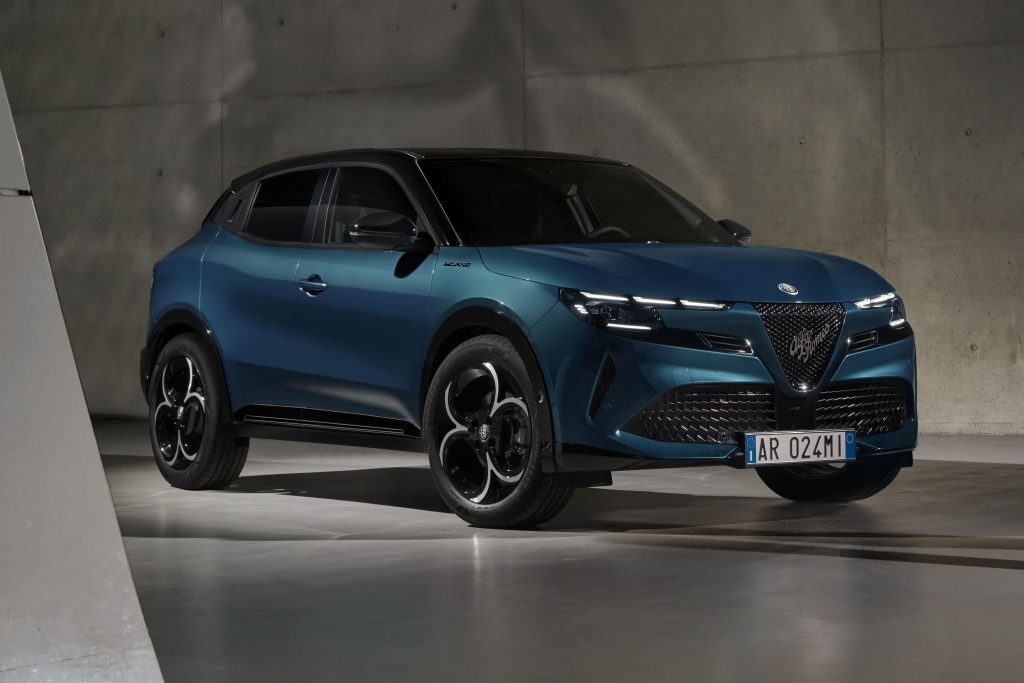
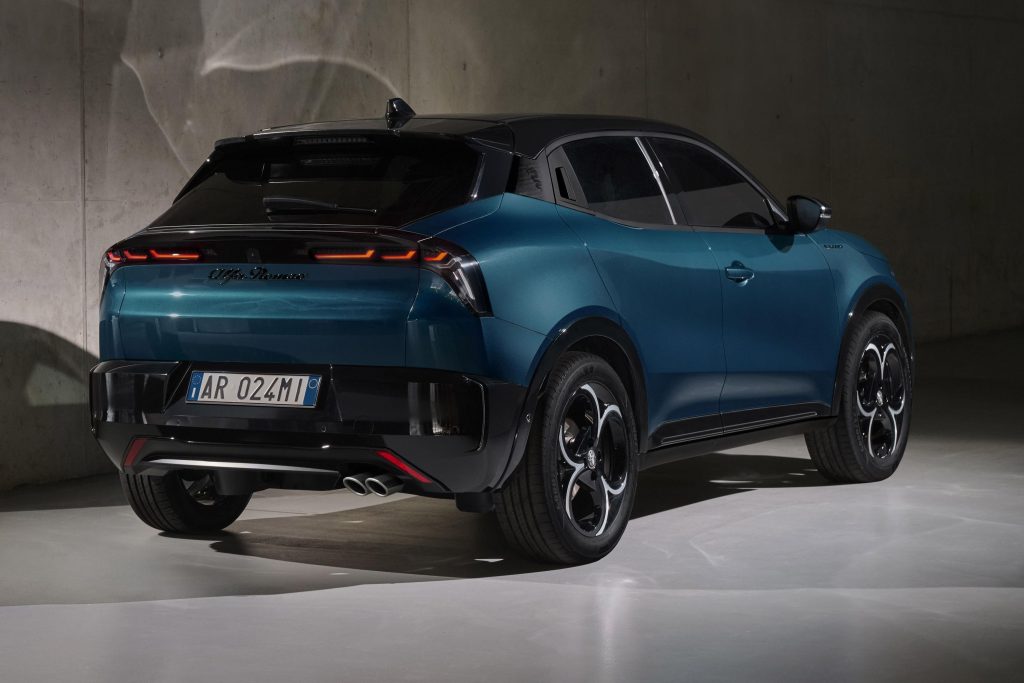
Alfa Romeo showed one image. Rear haunches, no badges, no name. Emanuele Cappellano, Chief Operating Officer of Stellantis, unveiled the teaser at Italy's National Automotive Industry Roundtable on July 14. A third SUV is coming. Not the Stelvio.
The unnamed C-SUV fills a gap that has been widening for years. Alfa currently sells the Tonale below 4.5 metres and the Stelvio above it, but nothing sits cleanly between them in European C-segment volume — where rivals including Volkswagen Tiguan and BMW X3 each cleared 100,000 European units in 2024, according to ACEA registration data published February 2025. The Stelvio replacement rides a different chassis entirely: STLA Large.
One Teaser Image, One Platform, One Plant
Cappellano stepped to the podium at the Ministry of Business and Made in Italy roundtable and released a single close-up photograph. It showed a sharply raked roofline meeting a sculpted rear quarter — enough to confirm a crossover silhouette, not enough to confirm dimensions or a name. Stellantis confirmed the car will ride the STLA Medium platform, the same architecture already carrying the Jeep Compass, Lancia Gamma, and Peugeot 3008. Production is assigned to Alfa's Melfi facility in Basilicata, southern Italy, scheduled to begin in Q4 2027. Alfa's design centre in Turin is leading the exterior work. This article sits within our coverage of OEM model launches tracked in the Global Auto Index, where platform assignments and plant allocations are recorded at announcement.
Where the Numbers Place This Car
The Tonale measures 4,528 mm in length. The current Stelvio sits at 4,687 mm — a gap of 159 mm. The new C-SUV, based on STLA Medium, will likely land somewhere between those two figures, probably in the 4,550–4,620 mm range, though Stellantis has not confirmed dimensions. STLA Medium supports a wheelbase of approximately 2,700–2,800 mm across existing derivatives. The Peugeot 3008 on the same platform uses a 2,738 mm wheelbase. Three powertrain variants are planned: mild hybrid, plug-in hybrid, and battery electric. Stellantis has not confirmed which combination reaches North America. If all three reach volume production, Alfa would carry six distinct powertrain configurations across its SUV range by 2028 — up from three today (mild hybrid Tonale, PHEV Tonale, Stelvio petrol). That is a doubling of powertrain complexity managed from a single Italian manufacturing site.
What Stellantis Actually Said
The only attributed statement released through Stellantis's official communications on July 14 described the model as featuring "multi-energy powertrains" — an eight-word phrase that does significant lifting given how little else was disclosed. The phrase appears verbatim in Stellantis's prepared remarks circulated to Italian trade press at the roundtable. It covers mild hybrid, plug-in hybrid, and full electric, without specifying whether all three launch simultaneously or roll out in sequence. For context, the Tonale PHEV — Alfa's most recent powertrain addition — took roughly 14 months from announcement to first customer deliveries in Europe, according to Alfa Romeo's own product timeline documentation. Whether the C-SUV follows a compressed or extended validation schedule ahead of Q4 2027 production has not been confirmed. Stellantis declined to provide a separate statement beyond the roundtable remarks.
The Stelvio Question Nobody Answered
Here is what was not confirmed on July 14: any update on the second-generation Stelvio. The existing Stelvio launched in 2016. By Q4 2027 — when the new C-SUV enters production — the current model will be eleven years old. Stellantis has stated it will ride STLA Large, but no production date, no plant assignment, and no powertrain configuration for the next Stelvio appeared at the roundtable. That silence is harder to read than the teaser itself. Meanwhile, Honda is navigating its own product gap in North America through 2027, suggesting compressed development windows are a broader industry condition right now — not an Alfa-specific problem. Still, announcing a third SUV before confirming the replacement for your flagship SUV is an unusual sequence. Whether that reflects platform readiness, capital allocation, or a deliberate sequencing of news is not something Stellantis addressed.
What This Means for Melfi and the Brand
The Melfi plant in Basilicata currently builds the Fiat Panda and has been the subject of ongoing discussions between Stellantis and the Italian government over production continuity. Assigning the new Alfa C-SUV to Melfi from Q4 2027 represents a concrete production commitment to a facility that has faced uncertainty. For Alfa Romeo as a brand, a third SUV — following the Junior (sub-4.2 metres) and Tonale — extends the volume end of the lineup rather than the performance end. McLaren's own SUV announcement earlier this year provoked similar questions about brand dilution versus revenue necessity. Alfa's challenge is different in scale but related in kind: it must justify a C-segment volume crossover to a buyer base that associates the brand with the Giulia and Stelvio. Both of those cars are confirmed to remain in production only until 2027, after which replacements have no announced on-sale date.
Alfa Romeo currently operates five models globally: Junior, Tonale, Giulia, Stelvio, and the limited-run 33 Stradale, of which just 33 units are being built at €1.5 million each. The unnamed C-SUV would bring the standard production range to six nameplates — the widest in the brand's modern era. The complete Alfa Romeo model history and specifications are catalogued in the Global Auto Index manufacturer database.
