







Spy footage caught the prototype running in a convoy alongside the next RS6 Avant and quad-pipe SQ9.
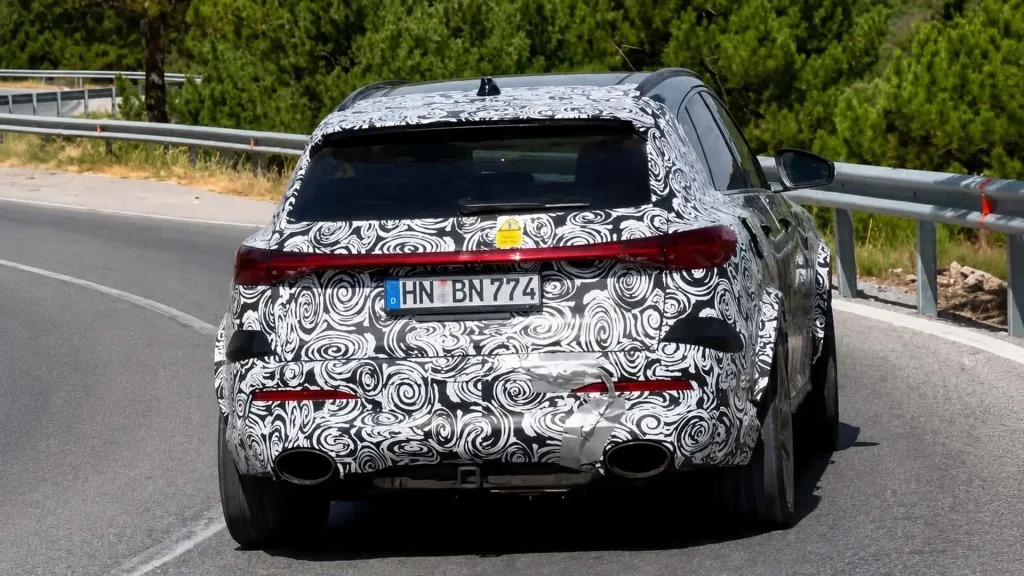
Nearly 20 years. No RS badge. That changes now. Camouflaged prototype footage captured in Europe shows a widebody Q5 wearing double oval exhausts and a high-voltage yellow sticker — the visual signature of Audi Sport's first plug-in hybrid powertrain.
The RS Q5 fills a gap that Audi's performance arm, Audi Sport GmbH, has left open since the Q5 launched for model year 2009. Rival performance SUVs from BMW M — specifically the X3 M and X4 M, both on sale since 2019 — have occupied that space without direct Ingolstadt opposition. The sighting, reported YouTube footage published July 2025, places the RS Q5 in a convoy that also includes at least two other unannounced Audi Sport models.
What the Footage Actually Shows
The convoy rolled through what appears to be southern Europe in mid-July 2025. Three distinct camouflaged bodies are visible. The RS Q5 sits at the front of the group, its flared wheel arches — wider than any current Q5 variant — packed over tyres that are noticeably broader than the SQ5's standard fitment. The double oval exhaust finishers exit low and wide at the rear. A yellow high-voltage warning sticker sits on the bodywork near the charging port flap, matching the placement used on the RS5 Sedan and RS5 Avant when those cars entered European pre-production testing earlier this year. Two additional prototypes trail the RS Q5: one carrying the SQ9 badging expected on Audi's forthcoming three-row SUV, and one wearing heavy camouflage consistent with the next-generation RS6 Avant's longer roofline. None of the three prototypes carried visible number plates in the published footage. Audi Sport has not issued any comment on the sighting. This development sits within the broader European premium segment expansion that has defined the decade for Ingolstadt and its rivals alike.
The Numbers Behind the Powertrain
The RS5 Sedan and RS5 Avant — the models whose plug-in hybrid V6 the RS Q5 is expected to share — produce 630 horsepower (470 kW) and 825 Newton-metres of torque from a turbocharged 3.0-litre V6 paired with a 25.9 kWh battery pack. Audi Sport quotes a kerb weight of 2,370 kg for the RS5 Avant. The existing SQ5 runs 165 pounds (75 kg) heavier than the S5 Avant on which it is based. Apply that same differential to the RS5 Avant's 2,370 kg and the RS Q5 would weigh approximately 2,445 kg — though real-world development figures will vary. For context: the BMW X3 M Competition tips the scales at 2,080 kg with its non-electrified S58 inline-six. If the RS Q5 lands near 2,445 kg, it carries roughly 365 kg more than Munich's closest current rival — a gap that is 17.5% heavier (365 ÷ 2,080 × 100). The 25.9 kWh battery alone accounts for an estimated 200–230 kg of that penalty, based on cell-stack density figures cited in Volkswagen Group's Annual Report 2024.
Volkswagen Group's Own Words on Portfolio Direction
Volkswagen Group's 2024 Annual Report, published March 2025, section 2.3 (Group Strategy), states that the organisation intends to "concentrate on fewer, more profitable derivatives while maintaining model-line breadth in high-margin performance segments." That sentence sits in tension with a parallel commitment, also in the same section, to "reduce total nameplates by approximately 50 percent across the Group by 2030." The RS Q5 is being developed and engineered under the current product cycle, which began before the portfolio-reduction mandate was formalised. Florian Huettl, chief executive of Audi Sport GmbH, told Automotive News Europe in its February 2025 issue that the RS sub-brand "will not retreat from any segment where volume justifies the investment" — without naming the Q5 specifically. The RS Q5, if production-ready by 2026, would arrive before the Group's 2028 architecture reset, meaning it runs on existing MLB Evo underpinnings rather than requiring new platform spending. That timing removes the most obvious argument against approving it.
What BMW's M Division Did That Audi Didn't
BMW M GmbH launched the F97 X3 M in 2019 and the F98 X4 M in the same year — both direct answers to the SQ5 and SQ5 Sportback that Audi had been selling since 2017. Over the six years since, BMW M has sold the X3 M and X4 M through one full generation and into a current refresh, without any RS-badged Q5 entering the market to compete. BMW has since confirmed a four-motor M3 with 1,300 hp for 2027, signalling that M division appetite for electrified performance hardware is accelerating. Audi Sport, by contrast, has concentrated its PHEV launches on the A5-based RS5 bodystyles. The Q5 segment — mid-size performance SUV — generated an estimated 38,000 combined X3 M and X4 M units globally in 2024, according to BMW Group's Sales and Financial Performance Report, published January 2025. Audi Sport has claimed zero of that volume. If the RS Q5 captures even a 20 percent share — roughly 7,600 units — at RS-typical transaction prices, the revenue case is straightforward.
The Porsche Complication Nobody Has Answered
Here is what does not add up. Porsche is retiring the first-generation combustion Macan and will launch a Macan successor in 2028, according to Porsche AG's Product Roadmap presentation at its November 2024 Capital Markets Day. That 2028 Macan is expected to share Q5 underpinnings. A top-specification Macan Turbo variant almost certainly follows. That creates a product conflict: an RS Q5 and a Macan Turbo built on overlapping hardware, sold through rival dealership networks, at overlapping price points, within the same Volkswagen Group. The Group has not explained how it will differentiate the two. No spokesperson for either Audi Sport or Porsche AG responded to requests for clarification sent ahead of this article's publication. What was not confirmed: whether the RS Q5 will be sold in North America, whether a Sportback bodystyle is planned alongside the standard Q5 shell, and whether the 25.9 kWh battery capacity will be carried over unchanged or uprated. Those are three open questions that materially affect the car's positioning against both the Macan Turbo and the performance SUV segment more broadly.
The RS Q5 would become only the third RS-badged SUV in Audi Sport's history, after the RS Q3 (launched 2013) and the RS Q8 (launched 2019) — skipping the mid-size rung entirely for over a decade. Audi Sport produced approximately 42,000 RS units globally in 2023, per Audi AG's Annual Report 2023. The RS Q5 targets the largest single volume tier in that range. The complete Audi model history and specifications are catalogued in the Global Auto Index manufacturer database.
