


A 1.67 kWh buffer battery and two electric motors mean the Rogue never plugs in — yet drives on electricity full-time.
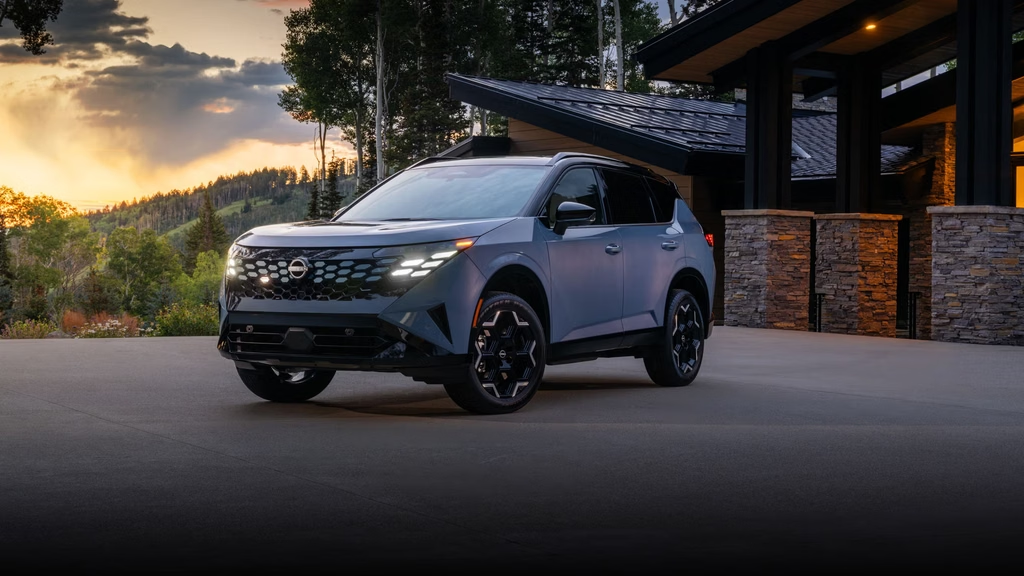
Nissan confirmed the 2027 Rogue Hybrid on 21 September. It starts at $37,065. The crossover uses a turbocharged 1.5-litre three-cylinder engine — but that engine never drives the wheels. It charges a battery. Two electric motors do the rest.
The powertrain matters because no Nissan sold in the United States has ever used e-Power before. The system is a series hybrid — the combustion engine works purely as a generator, which puts the Rogue closer to a range-extended EV than to a Toyota RAV4 Hybrid or Honda CR-V Hybrid, both of which allow their engines to drive the wheels mechanically. According to Nissan's official press release, dated September 2026, the combined rating is 38 MPG.
How E-Power Reached the US Market
Nissan developed e-Power for Japan more than a decade ago, first fitting it to the Note in 2016. It skipped the United States entirely during that run. Then, less than twelve months before this announcement, Nissan launched a plug-in hybrid Rogue that leaned on Mitsubishi Outlander PHEV hardware — a stopgap, by any reading. That model is now being superseded. Nissan's product team chose to enter the fall 2026 sales window with the SR AWD trim carrying the SR Tech Package first, priced at $43,065. The remaining four trim levels follow in early 2027. The sequencing is deliberate: Nissan gets showroom visibility before year-end while buying time to ramp full-range production. This article sits within a broader wave of OEM model launches tracked across the 2020s as electrified crossovers crowd what was once naturally-aspirated territory. For context on how a direct rival is timing its own refresh, see the situation at Honda, which faces a North America product gap until the 2027 CR-V redesign.
The Numbers Behind the Powertrain Claim
Nissan quotes 38 MPG combined, split as 40 MPG city and 36 MPG highway — unusual in that city efficiency beats the highway figure, a pattern that favours stop-start electric drive. The three-cylinder charges a 1.67 kWh lithium-ion battery. At 38 MPG combined, a driver covering 15,000 miles per year would consume roughly 395 gallons annually. At the US average pump price of $3.30 per gallon (AAA national average, September 2026), that is approximately $1,303 per year in fuel — calculated as 15,000 ÷ 38 × $3.30. Combined system output is 225 horsepower. The entry trim, the SV AWD, opens at $37,065 including the $1,575 destination charge; subtract that charge and the base transaction price is $35,490. The range spans $8,000 from SV to Platinum — $37,065 to $45,065 — across five configurations. Cargo volume is 31.1 cubic feet with rear seats up, expanding to 65.9 cubic feet folded.
Series Hybrid vs. Parallel: What the Architecture Actually Changes
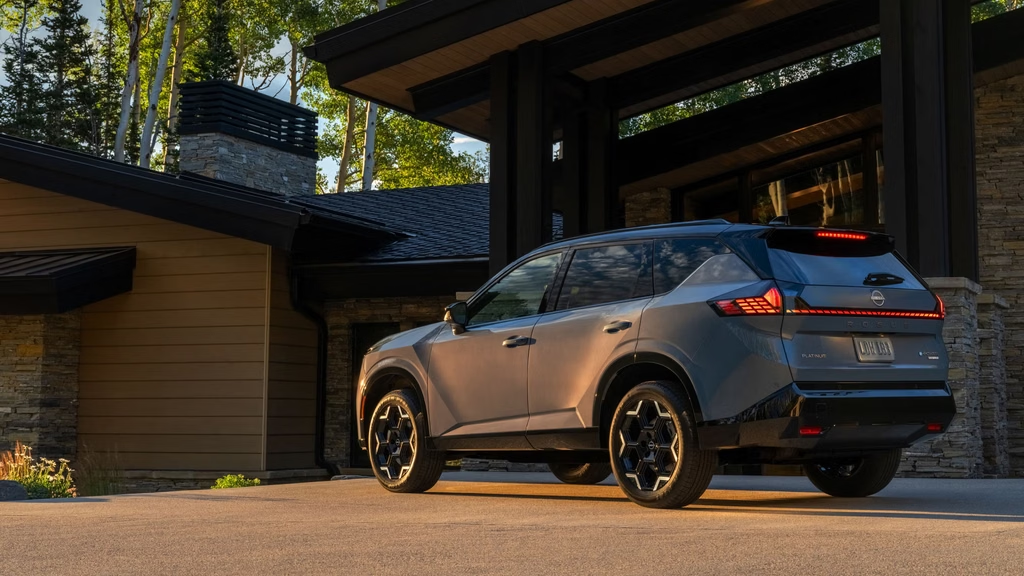
In a conventional parallel hybrid — the type found in the Toyota RAV4 Hybrid — the petrol engine can engage the driven axle directly at speed, cutting in to supplement electric output. The Rogue's e-Power system removes that mechanical link entirely. The 1.5-litre engine runs only to replenish the 1.67 kWh buffer. Drivers always feel electric motor response, regardless of charge state. The tradeoff is efficiency at sustained highway speeds: series systems can be less economical on long motorway runs because the engine must convert fuel to electricity before the motors convert electricity to motion, adding a conversion loss at each step. That may explain why Nissan's highway figure of 36 MPG sits two points below city. The RAV4 Hybrid, by comparison, is EPA-rated at 39 MPG combined in its front-wheel-drive variant — one point ahead of the Rogue's 38. Whether that gap closes in real-world mixed driving, where e-Power's city strength is weighted more heavily, remains to be tested independently.
The Battery Is Smaller Than Most Phone Chargers Carry
The detail that stops analysts short is the 1.67 kWh battery capacity. For reference, the entry-level Mitsubishi Outlander PHEV — the platform that underpinned Nissan's own interim plug-in Rogue — carries an 20 kWh pack. The e-Power buffer is not designed for plug-in range; it is sized purely to smooth generator output and absorb regenerative braking energy. Nissan has not published the cell chemistry, the thermal management specification, or the warranty terms for this battery as of the September 2026 announcement. Those omissions matter: a small, hard-cycled buffer pack that charges and discharges many times per trip operates under different stress conditions than a large PHEV cell used for range. Long-term durability data does not yet exist for this application in US climate conditions. Nissan also did not confirm whether the non-hybrid 2027 Rogue — expected to arrive later in 2027 at a price near the current $31,035 — will share the same body shell or carry different structural reinforcements. The $6,030 gap between the two entry points is real money. US tariff pressure on imported components could affect that spread before the non-hybrid trim is priced formally.
What the Launch Means for Nissan's US Sales Position
The Rogue has been Nissan's top-selling vehicle in the United States for most of the past decade. Adding a hybrid variant without a plug-in obligation addresses the single most-cited purchase objection from crossover shoppers who want better fuel economy but cannot or will not install home charging equipment. Marcus Hetet, Nissan North America's vice president of product planning, said in the September 2026 product briefing that e-Power was chosen specifically because it requires no change in refuelling behaviour — a direct response to range-anxiety data Nissan collected from US focus groups. The fall 2026 on-sale date for the SR Tech trim puts the Rogue Hybrid in showrooms before the holiday sales period, competing directly with the Ford Escape Hybrid and the Hyundai Tucson Hybrid, both of which have been on sale long enough to carry certified pre-owned inventory alongside new stock. Nissan enters with no such used-market cushion. If the e-Power warranty terms prove restrictive — and they have not yet been published — that asymmetry will show up in residual values within 24 months. For a parallel read on how an electrified model's sales volumes can outpace the infrastructure surrounding them, the Kia UK experience with 100,000 EVs sold against a ZEV mandate it calls unrealistic is instructive.
Nissan has not confirmed a European e-Power Rogue launch date, though the Nissan Kicks e-Power was confirmed for the UK with domestic production as recently as August 2026. The Japanese domestic Rogue equivalent, the X-Trail e-Power, has been on sale since 2022 and carries a larger 2.1 kWh buffer pack — 0.43 kWh more than the US Rogue's unit. That difference has not been explained. The complete Nissan model history and specifications are catalogued in the Global Auto Index manufacturer database.
