







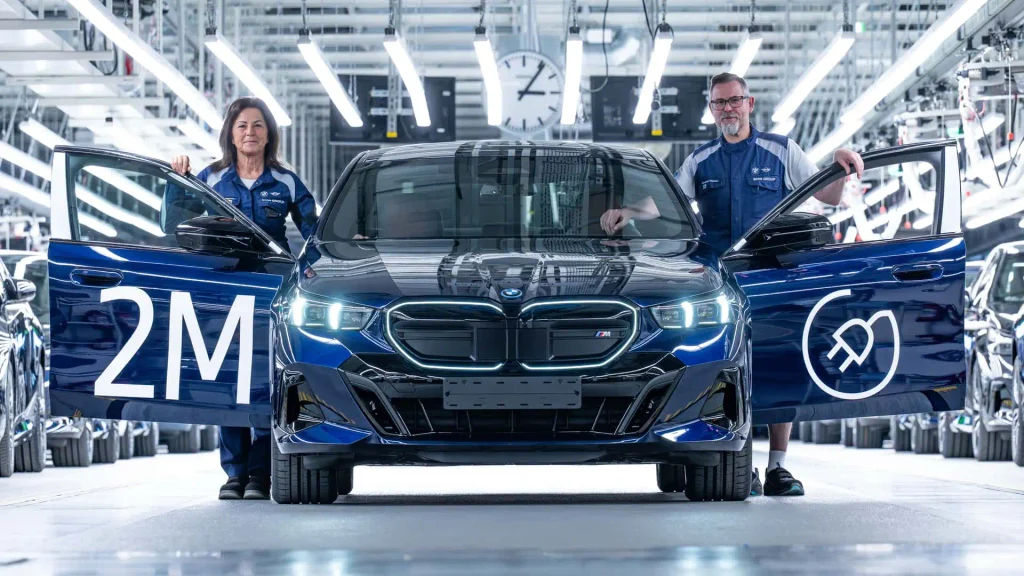
A Dingolfing-built i5 M60 xDrive hit the milestone in early May 2026, roughly 30 months after the first million.
Two million. BMW crossed that threshold quietly in early May 2026. The car was an i5 M60 xDrive assembled at Plant Dingolfing. Europe absorbed most of the growth. China and the US did not keep pace.
The gap between BMW's European performance and its two largest non-European markets is widening in ways that complicate the brand's stated target of 50 percent EV sales globally by 2030. In H1 2026, Europe's battery-electric share of BMW regional sales reached 28 percent, according to BMW AG's H1 2026 sales release, published August 2026 — a figure that dwarfs the trajectory in China and the US, where volume has either softened or been delayed .
From One Million to Two: How BMW Got Here
BMW crossed the one-million all-electric vehicle mark in late 2023. Adding the second million took roughly 30 months — a faster pace than the first, but still dependent almost entirely on European appetite. Plant Dingolfing produced the milestone car, a white i5 M60 xDrive, in early May 2026. BMW Group Plant Munich then started series production of the new i3 sedan on the Neue Klasse platform in August 2026. That Munich plant is scheduled for conversion to Neue Klasse-only output around 2027. The production sequence matters: every Neue Klasse model that enters volume builds the base for BMW's EV targets over the next four years. Jochen Goller, member of BMW AG's Board of Management responsible for Customer, Brands and Sales, stated in BMW's official milestone announcement that the figure "underlines how BMW and Mini models are winning over customers worldwide." The total electrified count — including plug-in hybrids — now exceeds 4.0 million units since the original i3 launched in late 2013. For coverage of BMW's performance EV direction alongside this growth, see the BMW performance and EV transition cluster.
Europe's 28% BEV Share Carries the Numbers
BMW's European battery-electric deliveries in H1 2026 reached 81,445 units, a 38 percent year-on-year increase. At 28 percent BEV share of total European BMW sales, that means total European BMW deliveries in the period ran at approximately 290,875 units (81,445 ÷ 0.28 = 290,875). The iX3 alone accounted for one-third of all European BEV orders placed with BMW in H1 2026 — roughly 27,148 cars at that order rate — and represented half of all X3 orders across powertrain types. One in four BMWs sold worldwide in the same period carried electrified hardware, counting plug-in hybrids. EU-wide EV sales rose approximately 40 percent in the same window, driven by elevated fuel prices and a wider spread of lower-priced models, according to Reuters reporting on European EV market data from June 2026. BMW's European BEV growth at 38 percent tracked that wave closely without clearly outrunning it, which raises questions about how much is brand pull versus market tailwind.
China Pre-Sales, US Discontinuations: The Other Side
China tells a different story. BMW opened pre-sales of a long-wheelbase Neue Klasse iX3 built specifically for the Chinese market, with first deliveries pencilled in for November 2026 and meaningful volume not expected until 2027. That is a 12-to-18-month lag behind European iX3 availability. In the US, the picture is starker. BMW discontinued the iX SUV in the American market, removing a model that had been the brand's flagship battery-electric entry in the region. Electrified US sales softened even as BMW's overall American volume climbed. Compare that with Europe: 38 percent BEV growth against a market backdrop of surging pump prices and expanding model choice. The US and China together represent BMW's two largest single-country sales markets. Carrying a 28 percent European BEV share while those two markets lag structurally puts severe pressure on how Neue Klasse production ramps at Spartanburg, South Carolina, and San Luis Potosí, Mexico — both of which need to reach volume before 2028 to keep the 50 percent global EV target credible. The tariff environment complicates Spartanburg's maths further; see how US truck tariffs and European IVA tightening are reshaping North American and European sales calculations.
What BMW Has Not Said About Its 2030 Target
BMW has not published a revised regional breakdown of how it expects to reach 50 percent EV sales by 2030. The H1 2026 sales release, published August 2026, confirmed the global electrified share at roughly one-in-four vehicles but did not specify what share the company requires from China or the US individually to hit the 2030 number. That absence is worth noting. If Europe sits at 28 percent BEV share midway through 2026 and the US and China are materially below that, the blended global figure needed by 2030 requires one of three things: European share accelerates further above 50 percent before 2030; China's Neue Klasse ramp from late 2026 produces outsized volume growth; or the US gap closes after Spartanburg conversion. BMW has confirmed none of those trajectories with production forecasts or delivery targets broken out by region. Kia, facing a different but related problem with ZEV mandate pace in its largest European market, has publicly called the mandate timeline "unrealistic" — a label BMW has so far avoided attaching to any jurisdiction. The Kia situation is documented in Kia UK's 100,000-EV milestone report.
Neue Klasse Scaling Is Now BMW's Single Binding Constraint
The production calendar for Neue Klasse determines almost everything else. Plant Munich entered series production of the new i3 in August 2026. Plant Dingolfing already builds the i5 and feeds European demand. Spartanburg and San Luis Potosí need to convert to handle North American and Latin American volume. The sequencing problem is that China's November 2026 delivery start for the long-wheelbase iX3 requires parallel ramp-up in Chinese manufacturing while European plants are still scaling. BMW has not disclosed which plant produces the China-spec long-wheelbase variant, nor what annual capacity ceiling applies in year one. For BMW's confirmed four-motor M3 with 1,300 hp, the Neue Klasse platform feeds performance derivatives in 2027 as well — adding another production variable to an already congested schedule. Goller's statement that customers worldwide are "winning over" to BMW EVs is accurate for Europe. Whether it holds for Spartanburg-assembled Neue Klasse vehicles by 2027 depends on a manufacturing ramp BMW has not yet fully detailed in public filings.
BMW's original i3 city car, which launched in November 2013 with a 22.6 kWh battery and a range-extender option, started a production run that ended in July 2022 after 250,000 units built at Plant Leipzig. The new i3 sedan on the Neue Klasse platform shares only the name. The complete BMW model history and specifications are catalogued in the Global Auto Index manufacturer database.
