







An SUV derivative with three-row seating is under consideration alongside the plug-in hybrid pickup.
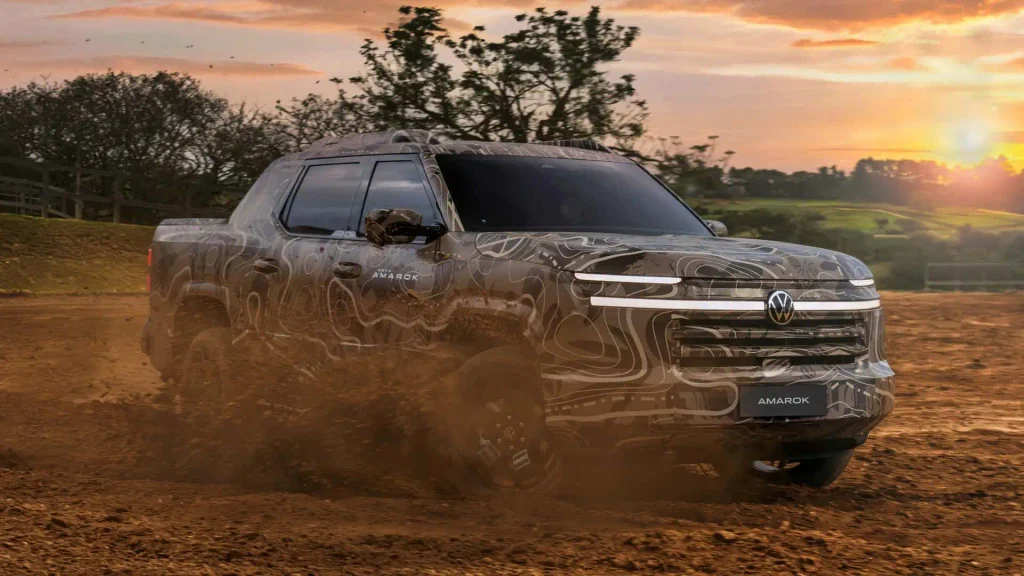
Barretos, August 2026. Volkswagen pulled a camouflaged prototype into the arena at Brazil's Festa do Peão rodeo and said almost nothing about it. That was deliberate. What the brand did confirm: 2027 launch, Argentina production, and the highest power output the Amarok nameplate has ever carried.
The reveal matters because it exposes a structural shift in how Volkswagen builds trucks outside Europe. The new Amarok will share architecture with the SAIC Maxus Interstellar X — a Chinese-developed platform — rather than the Ford Ranger ladder frame underpinning the current global Amarok. According to VW South America's statement released at Barretos, August 2026, this generation will be manufactured at the General Pacheco plant in Argentina, the same facility that has produced the Amarok since 2010.
Rodeo Arena, Prototype Wrap, No Engine Numbers
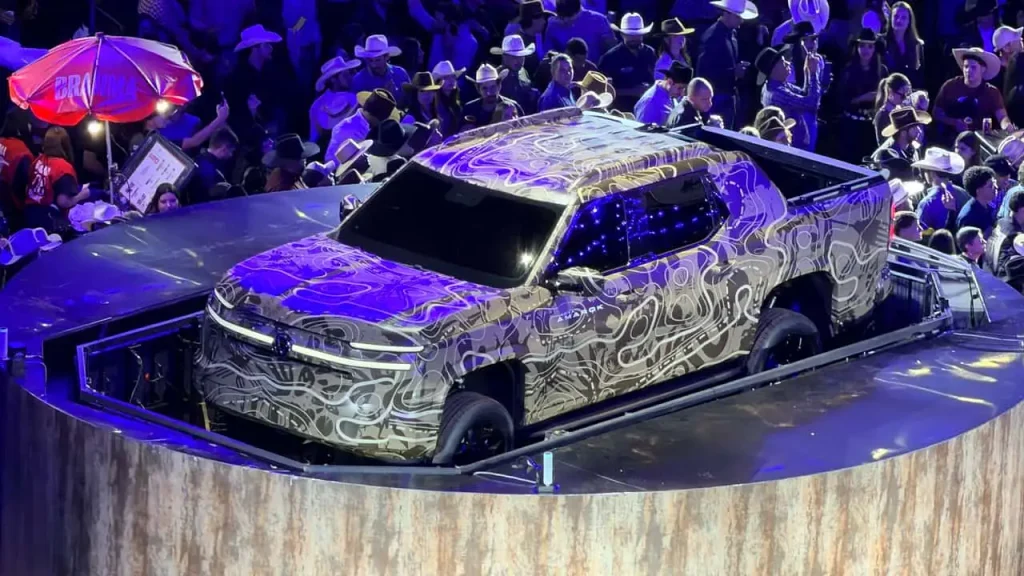
Volkswagen chose the opening night of the 2026 Festa do Peão de Barretos to put both its new Tukan compact pickup and the camouflaged Amarok prototype in front of an audience dominated by agribusiness operators — the single largest pickup-buying cohort in Brazil. The Tukan was shown first, in Robust and Extreme body configurations. The Amarok followed. VW's South American design, engineering, and validation teams took formal credit for the project in the official statement. The brand said nothing about battery capacity, electric range, or which transmission the production truck will use. Alexander Seitz, executive chairman of VW South America, had already drawn the performance comparison at an earlier press briefing in Lima, Peru: he said the new Amarok would accelerate on par with a Porsche Panamera. That remark has circulated without a published correction. This article belongs to the broader context of Volkswagen Group's global production and platform decisions across its truck and utility lineup.
800 Nm, 464 hp, and a 7.9-Inch Wheelbase Gap
The numbers VW has not denied are the ones doing the most work. The flagship variant will be called the Amarok 800 TSI — the suffix denoting 800 Nm of combined plug-in hybrid torque, equivalent to 590 lb-ft. Output is expected to exceed 464 hp, with a 0–100 km/h sprint projected at under five seconds. Compare that with the outgoing Amarok Extreme: 3.0-litre V6 turbodiesel, 254 hp, 580 Nm (427 lb-ft), eight-speed automatic. The power delta is 210 hp — an 83 percent increase over the current peak variant. Size grows too. The SAIC Maxus Interstellar X, which shares the platform, measures 216.5 inches long with a 129.9-inch wheelbase. The current Amarok is 210.6 inches long on a 122.0-inch wheelbase. Wheelbase difference: 129.9 − 122.0 = 7.9 inches. That additional length is what makes a three-row SUV derivative plausible on the same architecture without a full platform redesign.
The SAIC Connection VW Didn't Announce
The Barretos statement released by Volkswagen South America in August 2026 contains no mention of SAIC, the Maxus Interstellar X, or China. It references, instead, the involvement of VW's South American engineering and validation operations. The omission is conspicuous. Motor1 Brazil reporting, attributed to journalist Fábio Trindade across multiple dispatches published between early and mid-2026, identified the Interstellar X as the base architecture and published spy photographs showing near-identical body proportions, headlight clusters, door profiles, and bumper geometry between the two trucks. VW and SAIC have operated a joint venture in China since the 1980s, one of the longest-running foreign partnerships in the Chinese market. That relationship now extends to platform licensing for South American production — a different commercial arrangement from the Chinese JV but drawing on the same industrial ties. Where VW has pledged to differentiate: suspension tuning, steering calibration, electronic system mapping, and exterior design elements specific to South American road and load conditions.
Two Amaroks, One Name, Different DNA
There is now a structural oddity inside the Amarok lineup. The model sold in Europe, Australia, and South Africa uses a Ford Ranger platform under a VW body — a cost-share arrangement confirmed when that generation launched in 2022. The model arriving in South America in 2027 uses a SAIC-derived architecture built in Argentina. Both will carry the Amarok badge simultaneously. VW has not published a document explaining how it intends to manage overlap in markets where both trucks could theoretically be sold, nor has it clarified whether the 800 TSI powertrain will eventually migrate to the Ford-based variant. The 25 percent U.S. truck tariff now in effect adds a further complication: any plan to export the Argentina-built, SAIC-architecture Amarok into North America would face immediate cost exposure that the Ford-based truck, assembled in South Africa, would not. VW has not addressed North American sales for either variant.
SUV Derivative and What the Wheelbase Makes Possible
The 129.9-inch wheelbase on the Interstellar X platform gives VW's South American product team room to engineer a body-on-frame SUV without stretching the architecture. Three-row seating typically requires a wheelbase north of 114 inches; the Amarok's new foundation clears that threshold by more than 15 inches. VW South America has not confirmed the SUV project, but has declined to deny it — a pattern recognisable from the pre-reveal period of the Tukan, which went unconfirmed until the Barretos event itself. If the derivative proceeds, it would put VW directly against the Toyota SW4, Ford Everest, and Chevrolet Trailblazer in Brazil, a segment that shifted roughly 60,000 units in 2025 according to Brazil's ANFAVEA vehicle registration data, full-year report, published January 2026. It would also extend the SAIC architecture's return on investment across two nameplate lines rather than one — a commercial logic that benefits the General Pacheco plant's utilisation rate. For context on how other brands are managing SUV-adjacent product extensions, McLaren's own SUV plans, revealed summer 2025, illustrate how diverse the segment's appeal has become across price points.
The General Pacheco plant in Argentina has produced every Amarok built for Latin American markets since the nameplate's 2010 debut — more than 250,000 trucks across sixteen model years, according to VW Argentina production records cited in the company's 2024 annual report. The 2027 model will be the first there to carry a hybrid system. Production of the Ford-based Amarok for global markets continues at Silverton Assembly, Pretoria. The complete Volkswagen model history and specifications are catalogued in the Global Auto Index manufacturer database.
