







The ground-up kei EV targets 97 Wh/km efficiency and weighs just 1,030 kilograms at prototype stage.
Suzuki has confirmed the e Sky for Japanese sale this autumn. It is a purpose-built electric kei car. Not a conversion. The brand chose a 26-kWh lithium-iron-phosphate cell pack deliberately — small battery, low weight, maximum usable range from minimum capacity.
Japan's kei-car segment is electrifying faster than most observers expected. The Nissan Sakura debuted at roughly ¥2.3 million in 2022; the Mitsubishi eK X Electric followed within months. Suzuki sat out that opening round. Three years on, the e Sky arrives as the third major domestic-brand entrant, according to Suzuki's product announcement published August 2025. BYD's Racco, meanwhile, signals that Chinese competition for this sub-segment has already arrived.
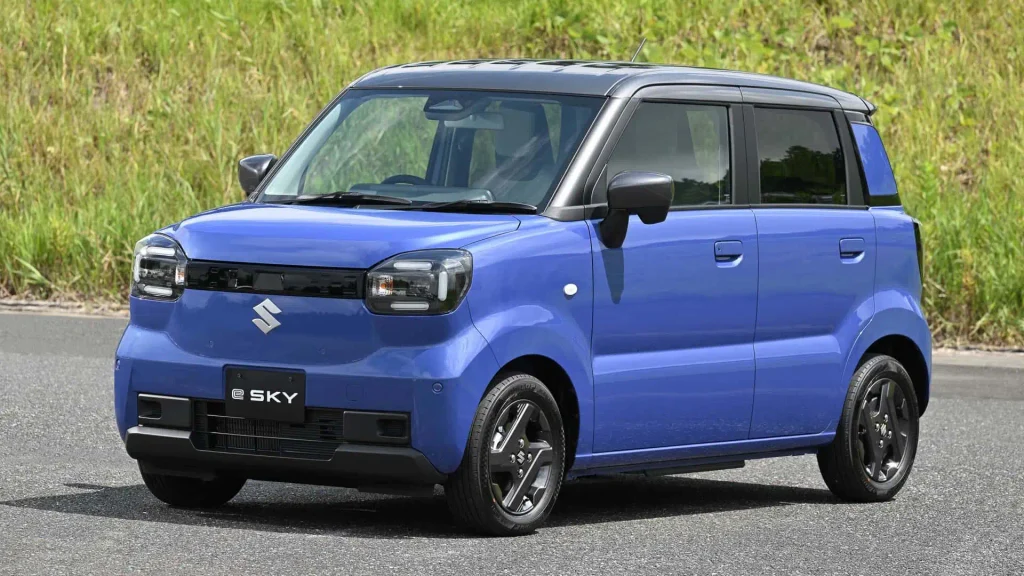
Ground-Up Architecture, Not a Conversion
Suzuki's engineering team started the e Sky from a blank sheet rather than adapting an existing petrol platform — a distinction the company stressed in its August 2025 product briefing. The body measures 3,395 mm long, 1,475 mm wide, and 1,625 mm tall, keeping it inside Japan's kei-class dimensional ceiling. The 2,460 mm wheelbase sits at the generous end for the segment. Drive goes to the front wheels only; Suzuki has not announced an all-wheel-drive variant. The cabin pairs a digital instrument cluster with a 10.1-inch touchscreen. Physical switchgear remains for the climate controls. A heated steering wheel, electronic parking brake, and a two-level centre console all feature, with the front-passenger dashboard section shaped as an open tray carrying a built-in cup holder. Colour and trim options have not been disclosed. Full pricing will follow closer to the on-sale date. Explore the broader Suzuki model portfolio in Japan for context on how the brand has historically approached small-car architecture.
Battery, Range, and Charging: The Numbers
The LFP pack carries 26 kWh of capacity. Suzuki quotes 97 Wh/km energy consumption — a prototype figure, not a certified result. Working through the arithmetic: 26,000 Wh ÷ 97 Wh/km = 268 km on a pure calculation basis. Suzuki lists 310 km, which implies either a more favourable real-world duty cycle or a correction for usable-versus-total capacity. Either way, the gap between the two numbers — 42 km — is worth watching when certified JC08 or WLTC figures arrive. DC fast charging tops out at 50 kW, covering 0 to 80 percent in approximately 25 minutes. AC charging runs at 3 kW for a full eight-hour overnight cycle, or 6 kW for four-and-a-half hours. Bidirectional charging is included, enabling vehicle-to-home use. Kerb weight stands at 1,030 kg in prototype form. That is 89 kg lighter than the Nissan Sakura's 1,119 kg production figure, according to Nissan's published specification sheet, October 2022.
Where the e Sky Sits Against Its Rivals
The Nissan Sakura launched in Japan at ¥2.33 million for the base grade in May 2022, carrying a 20 kWh battery and a 180 km WLTC range. The Mitsubishi eK X Electric followed at ¥2.75 million with the same 20 kWh pack. Suzuki's e Sky arrives with 26 kWh — 30 percent more capacity than both predecessors — while staying 89 kg lighter than the Sakura. That weight figure matters in kei-class EVs because Japanese road-tax and insurance bands respond to vehicle weight. The e Sky's 4.4-metre turning circle matches or beats most rivals in cramped urban environments. On charging speed, 50 kW DC is the same ceiling the Sakura offers, so no advantage there. Range is where Suzuki makes its clearest bid: 310 km prototype target versus the Sakura's certified 180 km — a 72 percent uplift on a battery only 6 kWh larger. Whether the production car holds that margin after certification is the open question. The wider shift toward EV mandate pressure in markets outside Japan has not yet touched kei-class regulation directly, but the domestic momentum is clear.
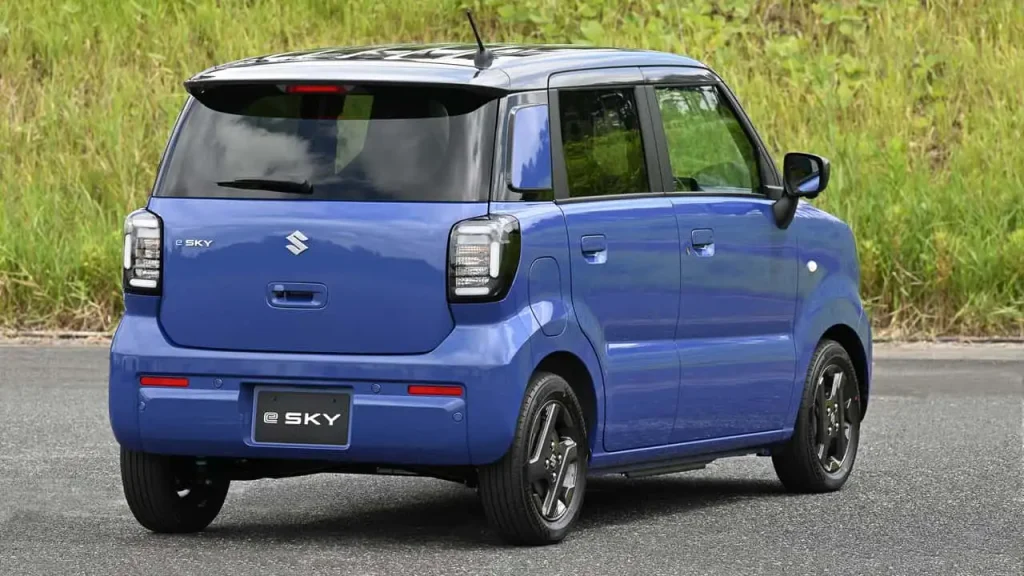
A 310 km Claim That Needs Scrutiny
Suzuki's published efficiency figure of 97 Wh/km is unusually low for a battery-electric vehicle, even a lightweight one. For reference, the Nissan Sakura achieves roughly 111 Wh/km on the WLTC cycle, according to Japan's Ministry of Land, Infrastructure, Transport and Tourism fuel-economy database, fiscal year 2023 edition. If the e Sky genuinely records 97 Wh/km under the same test protocol, it would be among the most efficient production EVs in any class globally — a claim that warrants independent verification. Suzuki has not confirmed which test cycle produced the 97 Wh/km figure, nor whether the 310 km range is calculated, simulated, or derived from a pre-certification drive cycle. The company labels all figures as prototype values. That caveat is standard at this stage, but the gap between the raw-division result (268 km) and the stated 310 km figure — noted above — suggests the efficiency number and the range number may not share a common methodology. No third-party test data exists yet. Certification results, expected before the autumn launch, will resolve this.
What the e Sky Means for Suzuki's Domestic Position
Suzuki held roughly 30 percent of Japan's kei-car market in fiscal year 2023, according to the Japan Mini Vehicles Association's annual report, published April 2024 — the largest share of any single manufacturer. Arriving without an electric kei option while Nissan and Mitsubishi sold their joint-platform EV since 2022 created a visible gap. The e Sky closes it. More pressingly, BYD's Racco targets the same segment from outside the kei-class dimensional rules, competing on price rather than regulatory category. Takanori Suzuki, General Manager of EV Development at Suzuki Motor Corporation, stated in the August 2025 briefing that the e Sky was developed to serve customers who prioritise total ownership cost over headline range figures — framing the 26 kWh pack as a deliberate cost-control decision rather than a technical limitation. If the on-sale price lands below ¥2.5 million, Suzuki would undercut the eK X Electric by at least ¥250,000. Full pricing has not been confirmed. The company's autumn launch window gives it roughly one quarter to establish volume before the fiscal year-end buying spike in Japan's March registration data. The broader dynamic around small-segment trade exposure is tracked in our coverage of tariff and trade shifts affecting compact vehicle categories.
Suzuki showed the e Sky Vision concept at the 2025 Japan Mobility Show before the production reveal. The production car retains the concept's exterior proportions without visible alteration — rare for a show-to-street transition. Japan's kei-car segment registered 1.97 million units in calendar year 2023, according to the Japan Automobile Manufacturers Association's market report, February 2024. Electric variants accounted for fewer than 5 percent of that total. Autumn 2025 is the target. The complete Suzuki model history and specifications are catalogued in the Global Auto Index manufacturer database.
