
The Irvine-based brand retires the Revero nameplate and opens configurator orders ahead of a December U.S. dealer launch.
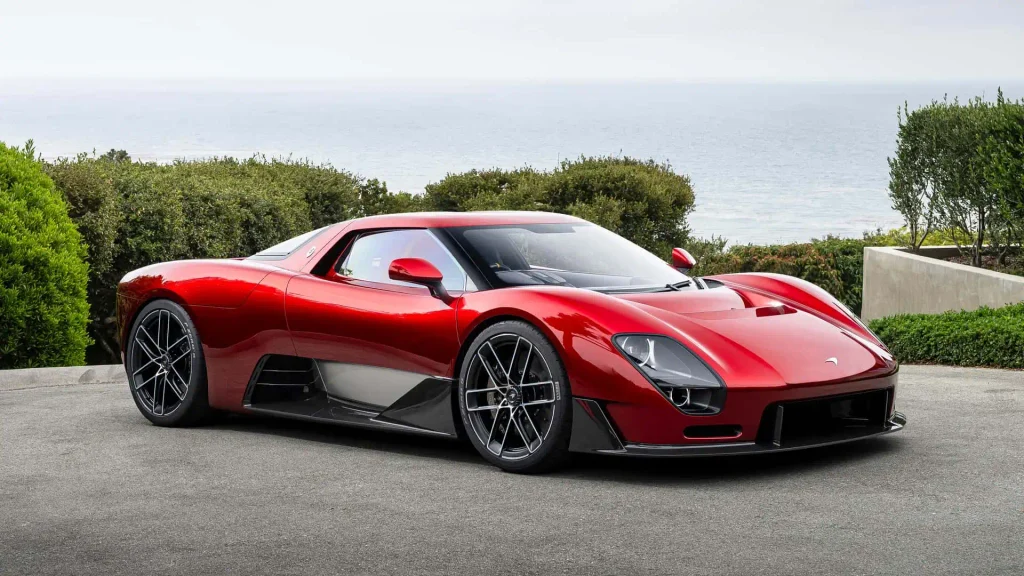
Karma Automotive priced its Gyesera Grand Coupe at $139,995 and opened orders in August. December delivery is the target. The Revero is done. Three new models now form the brand's entire forward product plan, spanning a price range from $139,995 to roughly $400,000.
The reveal at the 75th Pebble Beach Concours d'Elegance on Sunday, 17 August 2025 comes as established GT rivals accelerate full battery-electric transitions. According to Karma Automotive's product announcement, published August 2025, the Gyesera is the first vehicle on a new aluminium-and-carbon-fibre platform, replacing the plug-in hybrid Revero sedan that had anchored the brand since 2016. That is a nine-year platform cycle ending without a direct successor.
Powertrain Numbers Behind the HRL15665 System
Karma designates the Gyesera's drivetrain internally as HRL15665. The system produces 566 horsepower and 546 pound-feet of torque. Karma claims a 0–60 mph time of just under 3.7 seconds, which puts the grand tourer within 0.4 seconds of the BMW M3's upcoming four-motor variant at roughly one-tenth the output figure. At $139,995, buyers pay approximately $247 per horsepower — calculated as $139,995 ÷ 566 hp = $247.34/hp. By comparison, Porsche's Panamera Turbo S lists near $200,000 for 630 hp, or $317 per horsepower, making Karma's figure 22 percent lower on that crude metric. The four-seat body rides on a high-strength aluminium space frame with carbon-fibre-reinforced exterior panels. Kerb weight has not been published. That omission matters for any real-world performance claim, and Karma had not released that figure as of the August 2025 announcement.
From Concept Lawn to Configurator in One Weekend
Karma brought the Gyesera to three separate Monterey-area events across four days. The car appeared first at the Santa Lucia Preserve Concours in Carmel Valley on Thursday, 14 August. It moved to Exotics on Broadway in Seaside on Saturday, 16 August. Then it took its place on the Pebble Beach Concept Lawn on Sunday, 17 August — the event's 75th running. For that final appearance, Karma dressed the car in a one-off "PB75" livery: Electrum Gold bodywork, Stellar Red stripes across the hood and lower front doors, and 22-inch Light Speed wheels finished in Champagne and Galaxy Black with red brake calipers. Inside, Bridge of Weir leather in Reserve Red and Black covered the seats, with Charcoal Alcantara and Platinum accents throughout. Bridge of Weir is a Scottish tannery that supplies several ultra-low-volume GT builders, so the material choice signals a deliberate reach toward European coach-built associations. Orders through Karma's online configurator were live before the Pebble Beach appearance concluded.
Two More Models, One Going Electric and One Going Solid-State
The Amaris GT and the Kaveya Super Coupe sat alongside the Gyesera in Monterey but occupy entirely different market slots. The Amaris GT, a two-door body targeting a fourth-quarter 2027 launch, is described by Karma as the second model in its Hybrid EREV lineup. Pricing has not been confirmed. The Kaveya Super Coupe targets the first quarter of 2028 delivery at approximately $400,000 — $260,005 more than the Gyesera at base. Karma says the Kaveya will exceed 1,000 horsepower, feature butterfly doors, and draw styling cues from stealth aircraft. More unusually, Karma announced a partnership with Factorial Energy to explore use of Factorial's FEST solid-state battery technology in the Kaveya. Factorial Energy's FEST cells have not yet entered any production passenger vehicle as of August 2025, according to Factorial Energy's published technical disclosures. This places Karma's timeline against a technology that remains pre-production — a gap also present in McLaren's own electrification roadmap announced in summer 2025, where battery chemistry timelines remain unconfirmed.
A Low-Volume Bet Against the Direction of Traffic
There is a structural tension in Karma's plan that the August announcement did not address. The brand is moving toward lower volumes and higher prices at precisely the moment that the broader industry restructuring cycle of 2025–2026 is pushing mass-market manufacturers toward full electric architectures under tightening regulatory timelines. Karma's Hybrid EREV approach uses a combustion range extender — a configuration that some regulators, including the European Commission under its 2035 ICE phase-out provisions, may treat as a conventional hybrid rather than a zero-emission vehicle depending on classification methodology. Karma had not published WLTP or EPA range figures for the Gyesera as of August 2025, nor had it confirmed which emissions regulatory regimes the car would be certified under at launch. For a $139,995 vehicle targeting U.S. and potentially European buyers, that is a conspicuous absence. The Revero's final-year U.S. sales volumes were not disclosed in Karma's August announcement either, leaving the size of the customer base being handed a successor without a clear public number. Kia's public friction with ZEV mandate pace in the UK illustrates how even volume manufacturers find regulatory timing difficult to predict.
What the Revero Exit Means for Existing Owners
Lance Zhou, Chief Executive Officer of Karma Automotive, did not address parts supply continuity for existing Revero and Revero Invictus owners in the August 2025 product announcement — a detail that matters to a customer base holding cars with a bespoke aluminium structure and a proprietary powertrain. Karma Automotive's product announcement, published August 2025, confirmed that both the Revero sport sedan and Revero Invictus are winding down but gave no transition timeline for dealer service infrastructure. Independent Karma service facilities in the United States currently number fewer than 30, according to the brand's own dealer locator as of August 2025. As the Gyesera's aluminium space frame and HRL15665 drivetrain replace Revero components entirely, the overlap in parts and technician training between the old and new architectures is not documented publicly. For a brand whose ownership history includes the Fisker Automotive bankruptcy of 2013 — from which Karma itself emerged — service continuity is not an abstract concern. It is the specific anxiety that sits behind every purchase decision at this price point.
Karma Automotive was founded in 2014 following Wanxiang Group's acquisition of Fisker Automotive's assets out of Chapter 11 bankruptcy proceedings. The Gyesera name had not appeared in any prior Karma product filing or trademark registration searchable before January 2025. Three models. One platform generation. Delivery clock starts December. The complete Karma Automotive model history and specifications are catalogued in the Global Auto Index manufacturer database.
