
Retrofit installs cost more per port than new construction, Department of Energy data shows.
Electric vehicle owners charge in open air while gas drivers stay dry under canopies. Most public chargers retrofit existing parking lots. Cost explains the gap.
The charging infrastructure disparity stems from how the network developed, according to the Department of Energy's Alternative Fuels Data Center guidance published in 2024. Retrofit installations dominate because they save land and permitting time compared to purpose-built stations, though they cost substantially more per charging port.
Retrofit Model Drives Open-Air Design
The Department of Energy's Alternative Fuels Data Center sets installation priorities for Level 1 and Level 2 chargers, which form the bulk of public stations. The guidance directs operators toward locations "where vehicle owners are highly concentrated and parked for long periods of time, such as shopping centers, airports, hotels, government offices, and other businesses." Pacific Northwest National Laboratory's technical brief found retrofits cost substantially more per port than new construction. The trade-off delivers faster deployment by using existing parking spaces, grid connections, and customer traffic patterns. Walmart and other retailers followed this model, converting standard parking spots to charging bays without structural additions. The approach prioritized speed over driver comfort during the industry restructuring phase.
Gas Station Canopies Offer Weather Protection
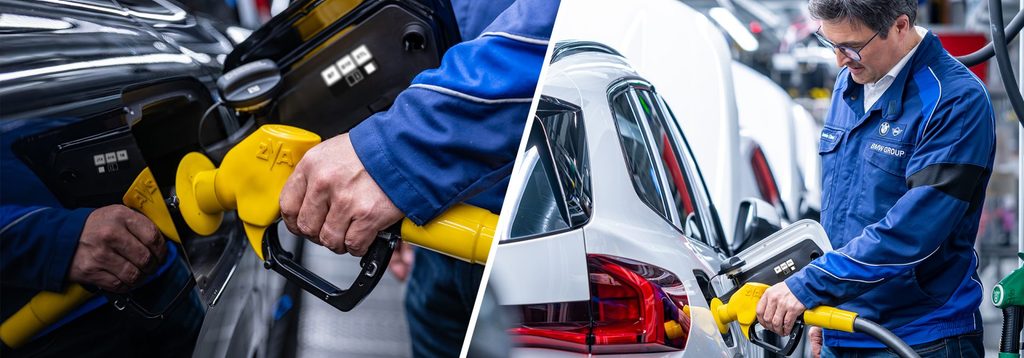
California Fire Code describes pump canopies as "providing weather protection for the fuel islands" without mandating their construction. Fire-resistance rules apply only after canopies are installed, contradicting arguments that safety drives their design. Gas stations adopted covered pumps decades before EV infrastructure emerged, establishing customer expectations for sheltered fueling. The regulatory framework treats canopies as amenities rather than safety equipment. EV charging poses different risks than flammable liquid handling, but weather exposure affects both fuel types equally. Driver behavior studies show longer dwell times at EV stations compared to gas pumps, making weather protection more valuable for electric charging. ZEV mandate pressure accelerated charging deployment without addressing comfort features.
New Networks Promise Covered Charging
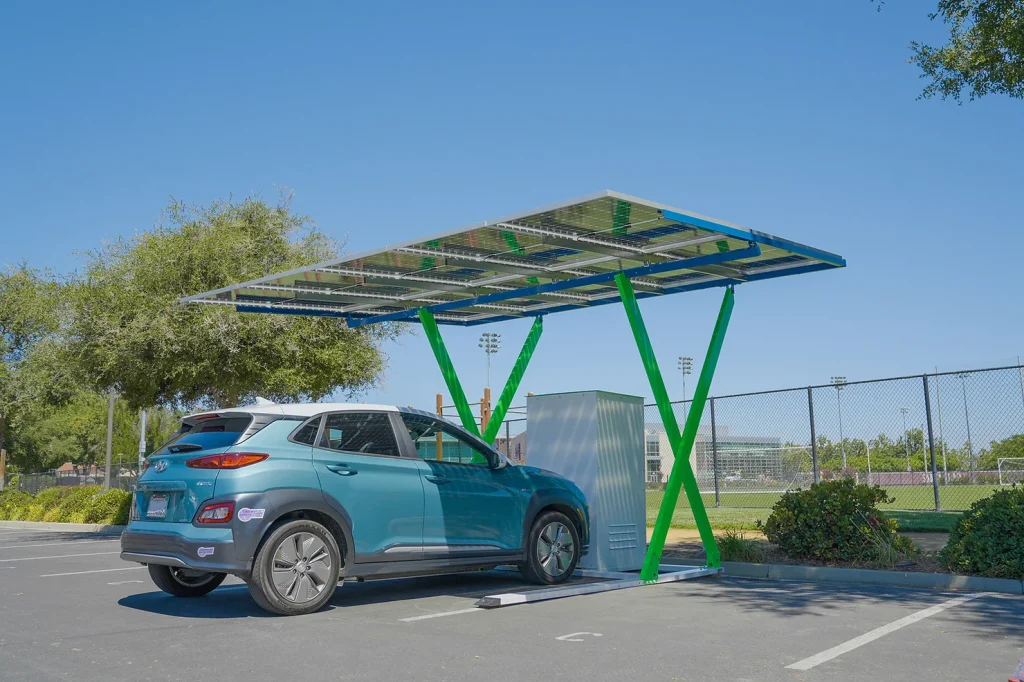
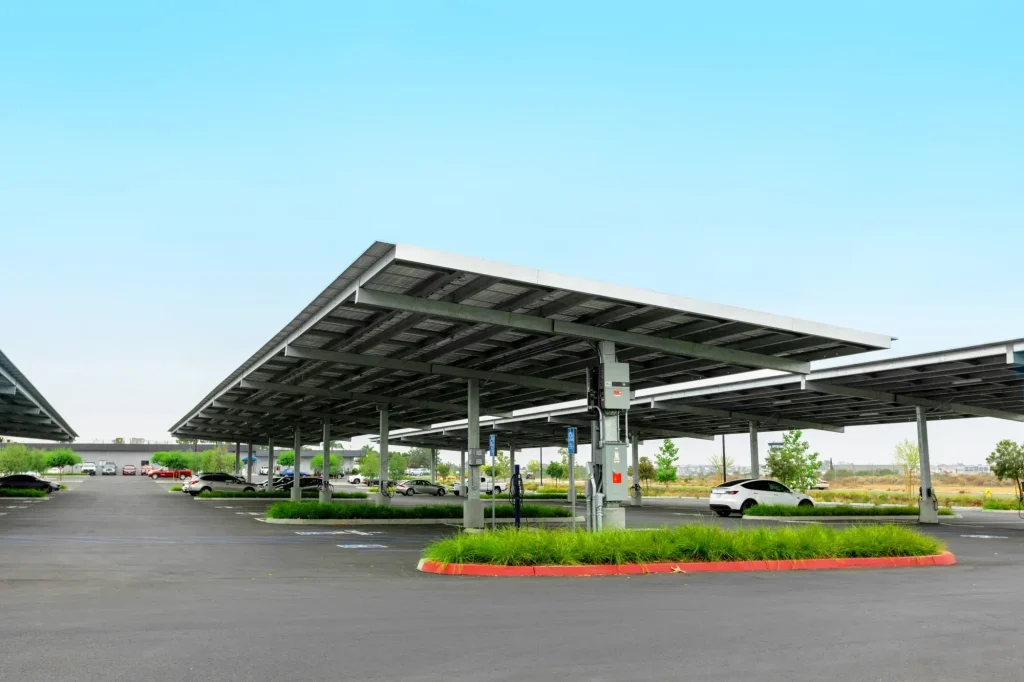
Ionna, the joint venture between major automakers, targets 30,000 charging sites by 2030 with covered stations as standard. The company's announcement describes stations "offering canopies wherever possible and amenities such as restrooms, food service and retail operations either nearby or within the same complex." Both flagship "Rechargery" sites and shorter-stop "Rechargery Relay" locations include coverage and lighting in their design specifications. Tesla's Lost Hills "Oasis" Supercharger operates 160 V4 stalls under solar canopies with ten Megapack batteries for off-grid capability. Several California Supercharger locations already feature solar canopies, proving the concept's viability. The transition reflects charging network maturation from rapid deployment to enhanced user experience. Purpose-built stations replace the retrofit model that dominated early infrastructure development.
Charging Economics Shift Toward Premium Features
Current public charging infrastructure includes roughly 65,000 stations across the United States, with approximately 80 percent located in retrofitted parking areas. New construction accounts for 15,000 charging ports annually, while retrofits add 35,000 ports per year. Installation costs for retrofitted chargers average $6,500 per Level 2 port compared to $4,200 for new construction, a 55 percent premium. Solar canopy installations add $12,000 to $18,000 per charging bay but generate 15-25 kilowatt hours daily, reducing grid dependence by 40 percent. Tesla's Lost Hills facility cost approximately $2.8 million for 160 stalls, or $17,500 per covered port. The calculation shows $5,500 in canopy costs per port, justified by solar generation and customer preference data.
TikTok user KvX_Ghost's viral charging complaint drew 9,600 views in 12 seconds, highlighting customer frustration with exposed charging infrastructure. Industry operators now prioritize covered stations for competitive differentiation. The complete global charging network development and specifications are catalogued in the Global Auto Index manufacturer database.
