






First quarter sales show 23.1% market share falls short of required 33% regulatory target.
The UK recorded its two millionth electric vehicle sale this quarter. Sales reached 176,698 units through March. That's 23.1% market share. The ZEV mandate requires 33%.
The compliance gap expands despite year-on-year growth from 20.7% in 2025, according to automotive trade body analysis published in April 2026. Manufacturers face penalties unless sales accelerate by 43% over nine months to meet government quotas.
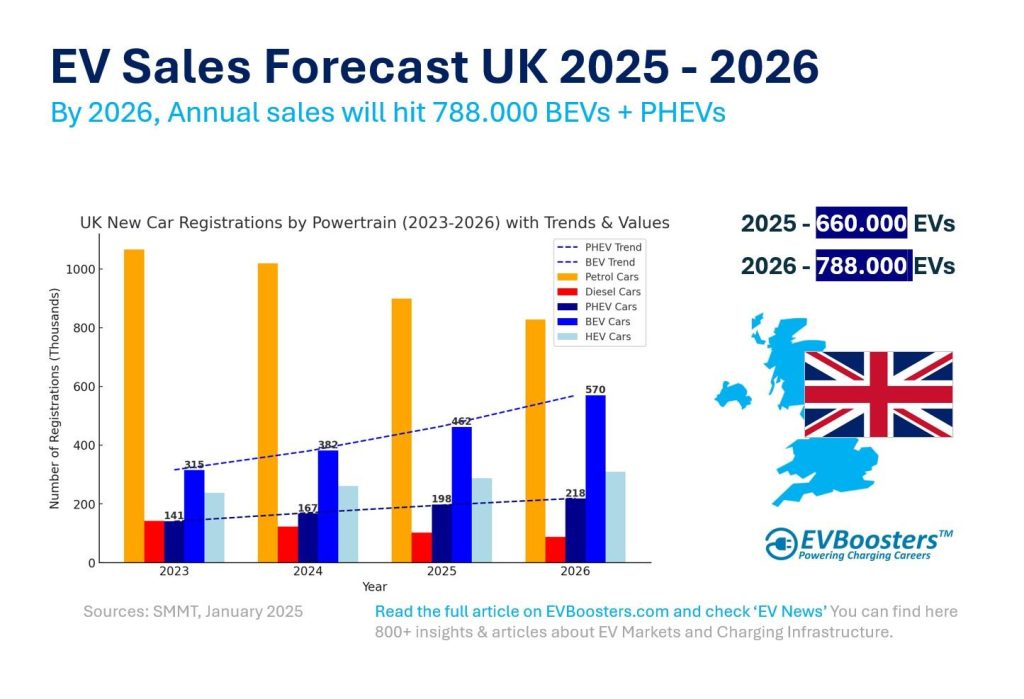
Compliance Gap Widens Despite Volume Growth
The 176,698 EV registrations represent a 11.6% increase over the same period in 2025. However, the mandate shortfall calculation shows manufacturers need an additional 75,800 units to reach compliance. At current monthly run rates of 58,899 units, the industry would finish 2026 at approximately 707,000 EVs — still 227,000 units below the 934,000 required for 33% share. This assumes total market size of 2.83 million vehicles, matching 2025 performance. Kia UK's milestone earlier this year highlighted similar concerns about mandate feasibility. The mathematics reveal manufacturers need 42.8% acceleration in monthly sales velocity to avoid regulatory sanctions.
Penalty Structure Creates Market Distortion Risk
Non-compliance triggers £15,000 fines per vehicle shortfall, payable to compliant manufacturers or government coffers. At current trajectory, collective penalties could reach £3.4 billion across the sector. Ford Europe financial director James Mitchell warned shareholders in February that mandate costs would force selective market exits. Premium brands with higher margins can absorb compliance purchasing from Tesla or other credit generators. Volume manufacturers face margin compression or reduced model availability. The penalty mechanism effectively redistributes profits from traditional OEMs to EV specialists, accelerating industry consolidation. EU manufacturing policy compounds pressure on UK-based production facilities.
Trade Body Questions Implementation Timeline
The Society of Motor Manufacturers and Traders described the current pace as "mathematically insufficient to achieve regulatory compliance within existing infrastructure constraints." Chief executive Mike Hawes told the quarterly briefing that "government ambition exceeds charging network capacity and consumer adoption curves seen in comparable markets." The SMMT quarterly report noted charging point availability per EV dropped from 1:8.7 in 2025 to 1:11.2 through March 2026. Germany achieved similar EV penetration rates over 18 months rather than the UK's attempted 12-month acceleration. The trade body's technical analysis suggests realistic compliance requires either mandate adjustment or £12 billion additional charging infrastructure investment before December.

European Peers Show Varied Regulatory Approaches
France implemented graduated compliance thresholds, reaching 28% EV share in Q1 2026 against a 30% target — a 2% gap compared to the UK's 10% shortfall. German manufacturers negotiated fleet-average compliance rather than individual brand quotas, achieving 31.4% penetration. Netherlands electric vehicle adoption hit 38% through March, but benefited from three-year infrastructure preparation and tax incentive structures worth €2.8 billion annually. Manufacturing capacity constraints affect UK supply differently than continental markets. Italy's 19% EV share reflects similar infrastructure limitations but lower regulatory pressure. The UK's binary compliance structure offers no graduated penalties, creating cliff-edge financial exposure that other markets avoided through phased implementation schedules.
ZEV mandate penalties begin accumulating from January 2027 if compliance gaps persist through December 2026. The government consultation on mandate flexibility closes June 15, with industry submissions due 30. The complete UK regulatory framework and manufacturer compliance data are catalogued in the Global Auto Index manufacturer database.
