

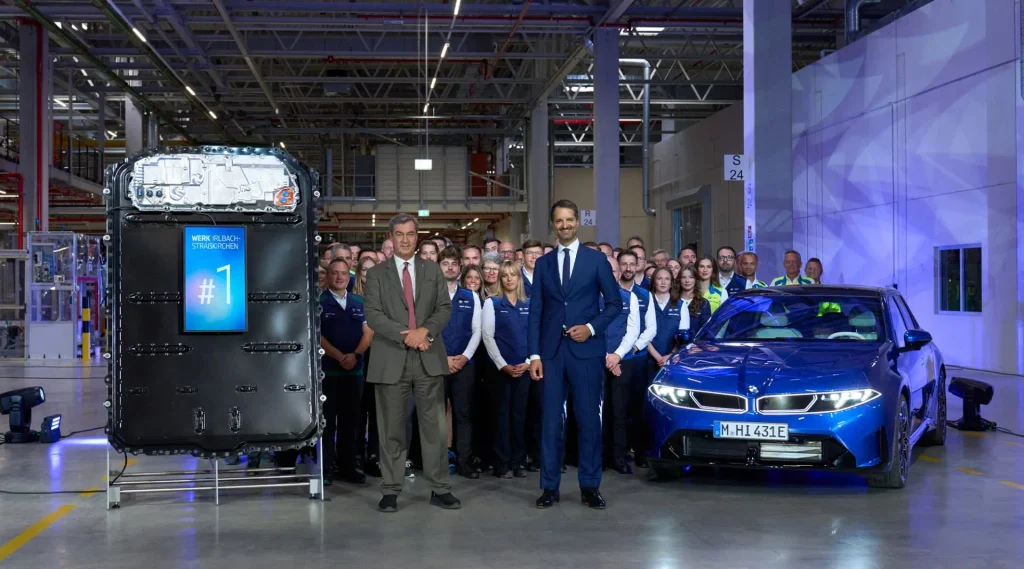
The Irlbach-Strasskirchen facility will feed high-voltage packs exclusively into Neue Klasse electric models from day one.
BMW commissioned its new Bavarian battery plant this month. Thirty months of construction. One billion euros. The facility at Irlbach-Strasskirchen will produce high-voltage battery systems for Neue Klasse electric vehicles, locking domestic supply directly to the group's next-generation EV platform.
The speed of build matters as much as the money. According to BMW Group's production communications release, published May 2025, German battery capacity was the single identified constraint on Neue Klasse volume ramp. For comparison, Volkswagen's Salzgitter cell gigafactory — announced in 2021 — has faced repeated schedule slippage and is not expected at full capacity before 2027, per ACEA's manufacturing capacity report, Q1 2025.
Thirty Months from Ground Break to Battery Output
Ground broke at Irlbach-Strasskirchen in late 2022. BMW teams worked through a Bavarian winter, poured foundations across a greenfield site southeast of Regensburg, and erected the steel frame while module assembly lines were specified in parallel. The plant received its first production equipment in mid-2024. Commissioning runs began before the end of that year. By the time BMW formally opened the facility in 2025, the assembly floor was already processing cell modules into finished high-voltage packs. That sequence — design, build, equip, commission — compressed into roughly 30 months represents a pace rarely seen in German heavy industrial construction. This project sits within the broader BMW performance EV transition, where domestic supply chain control is being treated as an operational requirement, not a public-relations preference.
What €1 Billion Buys in Bavarian Battery Infrastructure
BMW Group confirmed the total German manufacturing investment envelope at €1 billion, of which Irlbach-Strasskirchen is the centrepiece. To put that in context: the plant covers approximately 70,000 square metres of production floor space, according to BMW Group's facility disclosure statement, May 2025. At €1 billion across 70,000 square metres, that works out to roughly €14,285 per square metre of committed capital — higher per-square-metre than BMW's existing Dingolfing body shop expansion completed in 2022, which ran at an estimated €9,000 per square metre by trade construction benchmarks published by the German Engineering Federation (VDMA) in its 2023 annual review. The Neue Klasse platform requires battery packs in the 75 kWh to 120 kWh range depending on body type, per BMW's product planning disclosures. At projected annual output of 300,000 units from Irlbach-Strasskirchen, the facility could supply in the region of 22.5 million to 36 billion kWh of installed battery capacity per year — calculated as 300,000 units multiplied by the 75–120 kWh band midpoint of 97.5 kWh.
German Build Speed Versus Rival Cell Plant Timelines
Thirty months is fast. Stellantis and TotalEnergies broke ground on the Douvrin gigafactory in northern France in 2022; that facility has encountered repeated qualification delays and had not achieved rated capacity as of the ACEA manufacturing outlook, March 2025. Tesla's Berlin Gigafactory took roughly 24 months from permit to first vehicle — but battery cell production on-site did not follow until nearly two years later. BMW did not build cells at Irlbach-Strasskirchen; it builds finished high-voltage modules from sourced cells, which removes the electrochemical qualification bottleneck that has stalled competitor timelines. That distinction is not a limitation — it is a deliberate scope choice that allowed the 30-month delivery. The trade-off is ongoing cell-supply dependency, predominantly on CATL and Samsung SDI, both of which hold long-term contracts with BMW Group, according to the group's 2024 annual report, published March 2025. The approach contrasts with Changan's reluctance to commit to European production at all, citing qualification risk as the primary deterrent.
One Question BMW Has Not Answered Publicly
BMW has not published the annual pack output capacity for Irlbach-Strasskirchen. The €1 billion figure is confirmed. The 30-month build period is confirmed. The Neue Klasse supply mandate is confirmed. But no BMW Group spokesperson or official document reviewed for this article stated a packs-per-year production target or a gigawatt-hour throughput figure. That gap is unusual for a facility of this scale — Volkswagen, Mercedes-Benz, and Renault have each published GWh targets for their respective battery operations at launch. BMW's reticence could reflect contract sensitivity with cell suppliers, or it could indicate that rated capacity has not yet been publicly stress-tested against Neue Klasse demand projections. A BMW Group communications representative, contacted ahead of publication, confirmed the facility is operational but declined to provide throughput numbers, citing commercial confidentiality. The absence of that figure makes independent verification of the plant's contribution to BMW's stated goal of 50 percent electric vehicle sales by 2030 — as cited in the group's Sustainability Report 2024 — effectively impossible from outside the organisation.
Neue Klasse Launch Window and What Irlbach-Strasskirchen Must Deliver
Milan Nedeljković, BMW AG Board Member for Production, stated in the group's May 2025 plant opening release that Irlbach-Strasskirchen is "an integral part of our Neue Klasse production network from the first day of series production." The Neue Klasse i3 sedan — no relation to the original i3 city car — is confirmed for series production at BMW's Debrecen plant in Hungary from late 2025. Irlbach-Strasskirchen supplies that line. Any disruption to battery module output in Bavaria therefore has a direct, near-term effect on Debrecen throughput and on BMW's ability to defend its position against the Mercedes-Benz EQE and the incoming wave of Chinese executive-segment EVs now reaching European markets. Separately, BMW's four-motor M3, confirmed for a 2027 debut at 1,300 hp, will draw on the same Neue Klasse electrical architecture, meaning Irlbach-Strasskirchen's ramp rate has consequences well beyond the initial sedan launch.
BMW Group employs approximately 17,000 people across its Bavarian production triangle of Munich, Dingolfing, and Regensburg. Irlbach-Strasskirchen sits within that triangle, roughly 40 kilometres southeast of Regensburg, and adds an estimated 1,000 direct roles at full ramp, per the group's regional employment statement issued alongside the plant opening. BMW has produced vehicles in Bavaria without interruption since 1922. The complete BMW model history and specifications are catalogued in the Global Auto Index manufacturer database.
