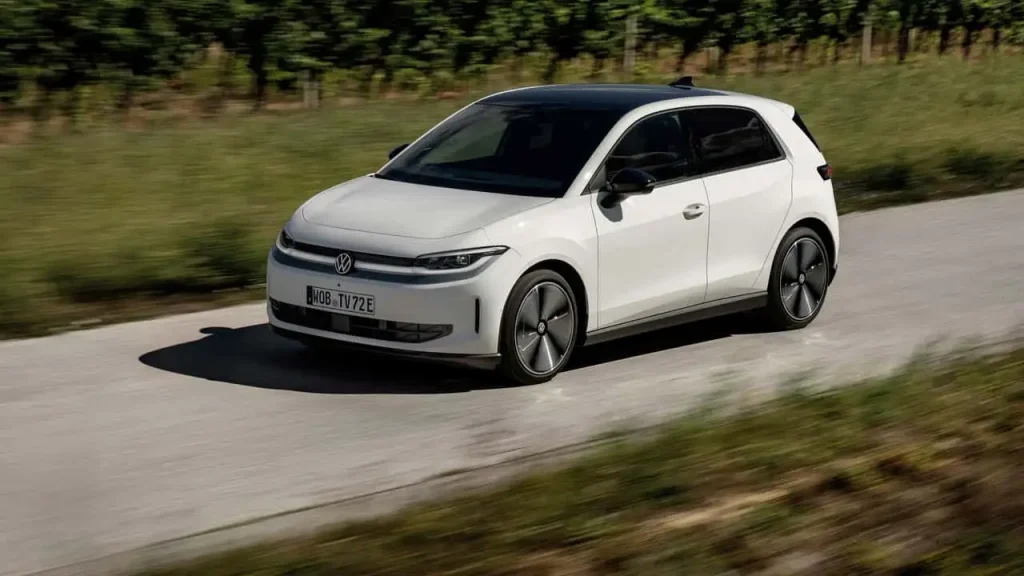
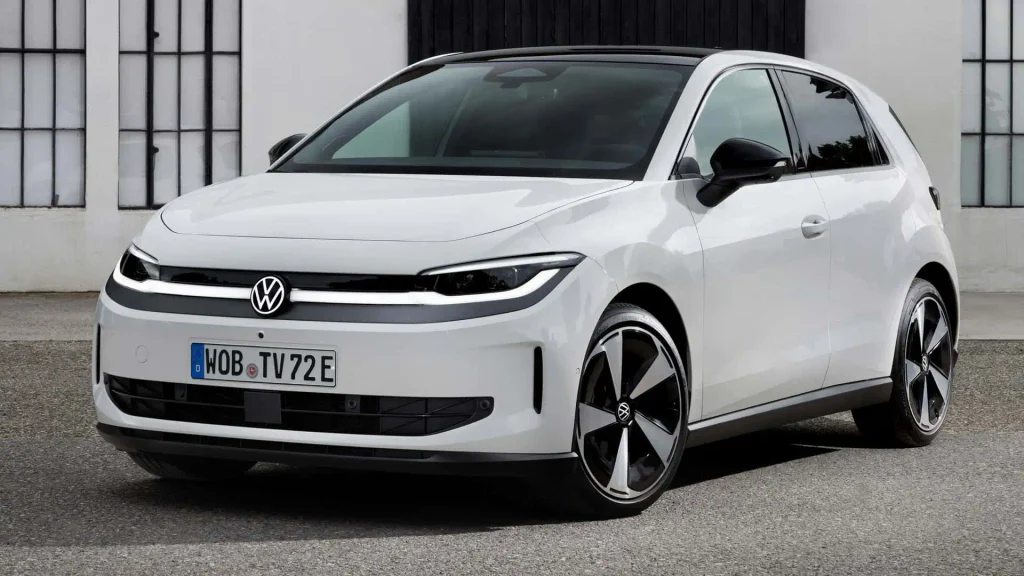
The ID. Polo alone has collected over 40,000 European orders, yet profit margins on each sale remain thinner than an equivalent petrol car.
Volkswagen is cancelling planned extra production shifts at its Wolfsburg plant. Not because demand collapsed. Because demand moved — fast, and in the wrong direction for a factory built around the combustion engine. EV orders in Germany now outnumber ICE orders for the brand.
The demand inversion arrived faster than VW's planners modelled, according to reporting , published September 2025. Wolfsburg is now forecast to build roughly 580,000 vehicles this year instead of the 600,000-plus originally targeted — a shortfall of at least 20,000 units driven not demand but by a product-mix the plant cannot yet fully serve. No other German volume OEM has publicly confirmed the same order reversal.
The Wolfsburg Numbers Don't Lie
Run the arithmetic: 600,000 planned units minus 580,000 projected units equals a 20,000-vehicle gap — roughly 3.3% of the plant's annual ceiling, wiped out by a scheduling adjustment rather than a sales crisis. Wolfsburg's three active nameplates are the Golf, the Tiguan and the Tayron, all combustion-led. The plant employs approximately 70,000 people across its main Wolfsburg complex, making every percentage-point shift in utilisation a serious labour-cost variable. At Emden, by contrast, VW is adding at least two extra shifts to lift output of the ID.7 liftback and wagon. Zwickau is running harder to meet demand for the ID.3 Neo. The directional divergence is stark: ICE-optimised factories losing scheduled time, EV-optimised factories gaining it. For VW's German works council — which negotiates shift structures under co-determination rules — that split creates competing pressures within the same collective-bargaining table. This sits inside a broader pattern tracked across EV regulation developments in Europe through 2026.
More Orders, Less Money: The Margin Trap
Here is what does not add up. VW spent the better part of three years arguing that tepid EV demand justified slower electrification. Now demand has inverted. The company should be accelerating. Instead, it is managing a factory network that cannot convert the order book into equivalent revenue without compressing margins further. EVs carry smaller profit margins than comparable ICE models — VW has not published a per-unit figure, and the company's February 2025 annual results presentation declined to break out EV-specific contribution margins at the brand level. That absence of disclosure is itself informative. The cost-cutting programme running through VW Group targets billions in annual savings through 2026, yet growing EV volume mathematically adds pressure rather than relieving it: fewer mechanical components per vehicle means fewer labour hours, fewer hours means lower absorption of fixed factory overhead, and lower absorption means worse unit economics at current volumes. Growing faster in EVs, paradoxically, worsens the short-term German manufacturing P&L.
40,000 Orders and a Budget Award for the ID. Polo
Automobilwoche's September 2025 reporting characterised the demand shift as having "happened faster than expected" — a phrase that carries weight coming from a trade title with direct access to VW's Wolfsburg communications team. The ID. Polo, manufactured in Pamplona, Spain, rather than Germany, had accumulated more than 40,000 orders across Europe by mid-September 2025. It then took the Budget category prize at the German Car of the Year awards, beating Renault's Twingo and Clio. The win matters commercially: GCOTY carries measurable brand credibility in the German retail channel. What VW has not confirmed publicly is the ID. Polo's per-unit margin target or when — if ever — it expects the model to reach ICE-equivalent profitability. A second, cheaper model currently referred to internally as the ID. up! is pencilled in for a launch sometime in 2026, though the production nameplate remains unconfirmed as of the date of this article's publication. Kia UK's experience hitting 100,000 EVs while questioning ZEV mandate pace suggests VW is not alone in finding demand growth and margin growth pulling in opposite directions.
Wolfsburg's Structural Problem, and What Comes After
Thomas Schmall, VW Group's board member for technology, acknowledged in VW Group's 2024 restructuring communications that German plant utilisation would fall as the product mix shifted — though the Wolfsburg shift cancellation reported by Automobilwoche is a concrete, scheduled manifestation of that general warning. The Golf's confirmed move to VW's Puebla, Mexico facility in 2027 will remove the plant's highest-volume nameplate. What replaces it in Wolfsburg is the electric Golf and an electric T-Roc, both confirmed for future assembly there, but neither yet in production. That gap — between losing the combustion Golf and gaining its electric replacement — is the exact window in which Wolfsburg faces its deepest utilisation trough. The plant's 88-year-old infrastructure was engineered around internal combustion. EVs require fewer assembly steps, which means the building has more floor space than the product needs. Repurposing that space costs capital VW is simultaneously trying to preserve. The EU Industrial Accelerator Act's push on EV manufacturing access could reshape how that capital investment is subsidised — but VW's Wolfsburg timeline pre-dates any policy relief.
ZEV Compliance Math and the Fine-Avoidance Incentive
Against 2025's EU CO₂ fleet targets, every additional battery-electric vehicle registered offsets multiple combustion vehicles in the pooled fleet average calculation — the precise multiplier depends on vehicle segment and whether VW has filed a compliance pool with another manufacturer. VW has not published its current pool arrangements for 2025. What is on the record: the European Commission's CO₂ penalty structure, confirmed under Regulation EU 2019/631, sets fines at €95 per gram of CO₂ per kilometre above the target, multiplied across every vehicle sold in a calendar year. For a manufacturer selling roughly four million vehicles annually in Europe, a one gram-per-kilometre miss can generate fines exceeding €380 million. Faster EV order intake reduces that exposure directly. By contrast, U.S. tariff pressure and European IVA tightening are squeezing revenue from the ICE models that currently fund the EV transition. VW's German EV order surge is thus simultaneously a compliance asset and a profitability liability — a combination that no single line in a quarterly report captures cleanly.
VW Group's Supervisory Board approved a revised investment plan in December 2024 allocating €170 billion across five years, with electrification taking the largest single share. Wolfsburg's next confirmed electric product, the electric Golf, is not due in volume production before 2027. Two model years of combustion-dependent output remain. The complete Volkswagen model history and specifications are catalogued in the Global Auto Index manufacturer database.
