







The gap opened after Washington let a $7,500 purchase credit expire on September 30, 2025.
US electric vehicle sales fell 30.7 percent through the first nine months of 2026. The credit died September 30, 2025. Gone with it: the $7,500 new-vehicle incentive and a $4,000 used-EV credit that had underpinned retail momentum for three years. Europe, meanwhile, set a record.
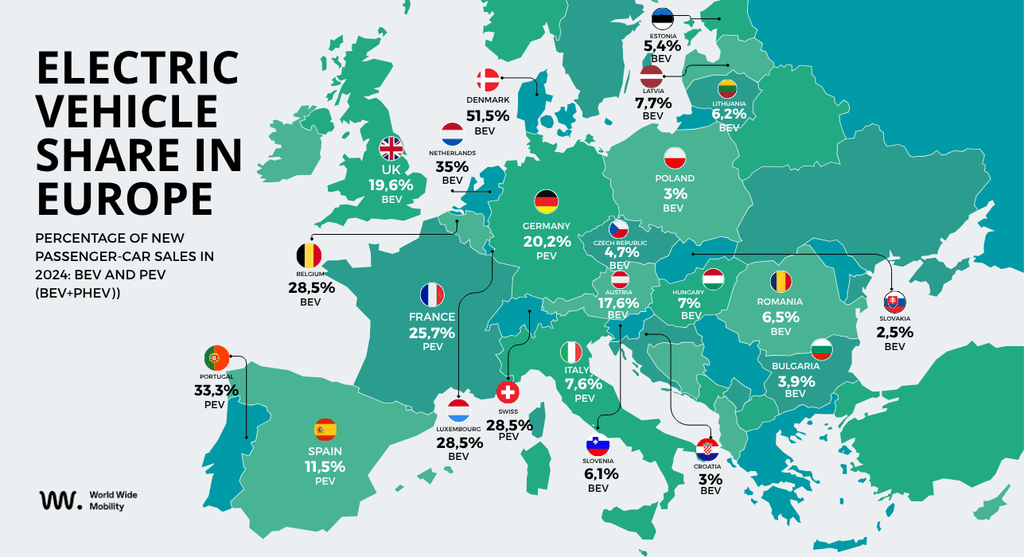
The divergence is not a blip. According to Automotive News, nine-month 2026 data show US EV share at 6 percent — down from 8.5 percent in the same period a year earlier — while European share reached 23.2 percent, up from 17.7 percent. That is a 17.2-percentage-point spread between the two markets, compared with roughly 9 points twelve months ago. The direction of travel on both sides of the Atlantic is now firmly opposite.
The Numbers Behind the US Collapse
Start with the arithmetic. US EV share stood at 8.5 percent through September 2025. Through September 2026 it sits at 6 percent. That is a 2.5-point absolute drop — or, expressed as a share-of-share decline, 29.4 percent of the base evaporated in twelve months. The headline sales volume figure is sharper still: down 30.7 percent year-on-year across all nine months. Tesla held up better than the segment overall, recording a 14 percent US sales decline through Q3 2026 — painful, but less than half the market's 30.7 percent fall. General Motors' EV figures softened more visibly; GM has not published a standalone nine-month EV volume for 2026, but internal sales data cited by Automotive News confirm the trend moved against them. Hybrids absorbed much of the displaced demand: hybrid sales rose 23 percent through Q3 2026 and now account for 15.6 percent of total US new-car sales. On-page calculation: if the US new-car market runs at roughly 15.5 million units annually, 15.6 percent hybrid share implies approximately 1.8 million hybrid sales in nine months — more than triple the EV volume at 6 percent share. Follow all EV regulation and market-share developments in our dedicated Europe EV tracker.
Europe's Record Share and What Drove It
Where the US lost 2.5 percentage points of EV share, Europe added 5.5 points — from 17.7 percent through September 2025 to 23.2 percent through September 2026. The model count partly explains it. More than 150 electric models were on sale in Europe during the first half of 2026, up from roughly 100 in 2024 — a 50 percent expansion of consumer choice in under two years. A cluster of new small EVs targets starting prices at or below €25,000 (approximately $28,000 at mid-2026 exchange rates). That bracket is nearly absent from the US market. Volkswagen's low-cost EV offensive, built around the ID.2 platform, had accumulated close to 150,000 European orders by the time Q3 data were compiled, according to Automotive News. Several European Union member states continue to run purchase incentives alongside EU fleet-emissions rules that impose per-gramme CO₂ fines on manufacturers. High pump prices — averaging above €1.60 per litre across major EU markets through mid-2026 — give European drivers a running-cost argument that US fuel prices, still below $3.50 per gallon in most states, do not replicate.
What the Policy Shift Actually Removed
The Inflation Reduction Act's clean-vehicle credits were not merely a consumer discount. They were, in the words of the Congressional Budget Office's cost estimate published in August 2022, intended to "accelerate the transition to zero-emission vehicles by reducing the effective purchase price at the point of sale." That mechanism — reducing effective purchase price — is precisely what disappeared on September 30, 2025, when the Trump administration allowed the credits to lapse rather than extend them. The administration simultaneously moved to roll back portions of federal vehicle fuel-economy and greenhouse-gas rules for future model years, removing a second lever that had pushed manufacturers toward EV investment targets. Andrea Amico, director of regulatory affairs at the Zero Emission Transportation Association, told Automotive News in October 2026 that the combined effect "removed both the carrot and softened the stick in the same policy cycle" — a compressed double withdrawal that manufacturers say compressed their planning windows. What was not confirmed: the White House has not published revised long-term fleet-emissions targets to replace the withdrawn rules.
The Tesla Paradox and the Affordable-Model Gap
Tesla's relative resilience deserves scrutiny. A 14 percent US sales decline through Q3 2026 looks manageable against the segment's 30.7 percent fall — until you remember that Tesla entered 2026 already carrying reputational damage from CEO Elon Musk's political visibility and a product line that had not seen a new mass-market model since the Model Y refresh. The brand shed share less because demand held firm and more because it started the year with a locked-in customer base and no meaningful affordable challenger below $40,000 in the US. That affordable-model gap is the structural anomaly in the US market. Kia's EV3, priced from approximately $31,000, represents one of very few entries in the sub-$35,000 electric bracket — a price band that, in Europe, now contains more than a dozen competing models. The US market has not lacked EV technology; it has lacked EV products that match the price expectations of median household income. Median US household income in 2024 was $80,610 according to the US Census Bureau; a $40,000 entry-level EV consumes roughly half of annual pre-tax income.
What the Divergence Means for Manufacturers With Dual Exposure
For Volkswagen Group, the split creates an operational tension. Its European EV push — anchored by the ID.2-family models at sub-€25,000 price points — is generating order volume that confirms the European thesis. But Volkswagen's US EV lineup, centred on the ID.4, sits above $38,000 before incentives that no longer exist. With federal credits gone, the ID.4's effective price to a US buyer rose by up to $7,500 overnight on October 1, 2025. No compensating price cut followed. General Motors faces the same arithmetic on the Chevrolet Equinox EV, launched in late 2023 partly on the promise that the $7,500 credit would bring its price within reach of a broad audience. That audience shrank when the credit expired. Kia, whose EV3 enters US dealerships at approximately $31,000, is better placed than most — but the EV3 did not reach US showrooms until mid-2026, meaning it missed the credit window entirely and now competes in a market whose appetite for EVs is demonstrably weaker than it was eighteen months ago.
European EV registrations crossed one million units in a single quarter for the first time in Q2 2026, according to the European Automobile Manufacturers' Association's registration bulletin, July 2026 — a threshold that US quarterly EV sales have never reached. US hybrid registrations, , are on course to exceed 2.4 million units for full-year 2026 if Q3 pace holds. The complete EV market history and specifications are catalogued in the Global Auto Index manufacturer database.
