A dual-port charging door with NACS and J1772 inlets replaces the single CCS1 connector across all US units.
Mercedes-Benz opened US order books for the 2027 G 580 Electric on September 30. Price with destination: $165,200. That is $650 more than the 2026 sticker. The bigger change is under the charging door.
The 2027 revision arrives as Mercedes faces a widening gap between G-Class variants. According to sales data cited , September 2025, roughly 1,450 electric G 580s had moved worldwide through April 2025 against approximately 9,700 combustion G-Class units across the same period — a ratio of about 1-to-6.7. The brand had already cut its customer discount from 5 percent to 10 percent in November 2024. Faster charging and Supercharger access are the next lever.
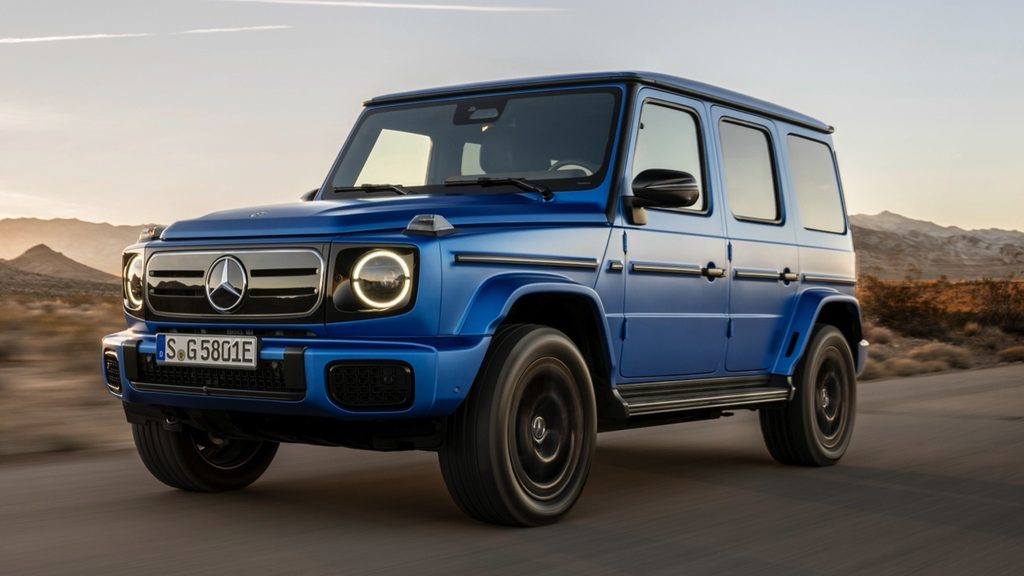
Price, Range, and Charging: The Numbers
The base price before destination sits at $163,750. Add the $1,450 destination charge and the out-the-door figure is $165,200 — up $650 from the prior model year's $164,550. EPA combined range rises to 249 miles from 239 miles, a gain of 10 miles. Efficiency climbs to 71 MPGe from 62 MPGe, an improvement of 9 MPGe or roughly 14.5 percent. DC fast-charging from 10 to 80 percent now takes 29 minutes, down from 32 minutes — a three-minute reduction at a capped peak of 200 kW. The onboard AC charger holds at 9.6 kW; a full charge from a 240-volt home outlet runs 13.6 hours. One configured unit listed by a US dealer had already reached $187,650 with options — $22,450 above the base sticker, or a 13.6 percent premium over the published opening price. Battery capacity remains 117 kWh throughout. Those figures appear in the Mercedes-Benz US build tool, updated September 30, 2025. Coverage of related European premium segment expansion provides wider context on how the G-Class fits Mercedes' SUV lineup cycle.
Dual-Port Setup Replaces CCS1 Inlet
The charging architecture change is the functional headline of the 2027 model year update. Mercedes-Benz's US product bulletin, published September 30, 2025, describes a single charging-door cover housing two separate connectors: a NACS port for DC fast charging and a J1772 port for Level 2 AC sessions. The previous single-port CCS1 inlet is deleted entirely. The NACS adoption means the G 580 Electric plugs directly into Tesla's Supercharger network without an adapter — a network that, according to the US Department of Energy Alternative Fuels Station Locator data, March 2025, comprised more than 22,000 Supercharger connectors across North America. Mercedes has not published a separate adapter programme for 2027 US customers; the J1772 port handles all AC sessions at public Level 2 stations and home wallboxes. Peak DC output stays at 200 kW, unchanged from the outgoing specification. The change mirrors moves by Ford, Rivian, and other manufacturers who adopted NACS connectors from 2024 onward following the SAE J3400 standardisation process.
Electric vs. Combustion: The Sales Gap Mercedes Won't Ignore
Mercedes-Benz AG's April 2025 sales summary, cited by Electrive, places worldwide electric G 580 deliveries at approximately 1,450 units through the end of that month. Combustion G-Class sales over the identical window: roughly 9,700 units. That is a 6.7-to-1 ratio in favour of the petrol and diesel models. By comparison, BMW's electric and combustion X5-class units ran at approximately a 1-to-4 ratio across the same European markets in the same period, according to the European Automobile Manufacturers' Association (ACEA) registration data, Q1 2025. Mercedes responded to its own gap in November 2024 by doubling the customer discount on the G 580 Electric from 5 percent to 10 percent. The 2027 charging upgrade represents a different approach: functional differentiation rather than margin reduction. Whether NACS access and a 10-mile range increase move units at $165,200 is a separate question — Kia's UK EV team found that hitting volume milestones does not automatically validate the pace demanded by mandate targets, a dynamic that applies with equal force to lower-volume luxury entrants.
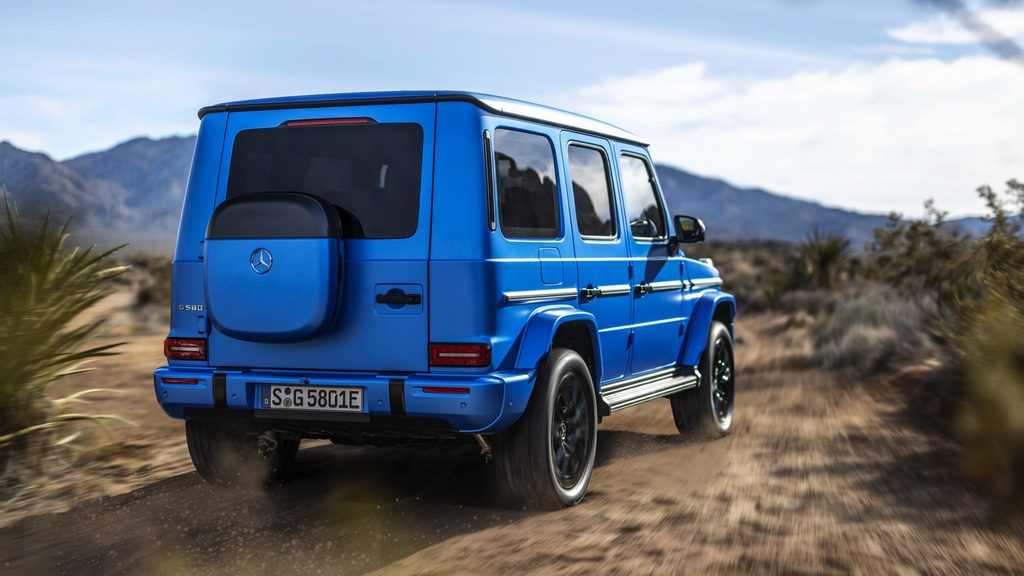
Performance Unchanged, Yet the Story Is Performance
Mercedes-Benz has not altered the mechanical package for 2027. Four electric motors still combine for 579 horsepower (432 kW) and 858 lb-ft of torque. The 0-to-60 mph time remains 4.6 seconds. Top speed holds at 112 mph. Those numbers are identical to the 2026 G 580 Electric's published specification sheet. Yet the press communication emphasises charging speed as the update's centrepiece. That is an odd emphasis for a vehicle whose competitors — including the BMW four-motor performance programme arriving in 2027 — are leading with output figures rather than infrastructure compatibility. The G 580 Electric's 200 kW DC cap also sits below what several competing platforms now accept: Porsche's Macan Electric accepts up to 270 kW, and the Rivian R1S manages 220 kW. Mercedes has not confirmed whether the 200 kW ceiling is a battery chemistry constraint or a thermal management decision. That question was not answered in the September 30 product update, and no separate technical bulletin was published alongside the pricing release.
Dealer and Tariff Exposure at $165,200
US dealers processing orders this week face a configuration window with a wide spread. The base at $165,200 and the already-visible configured example at $187,650 leave $22,450 of option-loaded margin for the brand to capture per unit. That matters more than it might in a higher-volume segment. At 1,450 worldwide units through April 2025, the G 580 Electric is a low-run, high-ticket line where per-unit economics carry outsized weight. Tariff exposure adds a layer of uncertainty. A 25 percent US import tariff on vehicles assembled outside North America — a measure currently under active review, as covered in reporting on US truck tariff adjustments and European IVA developments — could force a further price revision mid-cycle if Mercedes cannot absorb the duty within its current margin structure. The G 580 Electric is assembled in Graz, Austria, by Magna Steyr; it does not qualify for any North American content exemption under current trade rules. Mercedes-Benz AG has not commented publicly on contingency pricing for tariff scenarios.
The G 580 Electric's 117 kWh battery uses a pouch-cell architecture supplied , a detail disclosed in Mercedes-Benz's 2024 sustainability and supply chain report, published February 2025. The G-Class nameplate itself dates to 1979. The complete Mercedes-Benz model history and specifications are catalogued in the Global Auto Index manufacturer database.
