
A reported 30-month slip keeps European-built GLC imports flowing under a 15 percent US tariff.
Thirty months. That is how much time Mercedes-Benz may add to its GLC US production clock. Automotive News reported the Vance, Alabama start date could move from late 2027 to May 2030. Stuttgart has not confirmed it. The $7 billion US commitment, the company says, stands.
The reported delay matters because it extends Mercedes-Benz's reliance on European-built GLC imports at a moment when Washington has applied a 15 percent combined tariff to EU passenger cars, according to US Federal Register trade notices published in spring 2025. BMW's US production at Spartanburg, South Carolina — running above 400,000 units annually — shows what localised volume can do to tariff exposure. Mercedes currently has no equivalent GLC buffer.

How the Timeline Moved
Mercedes-Benz originally slotted next-generation GLC assembly at Vance into the fourth quarter of 2027. That date was tied to a broader expansion announced in spring 2026, when Mercedes and Alabama officials disclosed roughly $4 billion in facility investment linked to future SUV programmes. Vance already builds the GLE and GLS, and has done so since the 1990s, so adding the GLC was a logical extension. Then, according to Automotive News citing people familiar with the plans, the internal target shifted. May 2030 replaced Q4 2027 on the scheduling board. No official production documents have been released, no plant retooling timeline has been published, and Mercedes has not tied any public statement to the new date. The displacement follows a wider pattern of OEMs revisiting North American capital plans as tariff schedules remain unsettled — a pattern tracked across multiple programmes in our industry restructuring 2026 coverage.
What the Tariff Clock Costs on Paper
Work through the numbers. The US applies a 15 percent combined tariff to EU-origin passenger vehicles under the current trade framework. The GLC's European factory gate price sits in the range that puts a US-destination unit at approximately $45,000 to $55,000 before dealer margin. At 15 percent, tariff exposure per vehicle runs roughly $6,750 to $8,250. Mercedes reportedly expected its first 12 months of Alabama GLC output to reach 50,000 units. Multiply the midpoint — $7,500 per vehicle — by 50,000 units: that is $375 million in tariff costs avoided in year one alone once domestic production begins. Delay three years — 2027 to 2030 — and three additional model-year import cycles absorb that exposure before a single Alabama-built GLC reaches a dealer. The plant's broader expansion was costed at $4 billion across multiple models; the GLC share has not been broken out publicly.
Stuttgart's Official Non-Answer
Mercedes-Benz issued one statement when contacted for comment. A company spokesperson told Automotive News and subsequently confirmed to other outlets: 'At this time, we're not providing an update on production timing or allocation of an individual future model. Our commitment to Tuscaloosa and our planned US investment of $7 billion through 2030 has not changed.' The 22-word core of that response is a studied deflection. It confirms the $7 billion figure — announced previously — while explicitly declining to address either the 2027 date or the reported 2030 replacement. Notably absent: any denial that the delay is under consideration. Peter Zürn, head of Mercedes-Benz production planning and cited in earlier Vance expansion coverage, did not respond to requests for further comment by the time of publication. The absence of a denial from a company that has publicly defended its US investment posture is itself a data point.
The $4 Billion Announcement That Doesn't Align
Here is what does not add up. In spring 2026, Mercedes and Alabama state officials jointly announced approximately $4 billion in Vance investment. That announcement was framed around future SUV programmes — language that pointed squarely at the GLC alongside GLE and GLS refreshes. Public investment announcements of that scale are typically timed to anchor production commitments, not precede a 30-month delay. Yet the reported slip to May 2030 would mean the $4 billion headline landed roughly four years before the GLC line actually opens. Alabama's incentive packages, which are typically structured against production milestones rather than announcement dates, have not been publicly renegotiated. Neither Mercedes nor Alabama's Department of Commerce has confirmed whether milestone triggers have been adjusted. If the delay holds and the milestones do not flex, there is a gap between the public commitment and the actual delivery schedule that neither party has explained.
Vance Workers and the SUV Output Ceiling
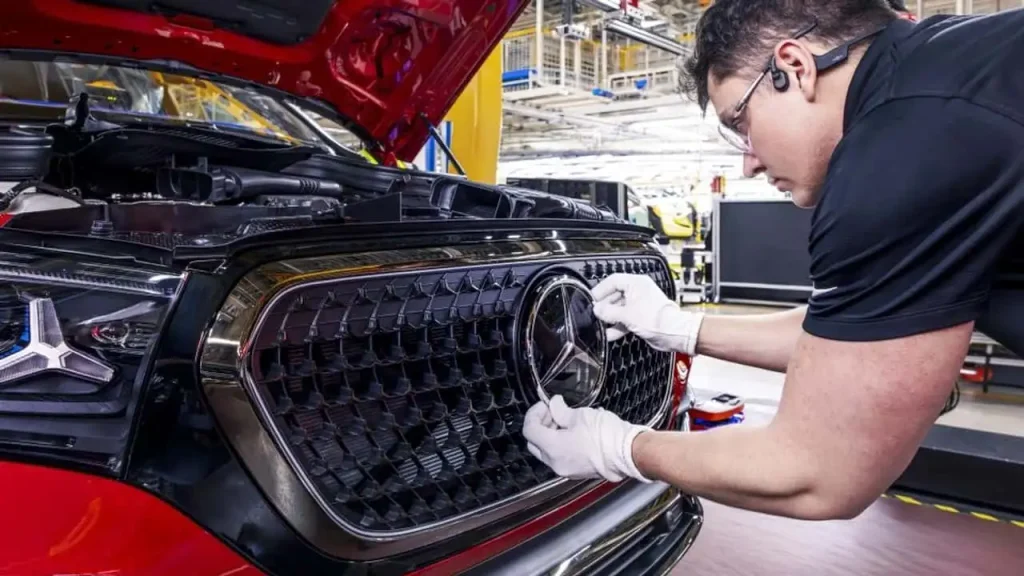
The practical effect lands on the Vance facility's workforce and output ceiling. The plant currently builds the GLE, GLS, EQE SUV, and EQS SUV for US-market delivery. Previous reporting cited by Automotive News suggested full GLC integration could push annual Vance output beyond 280,000 vehicles. Without the GLC line, that ceiling stays lower. United Auto Workers Local 112, which represents Vance employees, has not issued a public statement on the reported delay. Alabama Governor Kay Ivey's office, which co-announced the spring 2026 expansion, also had not responded to queries by publication time — a gap that matters given the state's financial exposure to the investment. Meanwhile, the GLC itself — currently built at Mercedes-Benz's Bremen plant in Germany — continues shipping to US dealers under the tariff regime that the Alabama line was partly designed to sidestep.
Vance opened in 1997 as Mercedes-Benz's first North American assembly facility, initially producing the M-Class at a reported construction cost of $300 million. Total investment at the site has since exceeded $6 billion across multiple expansion phases. Mercedes sold approximately 56,000 GLC units in the United States in 2024, making it the brand's second-highest-volume model in the market that year. The complete Mercedes-Benz model history and specifications are catalogued in the Global Auto Index manufacturer database.
