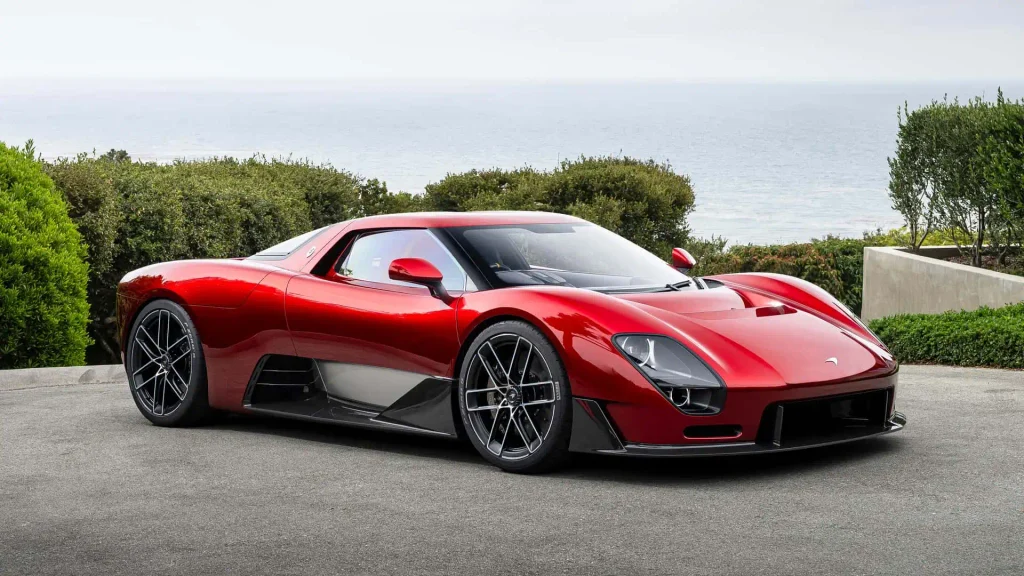
Milan's Eccentrica tapped ex-Lamborghini CTO Maurizio Reggiani to engineer the open-top conversion.
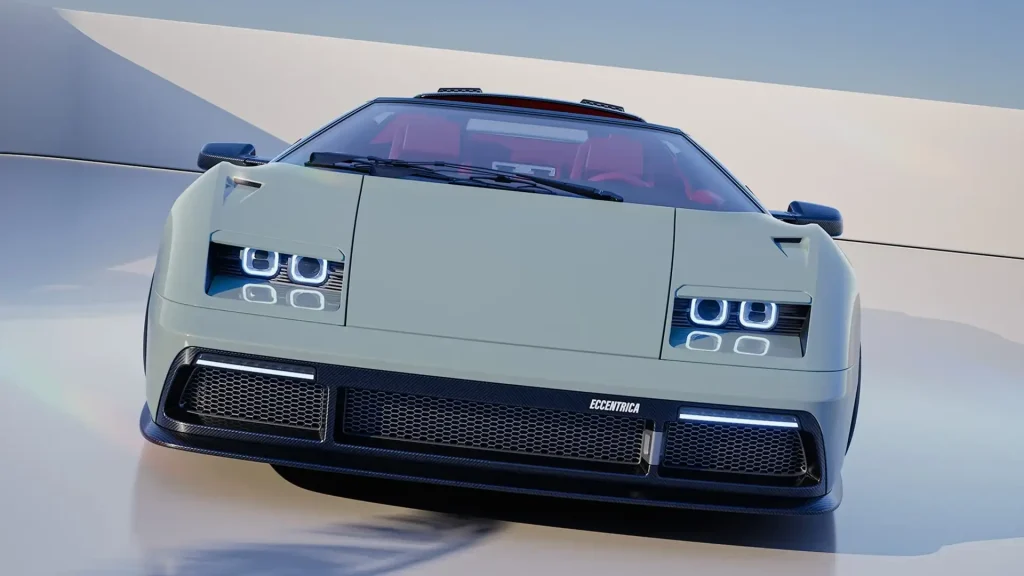
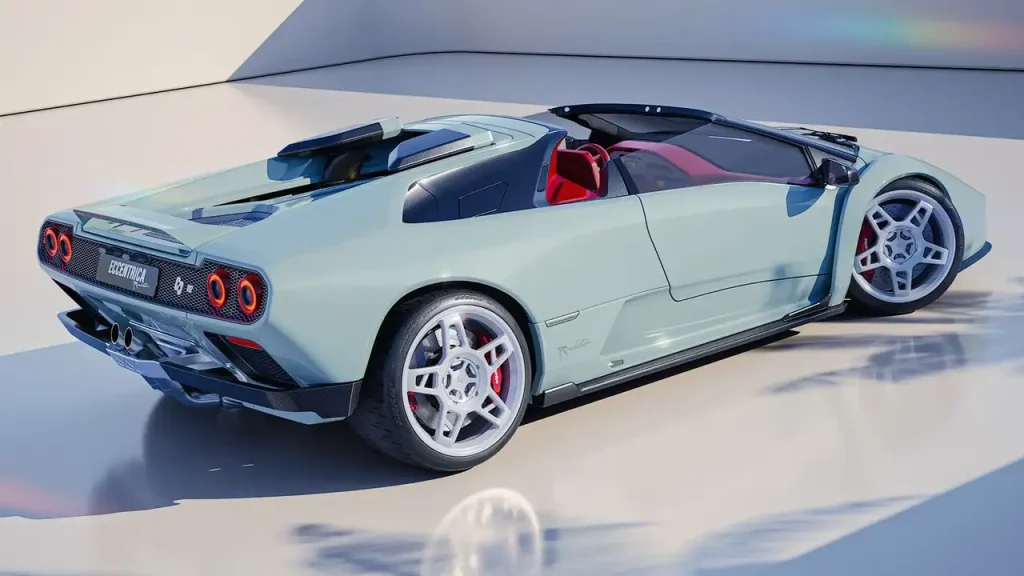
Nineteen cars. One configuration each. Eccentrica unveiled its V12 Roadster ahead of The Quail at Monterey Car Week, dropping the roof on its Lamborghini Diablo restomod and raising output to 550 horsepower. The gated manual stays. The price has not been disclosed.
The announcement lands as bespoke coachbuilders are demonstrating sustained appetite for analogue hardware — naturally aspirated engines, manual gearboxes, open bodywork — precisely as volume manufacturers abandon all three. According to Eccentrica's press release, published August 2025, the Roadster follows a sold-out 19-unit run of the original V12 coupe, meaning the Sant'Agata-derived platform has now supported two consecutive limited series. No electrification is planned for either car.
How the Roof Came Off
Removing a fixed roof from a mid-engined 1990s supercar is not a straight cut-and-weld exercise. Eccentrica conducted a dedicated aerodynamic study to manage airflow over the open cockpit once the structural roof skin was gone. Carbon-fibre reinforcements were added to the chassis to recover torsional stiffness. The body retains a combination of steel and carbon-fibre panels, preserving the Diablo's original proportions while accommodating a widened track. Revised suspension geometry followed, along with semi-active dampers, hydraulic steering, and Brembo brakes. The result sits inside the broader story of European coachbuilders targeting collector demand for analogue supercars — a market that has grown measurably since 2020. Eccentrica worked with Milan-based design studio Borromeo De Silva on the exterior, a collaboration the company confirmed in its August 2025 press materials.
The Numbers Behind 208 mph
The 5.7-litre naturally aspirated V12 produces 550 horsepower at 7,000 rpm and 443 lb-ft of torque. Eccentrica quotes a 0–62 mph time of 3.8 seconds and a top speed of 208 mph. Kerb weight is listed at 3,395 lb (1,540 kg). Power-to-weight ratio: 550 hp ÷ 1,540 kg = 357 hp per tonne. For comparison, the original Lamborghini Diablo VT Roadster of 1995 produced 492 hp from the same 5.7-litre displacement — meaning Eccentrica has extracted an additional 58 hp, a gain of roughly 11.8 percent, without forced induction. The six-speed gated manual transmission is carried over from the coupe specification. Three selectable driving modes adjust throttle and damper mapping. Production is capped at 19 units, matching the coupe run exactly. At that volume, even a unit price north of €1.5 million would place total programme revenue below €30 million — modest by hypercar standards, but sufficient to fund a follow-on series if demand holds.
Colombini's Case for No Filter
Emanuel Colombini, founder of Eccentrica, framed the Roadster as a deliberate escalation rather than a variant. In the company's August 2025 press statement he said: 'The Eccentrica V12 was our opening statement. The Roadster is the next chapter; more exposed, more immediate, more demanding.' The 25-word passage is doing real work. 'No roof. No filter. Nothing between you and the machine' — three consecutive short phrases that read less like marketing copy and more like an engineering brief written backwards. Colombini did not address pricing, order books, or delivery windows in the statement. Eccentrica's press office had not responded to a request for those details by the time this article was filed. The public premiere is scheduled for 14 August at The Quail, a Motorsports Gathering event held during Monterey Car Week on the Monterey Peninsula, California.
The Reggiani Appointment Raises a Question
Maurizio Reggiani served as Lamborghini's chief technical officer across a span that covered the Murciélago, Gallardo, Aventador, and Huracán programmes. His appointment to lead development of the Eccentrica V12 Roadster is the detail that does not quite fit the standard restomod story. Most coachbuild operations of this scale — 19 units, undisclosed price, single configurator per customer — are run by small engineering firms without access to the engineers who originally certified the donor platform. Reggiani's involvement suggests either a level of technical ambition, or a level of financial backing, beyond what Eccentrica's press materials spell out. The company has not published homologation status for road use in the European Union or the United States, nor has it confirmed which crash and emissions standards the Roadster is built to. Those are not minor omissions at 208 mph. McLaren's own bespoke programme announcements in summer 2025 included explicit regulatory pathway detail — Eccentrica's did not.
Where the Roadster Sits Against Coachbuild Competitors
The coachbuilt restomod sector has become measurably crowded since 2021. Singer Vehicle Design's Porsche 911 Turbo Study — also naturally aspirated, also manual — was priced above $1.8 million and sold out within weeks of announcement, according to Singer's own production disclosures. Touring Superleggera's Arese RH95, a Ferrari 488-based open car limited to 15 units, carried a base price of approximately €500,000 in 2021. Eccentrica's 19-unit cap matches Singer's typical series size but targets a different donor vehicle: the Diablo's collector value has risen sharply, with clean original examples selling at Gooding & Company's Pebble Beach auction for between $250,000 and $400,000 in the 2023–2024 cycle. Against those comparators, a restomod premium of three to four times donor value would imply an Eccentrica ask somewhere between $750,000 and $1.6 million — though the company has confirmed nothing. The contrast with volume supercar manufacturers, who face recall and regulatory pressure rather than sold-out waiting lists, is not lost on the coachbuild sector.
The original Eccentrica V12 coupe, the closed predecessor to this Roadster, featured more than 3,500 bespoke components per car — a figure Eccentrica carried forward to the Roadster specification unchanged. The Diablo production run at Sant'Agata ended in 2001 after 2,884 units across all variants. Nineteen more, done properly, is a different kind of arithmetic. The complete Lamborghini model history and specifications are catalogued in the Global Auto Index manufacturer database.
