The final roadster endured 400 kilometres of testing and hit 300 km/h at Colmar Airport before handover.
Molsheim is done with the W16. The 99th Bugatti Mistral — named "The Last of Its Kind" — was delivered in 2026, closing out a quad-turbocharged 8.0-litre engine line that ran for more than two decades. That's it. No more.
The W16 first turned a wheel in the 2005 Veyron. It outlasted three model generations — Veyron, Chiron, Mistral — and a corporate ownership transfer from Volkswagen Group to Rimac Automobili, which completed its acquisition in 2021, according to Rimac Group's corporate disclosure published November 2021. No comparable hypercar engine has maintained production-spec output across that span. The incoming V16 in the Tourbillon, co-developed with Cosworth, runs without forced induction — a deliberate departure from every W16 road car that preceded it.
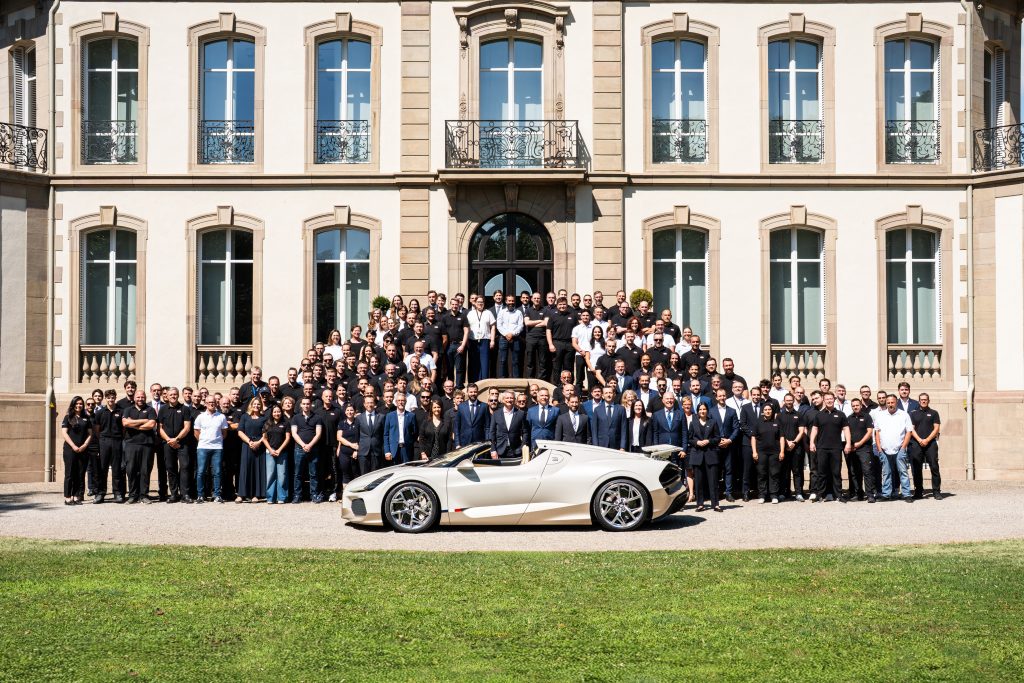
How the 99th Car Was Built and Delivered
Bugatti assigned three test drivers — each cleared to the brand's internal certification standard — to validate every Mistral before it left the factory. The 99th car cycled through 400 kilometres of structured evaluation. Then it went to Colmar Airport, roughly 20 kilometres from the Molsheim atelier in the Alsace region of northeastern France, where test drivers ran it to 300 km/h on the airfield strip. That gate-to-gate verification ritual applied to all 99 cars in the production run. The final customer specified a two-tone Pearl and Sparkle exterior, Magnolia and Grey Carbon Matt interior accents, and Ettore Bugatti's signature embossed on the headrests, machined into the aluminium door sills, and stitched into the engine cover's inner trim. No two Mistrals left Molsheim in the same specification. Bugatti's Programme de Personnalisation allowed changes down to individual stitching colour. The 99th is, by definition, also a one-off. This approach to European ultra-low-volume hypercar production has defined Bugatti's commercial model since the Veyron launch.
The Numbers That Define a Two-Decade Engine Programme
The W16's production lifespan stretched from 2005 to 2025 — exactly 20 years. Across that period, three road-car nameplates carried the engine: the Veyron (450 units produced), the Chiron (500-unit cap), and the Mistral (99 units). Adding the Bolide, a track-only machine capped at 40 units and fully built by November 2025 per Bugatti's own production confirmation, the W16 powered a combined ceiling of 1,089 cars across all models: 450 + 500 + 99 + 40 = 1,089. The Mistral's record run came in November 2024, when racing driver Andy Wallace reached 453.91 km/h at ATP Automotive Testing Papenburg in Germany — a figure that stands as the fastest verified speed for any open-top production car. Each Mistral carried a base price in the region of €5 million. At that figure, the 99-car run represents a gross revenue ceiling of approximately €495 million before options, which on Bugatti orders routinely add six figures per unit. The replacement Tourbillon is limited to 250 units. That's a 152.5% increase in production volume over the Mistral — the first time Bugatti has scaled an open nameplate upward since the Chiron exceeded the Veyron's unit count.
What Bugatti's Own Documentation Says About the Tourbillon Facility
Bugatti confirmed in its July 2026 facility announcement that La Manufacture, the new production site in Molsheim, is rated to build up to 200 cars per year. The brand's press materials, dated July 2026, describe the building as "inaugurated" — meaning it opened for operations but had not yet begun Tourbillon assembly at the point of publication. The Tourbillon's 250-unit production cap would, at La Manufacture's stated ceiling, represent a minimum 15-month production commitment running at full capacity, or longer if output ramps gradually from tooling completion. Bugatti has not confirmed a first-delivery date. The naturally aspirated V16, developed with Cosworth and paired to a hybrid system, represents a technical departure significant enough that the brand has declined to give a production-start quarter. Chris Harris, a journalist who drove a Tourbillon prototype, described the engine note in a separate account as "unlike any hybrid" — a descriptor that tells you more about the exhaust tuning than the powertrain numbers, which Bugatti has published as 1,000 hp from the combustion unit alone, supplemented by electric motors.
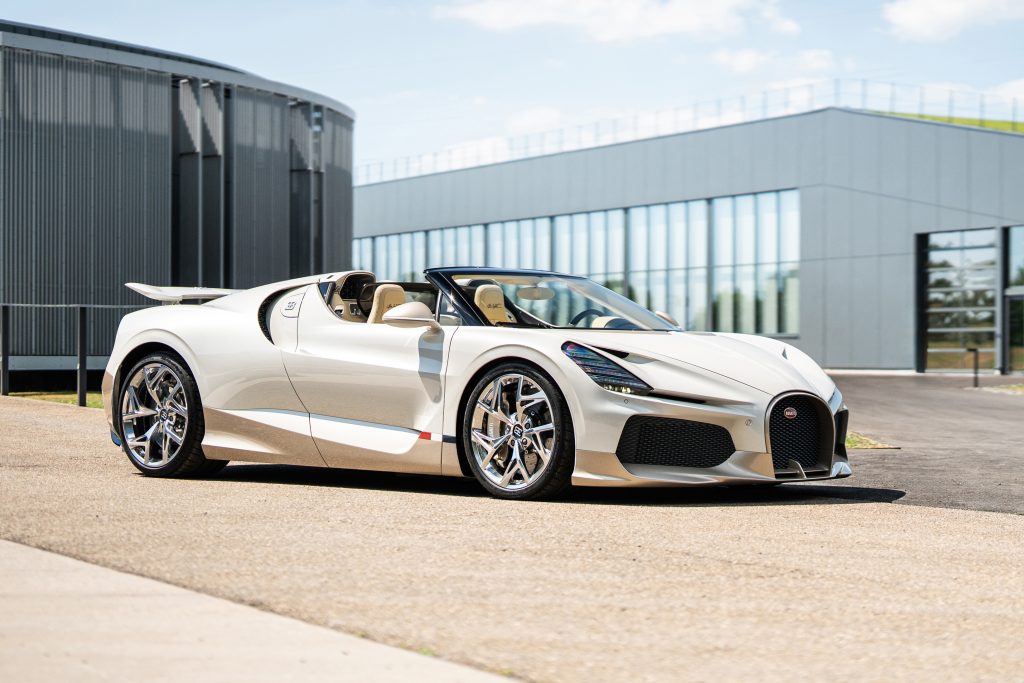
The Programme Solitaire Contradiction
Bugatti has formally retired the W16 from series production. That much is clear. What is less clear is the boundary the brand draws around "production." The Programme Solitaire — a bespoke commission service for few-offs and one-offs — explicitly remains open, and Bugatti has confirmed it will accept W16-based orders from existing model lines. Two cars per year maximum. Two W16-based Solitaire projects have already been revealed publicly: the Brouillard and the FKP Hommage, the latter a Veyron-inspired commission. Neither model has been assigned a VIN series or a public price, and Bugatti has not confirmed whether Solitaire cars count against any homologation or emissions registration framework. Under Euro 7 regulations — which the European Commission published in final form in June 2024 — type-approved vehicles face stricter NOx and particulate limits from 2025 onward, though low-volume exemptions exist for manufacturers producing fewer than 1,000 units annually. Whether the Programme Solitaire qualifies under those exemptions has not been addressed in any Bugatti public statement reviewed for this article. That gap matters. European regulatory pressure on high-displacement ICE vehicles is tightening, and a two-car-per-year carve-out may not survive contact with the next emissions review cycle.
W16 Exit vs McLaren's Concurrent ICE Expansion
Bugatti is retiring forced-induction internal combustion at the top of the market in the same window that McLaren is expanding its ICE portfolio. According to McLaren's product plan disclosure from summer 2025, McLaren confirmed new sports cars and an SUV — all expected to carry twin-turbocharged V8 or V6 derivatives — through the end of the decade. BMW, meanwhile, confirmed a four-motor M3 producing 1,300 hp for 2027, a figure achieved through electrification rather than displacement. The contrast is direct. Bugatti's V16 Tourbillon produces 1,000 hp from its combustion unit alone — no forced induction, 8.3-litre displacement — whereas BMW reaches 1,300 hp only by stacking four electric motors onto a combustion base. At the €5 million price tier, the engineering argument shifts from peak output to character. Bugatti is betting that a naturally aspirated V16 at that displacement justifies the absence of a turbo. No competitor at equivalent price has made the same call in the past 15 years. The last normally aspirated production car near that output tier was the Lexus LFA at 552 hp — less than 60% of the Tourbillon's combustion figure — which ended production in 2012.
Bugatti's Molsheim factory dates to 1909, making it one of the longest-continuously-operated specialist car plants in Europe. The Programme Solitaire's two-cars-per-year ceiling means that, across a full decade, it could produce fewer W16-based commissions than the Bolide managed in a single production run. Rimac Group has not confirmed a timeline for a Tourbillon open-top variant, and no Mistral successor has been announced. The complete Bugatti model history and specifications are catalogued in the Global Auto Index manufacturer database.
