The electric estate drops the 3 Series' long-running split-glass tailgate feature, prototype footage confirms.
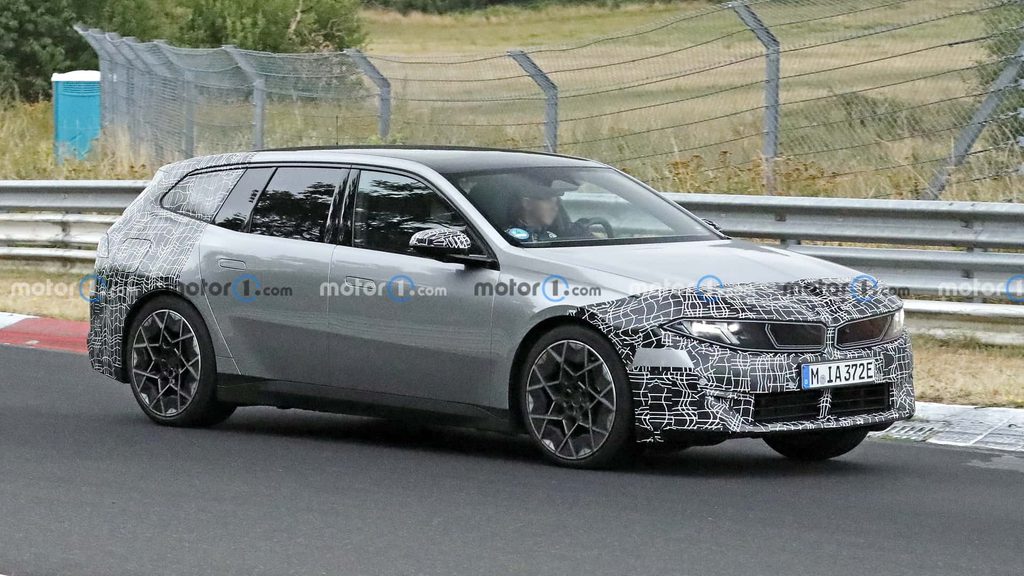
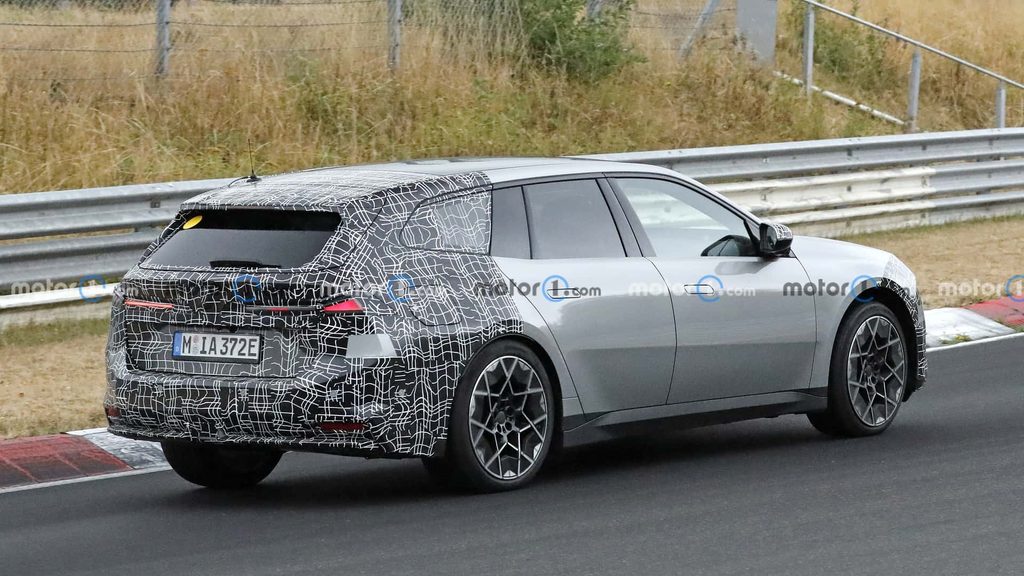
A camouflaged BMW i3 Touring prototype turned laps at the Nürburgring in early November 2025. The footage exists. It is not a render. Behind the B-pillar, the roofline extends into a full estate tailgate — a body style BMW has confirmed will be built in Munich.
The i3 Touring will ride BMW's Neue Klasse dedicated electric architecture, the same platform underpinning the i3 sedan revealed at the 2024 Munich IAA. That matters because Volkswagen's ID.7 Tourer — launched in Europe in late 2023 at a base price of approximately €57,000 — has had the electric estate segment largely to itself. According to BMW AG's investor day presentation, February 2025, Neue Klasse production at the Munich plant is confirmed from 2026, with additional body variants to follow in subsequent model years.
What the Prototype Footage Shows
Video captured by CarSpyMedia, published 6 November 2025, shows the i3 Touring completing multiple laps in heavy camouflage wrap. The disguise concentrates on the front fascia — suggesting that section is still being finalised — but leaves the extended roofline partially readable. Engineers stretched the cabin rearward from the B-pillar, producing a longer rear quarter window and a tailgate opening that sits lower and wider than the sedan's boot lid. A panoramic glass roof spans the full length of the cabin. It is a fixed panel, one piece, with no sliding section — matching the arrangement already fitted to the production i3 sedan. The rear bumper shows no visible tow-hitch preparation, though European Touring variants have historically offered a detachable unit as a factory option. No badging is visible in the footage. For BMW's full Neue Klasse EV transition coverage, see the dedicated cluster on this site.
Cargo Numbers: What the Estate Format Gains Over the Sedan
The production i3 sedan carries a 420-litre boot and a 31-litre front storage compartment, giving a combined accessible volume of 451 litres. Estate conversions on previous 3 Series generations added between 185 and 210 litres to the boot floor measurement — the G21 3 Series Touring, for example, offered 500 litres with seats up against the sedan's 480 litres, a 20-litre differential on that generation that widened to roughly 675 litres with seats folded. If BMW achieves a similar proportional gain on the Neue Klasse estate body — call it a conservative 150-litre addition — the i3 Touring would land around 570 litres with seats up: 420 + 150 = 570 litres. That figure would sit below the Volkswagen ID.7 Tourer's rated 605-litre boot but above the BMW iX3's 510-litre load bay. The 31-litre frunk, according to the source footage analysis, appears structurally unchanged between sedan and estate variants.
The Disappearing Button: Aerodynamics or Accountancy
For decades, every BMW Touring came with a button — usually mounted in the boot sill or on the key fob — that opened the rear glass independently of the full tailgate. Useful in tight car parks. Useful in the rain. The i3 Touring prototype, based on the November 2025 footage, shows no visible actuator or button placement on the tailgate lower sill where it has historically sat. BMW removed the same feature from the G61 i5 Touring at its 2023 launch. When asked directly about that deletion, BMW's press office did not cite cost reduction. The official line, relayed through BMW's product communications team, cited aerodynamic sealing requirements around the tailgate aperture. That explanation deserves scrutiny: the outgoing G21 3 Series Touring, built on the older CLAR platform, retained the split-glass function throughout its production run without documented aero penalty. No technical white paper has been published by BMW AG explaining the specific drag coefficient difference between single-piece and split-glass tailgate designs on Neue Klasse bodies.
Neue Klasse vs CLAR: Two Platforms, Two Factories, One Badge
BMW has confirmed Munich's Plant 1 for i3 Touring production — the same facility assembling the i3 sedan from 2026. A combustion-powered 3 Series Touring, if it proceeds, would be built at Dingolfing on the CLAR platform, approximately 75 kilometres northeast of Munich. The two cars would share exterior proportions and the Touring name but nothing structural underneath. CLAR, introduced on the G30 5 Series in 2017, is a modular architecture supporting petrol, diesel, and plug-in hybrid drivetrains. Neue Klasse is battery-electric only, engineered from scratch with a cell-to-body integration approach BMW AG described in its Annual Report 2024 as targeting a 30 percent improvement in energy density per litre of pack volume compared to the fifth-generation battery system used in current iX and i7 models. The two-platform split also means the i3 Touring and any future 3 Series Touring G30-successor would not share suspension tuning, steering calibration, or software architecture — a greater divergence than the gap between, say, the E46 petrol and E46 diesel variants of twenty years ago.
M Versions and the US Market Gap
BMW M GmbH is expected to develop performance derivatives once the standard i3 Touring reaches production. Thomas Steg, head of BMW Group external relations, confirmed in a panel discussion at the 2025 Munich IAA that M involvement in Neue Klasse variants is active, without specifying models or timelines. An i3 M60 Touring — mirroring the i3 M60 sedan already revealed — would use a quad-motor setup. The direct consequence falls on North American BMW customers. Currently, the only BMW estate available in the United States is the M5 Touring, which carries a manufacturer's suggested retail price starting at $139,900 for the 2025 model year, according to BMW of North America's published pricing, October 2024. A standard-output i3 Touring, priced in line with the European i3 sedan's expected positioning below €60,000, would represent an entirely different access point. BMW has not confirmed US allocation for the i3 Touring. That silence is itself a decision: without a formal product announcement, US dealers have no order pipeline to manage and customers have no alternative to the M5 Touring's six-figure entry point.
BMW's Touring lineage dates to the E30-based 3 Series estate of 1987 — 38 years of continuous production across six generations on the combustion side alone. The i5 Touring, launched in 2023, became the first electric BMW estate; the i3 Touring would be the second. BMW Group sold 2.55 million vehicles globally in 2024, according to BMW AG's full-year results, February 2025. The estate body style represented less than 12 percent of that volume. That share may shift. The complete BMW model history and specifications are catalogued in the Global Auto Index manufacturer database.
