







The 115 kWh seven-seat SUV needs BYD's own 1,500 kW Flash chargers to hit that figure.
Nine minutes. That is the number BYD put on the board in Paris on October 12. The Atto 8 — a 115 kWh, seven-seat SUV — is the brand's largest European model yet. It reaches showrooms in Q1 2027. The claim comes with conditions.
Flash charging at that speed demands BYD's own second-generation Blade battery paired with proprietary Flash chargers rated at up to 1,500 kW, according to BYD's official Atto 8 product brief, published October 2025. For context, the fastest publicly available DC chargers in Europe top out at 350 kW. BYD plans 3,000 Flash stations across the continent -2027 — a network that does not yet exist.
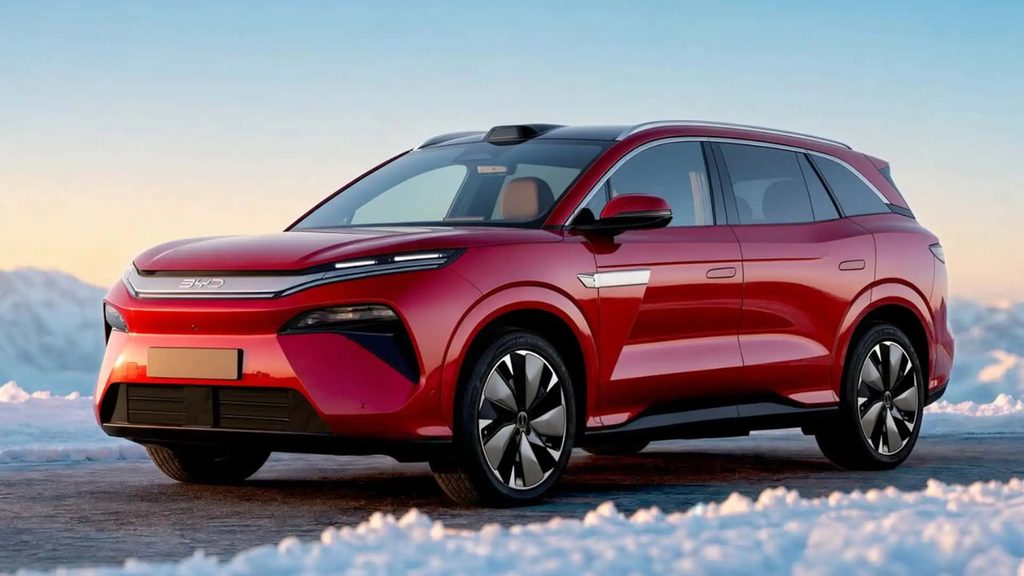
A Flagship Arrives on Europe's Biggest Stage
BYD chose the Paris Motor Show for the Atto 8 reveal, a deliberate venue selection. Paris draws European press, European regulators, and European dealer networks in a single room. The Atto 8 is 198.4 inches long, 78.6 inches wide, and 69.3 inches tall — dimensions that place it alongside the Skoda Enyaq Coupé RS and the Kia EV9 in footprint. BYD Executive Vice President Stella Li presented the model as evidence of the brand's ambitions in the region, describing it as the vehicle where the company turns its battery technology into something a family can actually use on a school run or a motorway trip. The interior includes a panoramic glass roof covering 25.7 square feet and a 15.6-inch central touchscreen. Deliveries are targeted for the first quarter of 2027. European pricing has not been confirmed. For broader context on how Chinese manufacturers are entering European markets, see our Chinese OEM Europe expansion tracker.
The Numbers Behind the Nine-Minute Headline
BYD offers the Atto 8 in two drivetrains. Work through them in order. The Design variant runs rear-wheel drive with a single motor producing 455 hp. WLTP range is claimed at 405 miles, and 0–62 mph takes 5.8 seconds. The Excellence variant adds a second motor for all-wheel drive: combined output is 764 hp with 571 lb-ft of torque, 0–62 mph drops to 4.6 seconds — a difference of 1.2 seconds — and WLTP range falls to 374 miles. That 31-mile range penalty for the AWD configuration works out to a 7.7 percent reduction: 405 minus 374, divided by 405, multiplied by 100. On charging: 10 percent to 70 percent in five minutes; 10 percent to 97 percent in nine minutes. The usable charge window in those nine minutes is therefore 87 percentage points of a 115 kWh pack, or roughly 100 kWh of delivered energy — at 1,500 kW peak draw, the arithmetic checks out in theory. Cold-weather performance drops to 12 minutes for the same 10–97 percent window at minus 30 degrees Celsius.
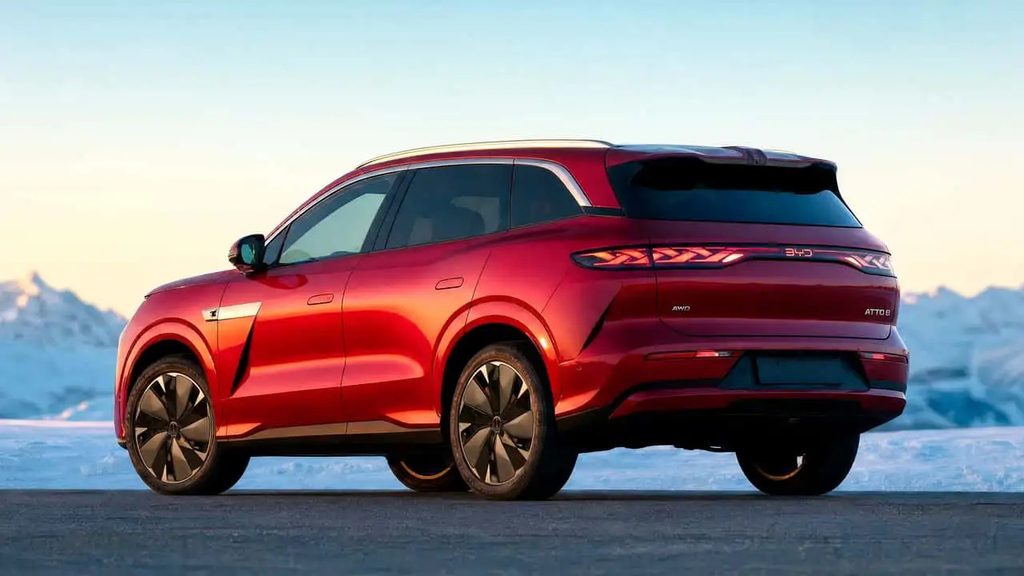
Li's Refuelling Comparison and What It Glosses Over
Stella Li, BYD Executive Vice President, told the Paris audience the Atto 8 represented "the breakthrough for EVs that everyone has been waiting for," drawing a direct comparison to filling a petrol tank. The eight-word extract — "the breakthrough for EVs that everyone has been waiting for" — was the line that led most European trade coverage. It is a confident claim. BYD's own product materials, however, specify the nine-minute figure applies only when the Blade battery second generation is connected to BYD Flash chargers rated at up to 1,500 kW, according to BYD's Atto 8 technical specification sheet, published October 2025. Li did not address the charger network gap in her Paris remarks. A petrol station does not require a proprietary pump. The comparison flatters the charging speed while sidesteping the infrastructure dependency — a dependency BYD has three years and 3,000 planned stations to resolve before the Atto 8's sales cycle matures.
3,000 Stations for a Continent of 447 Million People
Here is what does not add up. BYD is selling nine-minute charging as a core differentiator. The nine-minute figure requires BYD Flash hardware. BYD has committed to 3,000 Flash stations across Europe by the end of 2027. The European Commission's Alternative Fuels Infrastructure Regulation, published in the Official Journal of the European Union, March 2023, required member states to deploy public charging every 60 kilometres along the TEN-T core network by end-2025 — a target that involved tens of thousands of charge points across multiple operators. Three thousand proprietary stations spread across a landmass containing 27 EU member states plus Norway, Switzerland, and the UK is a thin footprint. BYD has not published a station-by-station deployment map or confirmed which markets receive hardware first. The company also has not clarified what the Atto 8 accepts at third-party CCS stations in terms of peak kilowatt intake — a figure that would determine real-world charging behaviour for the overwhelming majority of journeys in 2027 and beyond. That number was absent from the Paris materials.
How the Atto 8 Stacks Against Established European Three-Row EVs
The Kia EV9, which reached European markets in late 2023, offers a 99.8 kWh battery in its largest configuration and accepts up to 240 kW on DC. A 10–80 percent charge takes approximately 24 minutes under those conditions, according to Kia's product documentation, published Q3 2023. The Atto 8's 115 kWh pack is 15.2 kWh larger — a 15.2 percent increase — and BYD's headline charging rate of 1,500 kW is more than six times the EV9's peak DC acceptance. On paper, those are wide margins. Range tells a tighter story: the EV9 Long Range AWD claims 512 km WLTP; the Atto 8 Excellence AWD claims 374 miles, which converts to approximately 602 km — a 90 km advantage. Whether European drivers encounter BYD Flash hardware often enough to experience that charging gap in practice is the open question. Mercedes-Benz's EQS SUV, priced above both, peaks at 200 kW on DC and carries a 118.0 kWh pack — almost identical in capacity to the Atto 8, but at a significantly different price point that BYD has yet to set.
The Atto 8 carries a drag coefficient BYD has not yet disclosed — a figure that will affect whether the 405-mile WLTP range holds across European speed limits. BYD's European sales volume reached approximately 83,000 units in 2024, according to the European Automobile Manufacturers' Association data, published February 2025. The complete BYD model history and specifications are catalogued in the Global Auto Index manufacturer database.
