







The ID. Buzz-based van sleeps two and can run climate control for 48 hours on battery alone.
Volkswagen has confirmed the ID. California Cruise. Price: €60,800 in Germany. The California nameplate, running since 1988, gets its first zero-emission model. Deliveries start early 2027. The platform is the ID. Buzz Pro.
The California has sold on a single proposition for 37 years: a van you drive to work Monday and sleep in . Moving that to battery-electric is not a cosmetic update — it requires rethinking power management, climate, and range anxiety on touring routes. According to Volkswagen Nutzfahrzeuge's official product release, published August 2026, this model opens a planned family of electric camper variants scheduled to expand through 2028, putting it directly against Stellantis's Citroën ë-Spacetourer-based conversions already on sale in France.
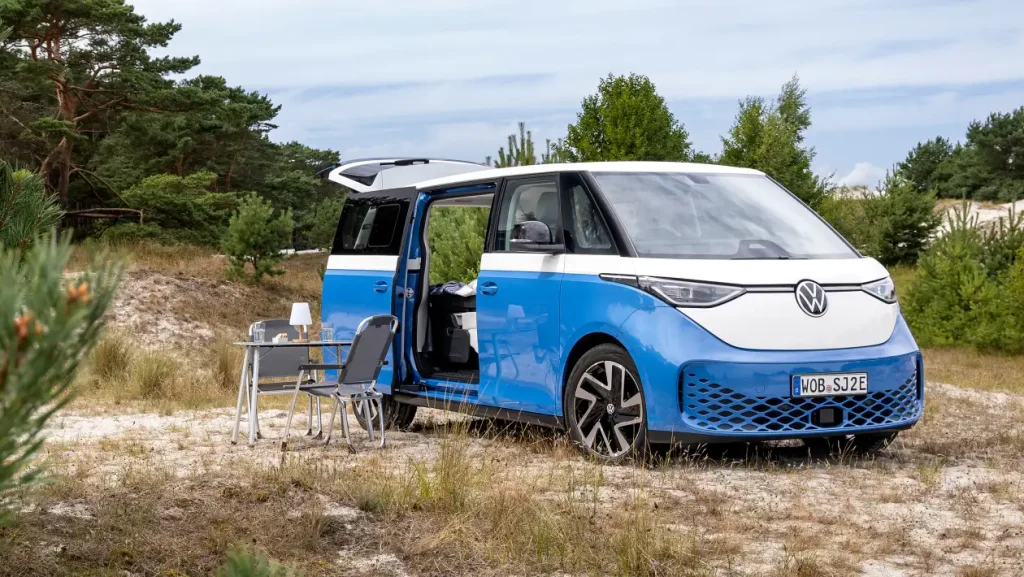
Düsseldorf Debut Closes a 38-Year Combustion Chapter
Volkswagen chose the 2026 Caravan Salon in Düsseldorf to pull the cover off the ID. California Cruise — the show floor where the leisure vehicle trade writes its annual order books. The choice was deliberate. Caravan Salon draws roughly 250,000 visitors across nine days, and Volkswagen Commercial Vehicles needed the room crowds, not a press-only webcast, to signal that this is a volume product, not a concept. The California name appeared on its first T3-based camper in 1988. Every generation since has used a combustion engine in some form. The ID. California Cruise ends that run. It goes on sale in Germany first, with broader European rollout timing not yet confirmed by Volkswagen Nutzfahrzeuge. This launch sits within the broader OEM model launches covered in our manufacturer database, where platform transitions of this scale are tracked across model cycles.
Bed, Battery, and the 48-Hour Climate Claim
The sleeping platform measures approximately 203 cm long by 119 cm wide — call it a generous double, not a queen. The folding mattress is 9 cm thick. Climate control, according to Volkswagen's product specification sheet, can sustain heating or cooling for up to 48 hours, though the company qualifies that figure against battery state-of-charge and the delta between cabin and ambient temperature. Run the arithmetic: a standard ID. Buzz Pro carries a 79 kWh usable pack. Running a vehicle HVAC system draws roughly 1–2 kW in moderate conditions, so 48 hours at 1.5 kW average consumes 72 kWh — that is 91% of the pack, leaving almost nothing for driving. In practice, expect the 48-hour figure only in mild weather with a near-full charge. VW does not publish the dedicated camping-mode power draw rate in the August 2026 release, which is a gap worth watching when independent tests arrive.
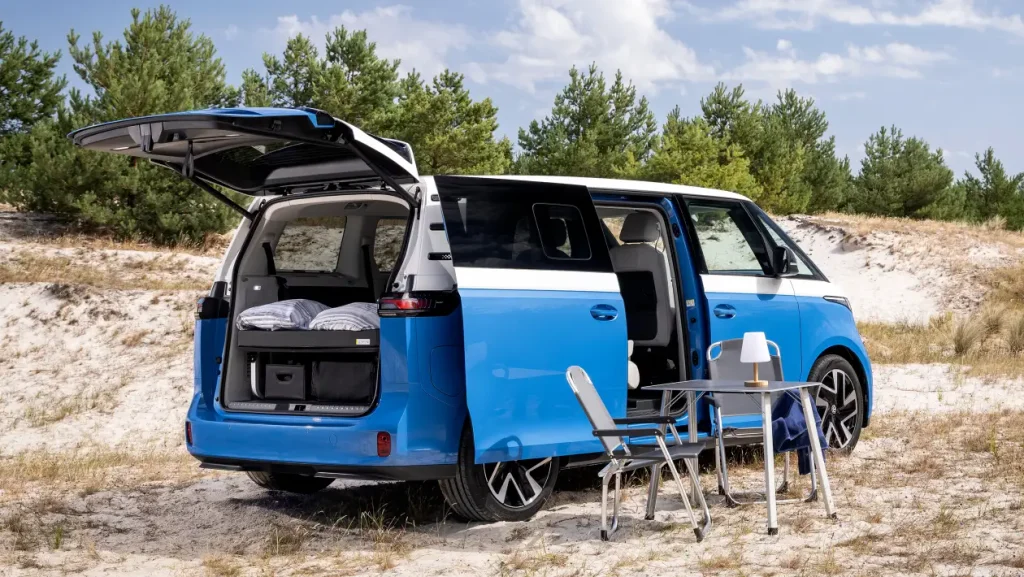
Vehicle-to-Load and the California Mode Promise
Volkswagen's August 2026 product documentation describes California mode as "developed specifically for use while parked," managing lighting, USB continuity, and pre-conditioning for overnight stays through a secondary control unit independent of the main drive system. That separation matters: it means California mode does not require the full vehicle computer stack to stay live, which reduces phantom drain. The vehicle-to-load function extends the battery's reach further — powering coffee makers, induction plates, portable refrigerators, e-bike chargers, and what Volkswagen calls "mobile workstations." No output wattage figure was published in the August 2026 release. Comparable V2L implementations on the Hyundai Ioniq 5 and Kia EV6 deliver 3.6 kW at the external socket — Volkswagen has not confirmed whether the ID. California Cruise matches that figure, exceeds it, or falls short. The California App gains route-planning functions that identify compatible charging stations, and Plug & Charge activation removes manual authentication at supported stations.
How the Cruise Stacks Up Against Existing Electric Camper Conversions
The ID. California Cruise enters a market that conversion specialists have occupied for three years. Reimo Reisemobile, based in Egelsbach, Germany, has been fitting ID. Buzz Cargo vans with camper interiors since 2023, with finished prices ranging from €75,000 to €90,000 depending on specification. The ID. California Cruise's €60,800 opening price undercuts those by at least €14,200 at the low end — a difference of roughly 19%. The trade-off is factory standardisation versus bespoke flexibility: conversion buyers can specify a high-top roof or a full kitchen galley; the Cruise offers neither at launch. On wheelbase, Volkswagen offers both short and long ID. Buzz body lengths, giving buyers a choice the T6.1 California never had in its final combustion form, which was available only in the standard wheelbase. Kia's UK EV rollout and its V2L precedent on the EV6 give some indication of where EV camping power standards may settle across the segment.
What Volkswagen Has Not Said
Several figures absent from Volkswagen Nutzfahrzeuge's August 2026 release deserve attention before order books open. Range is unconfirmed — the ID. Buzz Pro Long Wheelbase posts a WLTP figure of around 461 km in standard trim, but California mode's added weight from camping furniture and the battery load from V2L use will reduce that. Volkswagen has not published a California-specific WLTP cycle. Payload capacity is also missing: the bed frame, mattress, chairs, table, and blackout shades add mass, and the ID. Buzz Pro already operates close to its gross vehicle weight limits in fully loaded family configurations. Tow rating is unaddressed, despite touring campers frequently pulling a trailer or bike carrier. Finally, the 2028 expansion models are referenced in the release without body style, price band, or platform detail. Volkswagen confirmed the family exists. It confirmed nothing else. The regulatory picture for electric leisure vehicles is shifting too — Europe's evolving IVA tightening could affect how camper conversions are classified and taxed at the point of sale.
The California name has appeared on six distinct generation platforms since the T3 in 1988 — T3, T4, T5, T6, T6.1, and now MEB. Volkswagen Commercial Vehicles produced more than 250,000 California units across the T5 and T6 generations combined, according to internal sales data cited Nutzfahrzeuge press office in 2023. Early 2027 delivery slots are expected to open in Germany before year-end 2026. No confirmed right-hand-drive date has been published for the United Kingdom. The complete Volkswagen model history and specifications are catalogued in the Global Auto Index manufacturer database.
