Mercedes-AMG recorded its old 3.0-litre six using 16 microphones to build the GT 53's acoustic profile.
Stuttgart moved fast. Three months after the GT 55 and GT 63 debuted in May, Mercedes-AMG added a third variant. The GT 53 4-Door arrives with 536 hp, a 503-mile WLTP range estimate, and an acoustic system that mimics a combustion engine it no longer carries.
The GT 53's appearance matters because it sits €39,270 below the GT 63 at a German list price of €115,430, according to Mercedes-Benz pricing published August 2025, and it offers 71 more WLTP miles than the GT 63's 432-mile figure. Where most OEMs have left EV sound design to software teams, Mercedes-AMG has built a recorded-sample approach that other performance brands have not yet matched publicly.
Three Motors Down to Two — the Range Trade-Off in Numbers
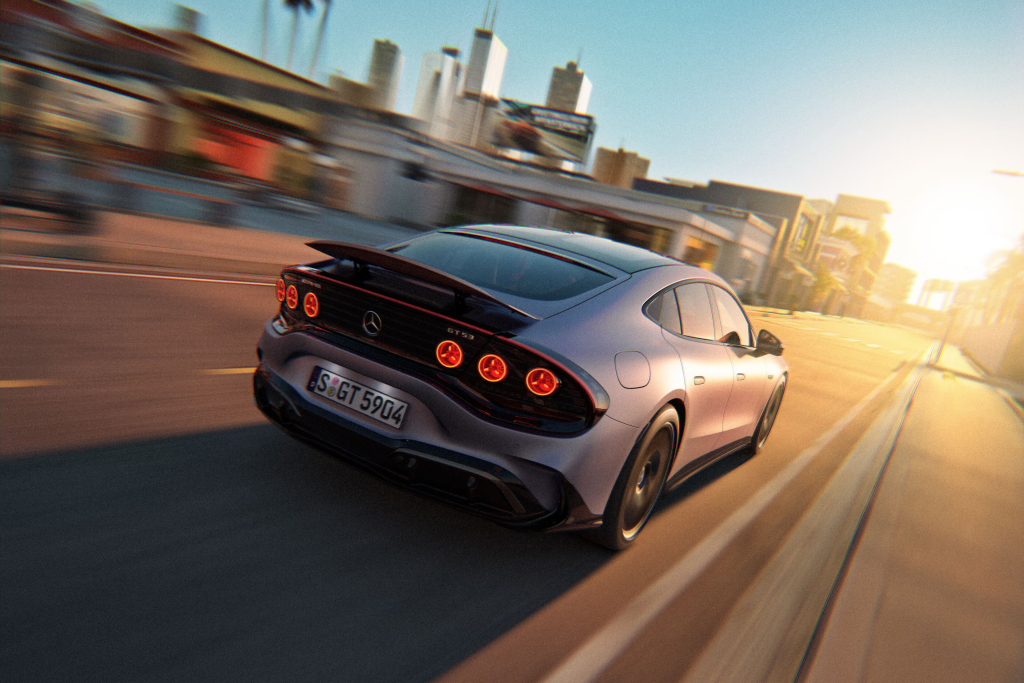
The GT 53 drops the three axial-flux motors found in the GT 55 and GT 63 and uses two electric motors instead. Peak output lands at 536 hp (400 kW) and 800 Nm of torque. Continuous rated output is 362 hp — meaning the headline figure is available only in bursts, a gap of 174 hp between peak and sustained delivery worth noting for track use. On range, the arithmetic favours the base car. The GT 53 claims 809 km (503 miles) on WLTP; the GT 55 returns 700 km (435 miles); the GT 63 manages 696 km (432 miles). That is a 113 km advantage over the GT 55 and 113 km over the GT 63 — roughly 16 percent more range from the least powerful variant. Charging figures are equally aggressive. The GT 53 supports 600 kW DC peak charging, with a 10-to-80 percent fill taking 11 minutes. Ten minutes of charging at peak rate adds up to 534 km (332 miles) of recovered range, according to Mercedes-Benz technical documentation released August 2025. This is part of the wider performance EV transition playing out across German OEMs, where range and charge speed are now the metrics luxury brands fight over.
16 Microphones, 100-Plus Measurements: How the Sound Was Built
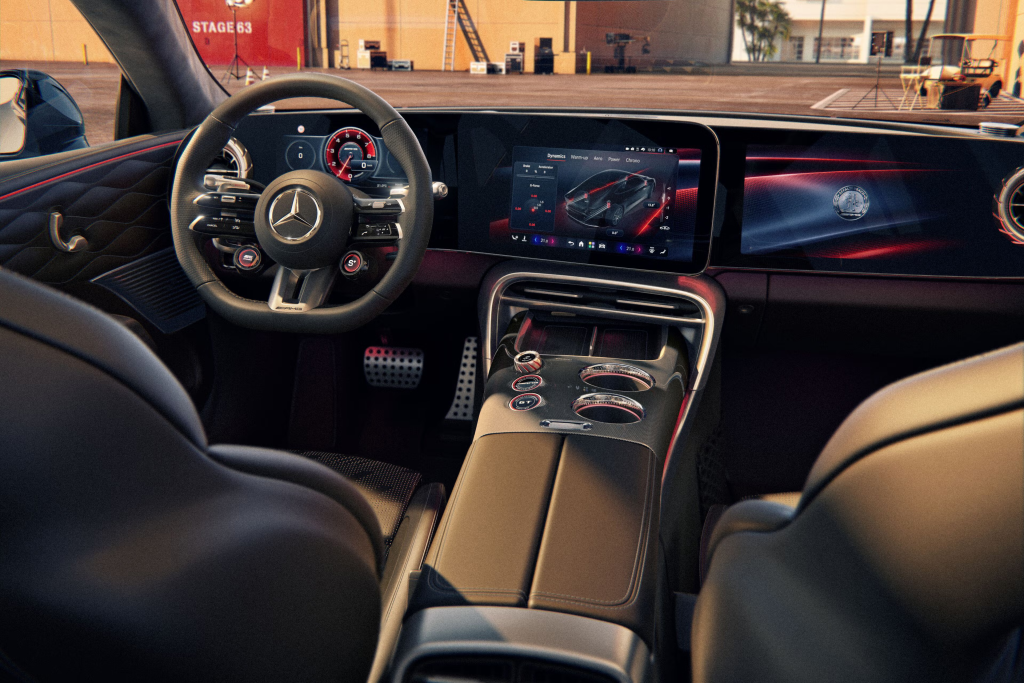
Mercedes-AMG's acoustic brief for the GT 53 is documented in the vehicle's official technical release, published by Mercedes-Benz communications on 6 August 2025. The document states that engineers recorded the sound of an actual inline-six combustion engine — specifically the turbocharged 3.0-litre unit from the AMG E53 Coupe — using 16 microphones mounted both inside and outside the donor vehicle. More than 100 separate measurements were taken, with the source car running both stationary and at speed. The resulting audio was then mapped to the GT 53's electric powertrain so that sound output tracks throttle input and simulated gear changes in real time. The release describes the result as an "authentically reproduced combustion engine sound" intended to deliver what Mercedes-AMG calls a "goosebump factor." The GT 55 and GT 63 use a different sample set that mimics a V8, not a six-cylinder, meaning each tier of the three-car lineup carries a distinct acoustic identity. Sport+ mode, selectable alongside Comfort, Sport, Slippery, Eco, and Individual, activates both the sound and the simulated gear-shift feedback through the steering-wheel paddles.
Skoda's Frequency Gap versus AMG's Sample Library
Not every OEM is approaching EV acoustics the same way. Skoda's DuoBell prototype targets a 750–780 Hz gap in active noise-cancellation systems to deliver tone without triggering suppression algorithms — a hardware-first method that differs sharply from Mercedes-AMG's recorded-sample approach. The contrast is instructive. Skoda's method works at the speaker-and-frequency level and requires no specific combustion-engine reference. Mercedes-AMG's method anchors identity to a named engine from a named model — the AMG E53 Coupe — which preserves heritage branding but also locks the sound to a single displacement and character. Separately, BMW's confirmed four-motor M3, debuting in 2027 with 1,300 hp, has not yet published details of its acoustic approach, leaving a gap in what the Munich brand's answer to the sound-identity question will be. Mercedes-AMG, for the moment, has the most granular publicly documented methodology in the German performance segment.
An Executive Said It 'Shouldn't Exist.' The Numbers Suggest Otherwise.
A named Mercedes-AMG executive was quoted, according to the Motor1 report sourcing a company statement, as saying the new AMG GT 4-Door Coupe "shouldn't even exist" — an admission that sits uncomfortably against the three-variant lineup now confirmed for sale. The internal tension is not trivial. At €115,430 for the GT 53, €154,700 for the GT 55, and €196,350 for the GT 63 — German list prices per Mercedes-Benz, August 2025 — the range occupies a price band where buyer volumes are structurally thin. The GT 63's price is approximately 70 percent above the GT 53's, yet the GT 63 delivers 68 fewer WLTP kilometres. The cost-per-kilometre-of-range calculation does not favour the top model. What remains unconfirmed: Mercedes-AMG has not published projected annual sales volumes for any of the three variants, nor has it disclosed whether the GT 53's lower price reflects a different battery chemistry or a shared cell format with the GT 55. Those figures were not in the August 2025 technical release.
US Timing Splits the Lineup — GT 53 Waits Until Early 2027
Mercedes-AMG's US retail sequence creates a window in which American buyers can access only part of the lineup. The GT 55 reaches US dealers later in 2025. The GT 63 and GT 53 follow in early 2027, according to Mercedes-Benz's August 2025 release. For the GT 53 specifically, that delay matters because the 503-mile WLTP range figure — the clearest competitive argument for the entry variant — will not be verifiable against the EPA cycle until closer to the 2027 on-sale date. WLTP and EPA figures for large-battery vehicles have historically diverged by 15 to 25 percent, meaning the US-rated range could fall to roughly 378–428 miles if the same differential applies. Mercedes-Benz has not published an EPA estimate. That absence is the single largest outstanding data point for the US market case. The broader pricing pressure on European EV launches is discussed in the context of the 25 percent US truck tariff and Europe's IVA tightening, which affects the landed cost calculus for any German OEM selling into North America.
Mercedes-AMG's parent company reported that the first-generation AMG GT 4-Door Coupe, introduced in 2018, was built on a platform shared with the Panamera — a Porsche-derived architecture the new fully electric model abandons entirely in favour of a bespoke EV structure. The GT 53's steering-wheel paddles deliver haptic feedback timed to each simulated gear event. No manual-mode hold function has been confirmed. The complete Mercedes-AMG model history and specifications are catalogued in the Global Auto Index manufacturer database.
