An internal profit-floor rule — every new EV must match full-hybrid margins — is keeping Renault off the discount ladder.
Revenue up 9.5%. Volume flat. Net profit back. Renault posted those three lines for the first half of 2026 while Chinese hatchbacks undercut European rivals across every compact segment. The group sold just over 1.165 million vehicles globally. Fewer cars, more money.
The split matters because it runs against the prevailing European pattern. Most legacy brands are buying EV share with margin concessions — Stellantis cut entry EV prices twice in Q1 2026, according to Stellantis's investor presentation published March 2026. Renault refused. Electrified models reached 52% of European sales in H1 2026, with pure battery-electric accounting for 18.8% of group volume, according to Renault Group's Half-Year Financial Results, published July 2026.
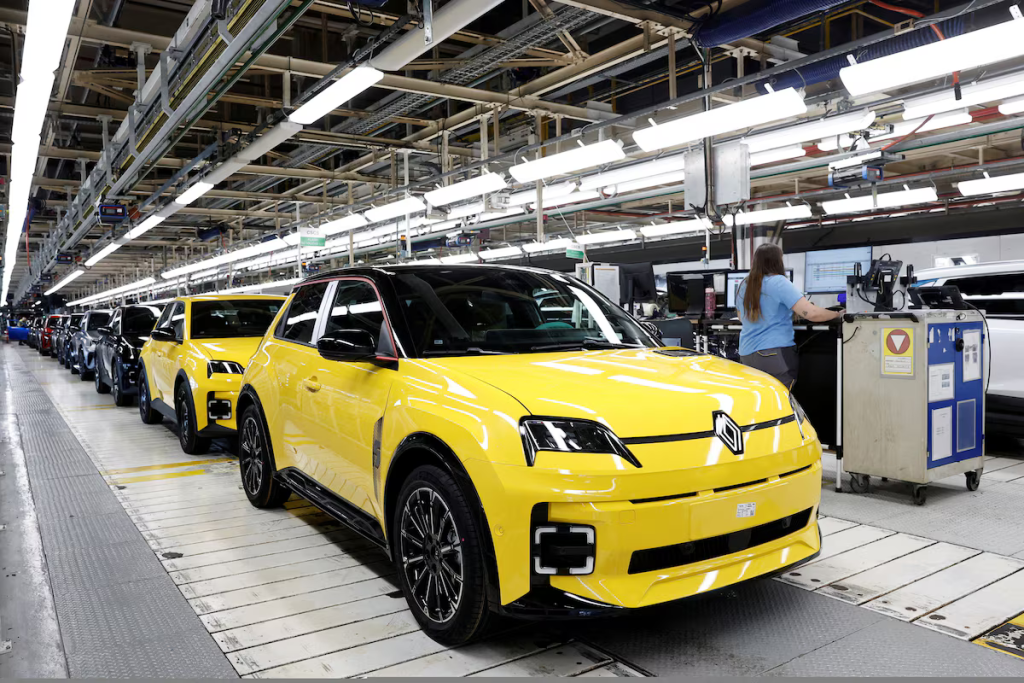
The Numbers Behind a Leaner Mix
Global registrations fell 0.4% in H1 2026, landing at roughly 1.165 million units. Revenue still climbed approximately 9.5%. That arithmetic works only if the revenue-per-unit figure moves sharply upward: 1.165 million × 9.5% revenue growth on flat volume implies a per-vehicle revenue gain in the mid-to-high single-digit percentage range — Renault has not published a per-unit average, but the direction is unambiguous. For the Renault badge specifically, battery-electric deliveries rose more than 60% year-on-year. Pure EVs now sit at 18.8% of group volume; add full hybrids and mild hybrids and the electrified share hits 52% across Europe. The group had already extracted roughly €400 per vehicle in variable cost savings by 2025, according to Renault Group's Half-Year Financial Results, published July 2026. A second tranche — this time targeting structural costs across engineering, platforms and shared components for Renault, Dacia and Alpine — is now underway, with a similar per-vehicle target set for the medium term. Those two lines of saving are the floor under the pricing discipline described below. Tracking this shift sits within the broader Chinese OEM Europe expansion coverage on this site.
The Profitability Floor: One Rule, Three Models
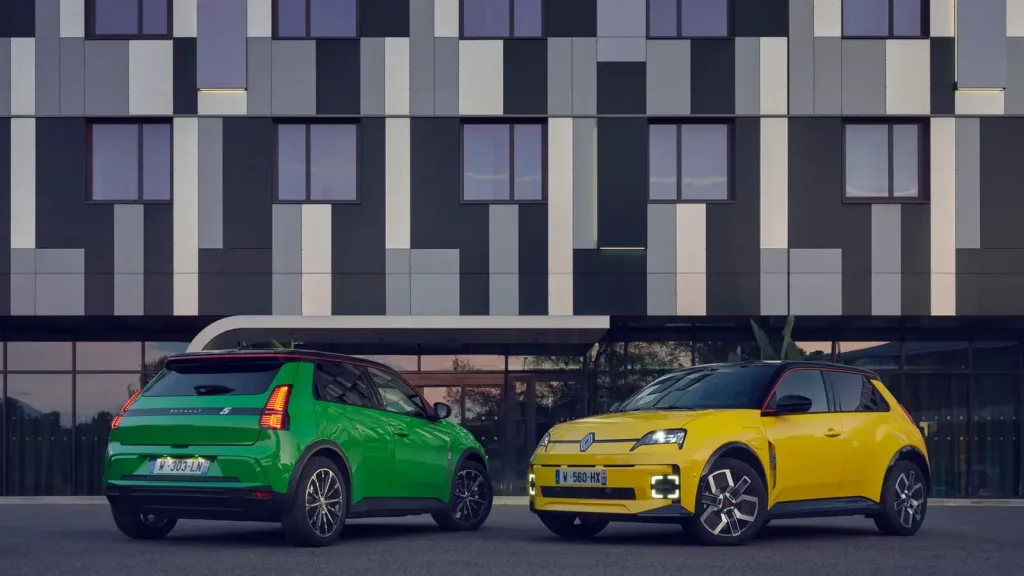
The mechanism is a single internal approval gate. According to Renault Group's Half-Year Financial Results, published July 2026 — specifically the product policy section — no new battery-electric model reaches production sign-off unless its margin projection at least matches the group's full-hybrid programme. Luca de Meo, Chief Executive Officer of Renault Group, has described the rule publicly as a refusal to build 'compliance cars' that exist purely to satisfy EU CO2 targets. The Renault 5 E-Tech electric, the Renault 4 E-Tech electric and the forthcoming Twingo electric were all evaluated against that threshold before board approval. The Twingo, expected to enter the sub-€20,000 segment, is the sharpest test: it must turn a profit at a price point where several Chinese entrants are currently operating at a loss or on thin subsidised margins. If the Twingo clears the bar, it becomes the lowest-cost proof-of-concept for the rule. If it doesn't, Renault has said the model does not launch. That is an unusually hard commitment for a volume brand in a segment defined by price wars.
Stellantis and the Chinese Wedge
The contrast with Stellantis is direct. Where Renault tightened its profitability gate, Stellantis moved in the opposite direction through early 2026, cutting entry-level EV transaction prices on the Citroën ë-C3 and Opel/Vauxhall Corsa Electric to compete with BYD's Seagull and the Jaecoo 7, which became the first Chinese model to top a UK monthly sales chart. Stellantis's European EV share remained below 12% in the same period, versus Renault's 18.8%, according to ACEA registration data, published June 2026. Meanwhile Zeekr's X outperformed the Volvo EX30 in Euro NCAP testing, signalling that Chinese brands are no longer trading only on price — they are closing the safety and quality gap that legacy OEMs once relied on as a soft moat. Renault's Western European business still generates the bulk of group profit, but growth is arriving faster from lower-margin markets: India and Turkey together accounted for a rising share of H1 2026 volume, diluting per-unit returns at the group level even as the European mix improves.
What the Results Don't Explain
One number resists the tidy narrative. Renault's global volume dipped 0.4% at a moment when the group's electrified share — and therefore the models commanding the richest pricing — rose sharply. That combination should, in theory, produce stronger volume recovery as EV demand builds. It hasn't yet. Renault has not published a market-by-market breakdown explaining where registrations fell, so it is not publicly clear whether the drop reflects deliberate withdrawal from low-margin fleet contracts, softer demand in specific export markets, or supply constraints on the Renault 5 platform at the Douai facility. The Douai line was operating on a modified shift pattern as recently as Q1 2026, according to statements from the Confédération Générale du Travail's Renault section, published February 2026 — though Renault Group has not confirmed whether that affected H1 delivery totals. The structural cost programme, meanwhile, involves reorganising engineering headcount across Renault and Alpine. Renault has not confirmed how many engineering roles will be affected, nor whether any model timelines have shifted as a result. The Twingo launch window has not been officially restated since the original 2025 announcement. Those gaps matter for anyone modelling whether the margin discipline holds into 2027. Related tariff and regulatory pressure on Chinese imports is tracked separately at EU and US trade barrier developments.
What This Means for Dacia and Alpine
The shared-component push has direct consequences for two Renault Group sub-brands. Dacia, which sells the Spring — currently the lowest-priced EV on the European market at around €16,990 in France — operates on a separate cost architecture from the Renault badge. The Spring's bill of materials is already optimised for sub-€20,000 retail pricing, but the new structural savings programme means Dacia will be expected to share more platform DNA with Renault 5 derivatives, potentially limiting how far Dacia can differentiate on specification. Denis Le Vot, Chief Executive Officer of Dacia, stated in the brand's 2025 annual review that Dacia's identity depends on 'refusing complexity' — a position that sits in some tension with deeper integration into Renault Group platforms. For Alpine, the consequence runs the other way. Greater shared-component usage with Renault lowers Alpine's per-unit engineering cost, which matters for a brand whose forthcoming A290 electric hot hatch needs to justify a €38,000-plus price tag against well-specified Chinese sport variants. Alpine has not published margin projections for the A290, and Renault Group has declined to break out Alpine's contribution to group EBIT in the H1 2026 results.
Renault's full-year 2025 operating margin came in at 7.4%, according to Renault Group's Full-Year Results published February 2026 — above the 6% floor the group had set as its medium-term floor when the turnaround plan launched in 2023. The H1 2026 net profit return marks the first back-to-back profitable first half since 2019. Watch the Twingo launch date. The complete Renault model history and specifications are catalogued in the Global Auto Index manufacturer database.
