







A side-by-side reference of periodic technical inspection regimes across seven major markets, with pass-rate distributions, common failure categories and methodological caveats for cross-border interpretation.
What this reference covers
This article is a comparative reference for the seven inspection regimes most frequently cited as primary data sources for vehicle reliability and safety reporting in Europe and North America. It is written for analysts comparing inspection-based reliability data across borders, regulators benchmarking their own regime against international peers, and journalists reporting on changes to national inspection requirements.

The regimes covered differ along several dimensions: the inspection authority (state, private operator, authorised workshop), the inspection frequency, the number of inspection points checked, the documented failure-category taxonomy, and the publication policy for aggregated results. These differences are summarised in section 2 and treated in detail in the per-country sections that follow. The methodological consequences of these differences for cross-border comparison are discussed in section 11. The data is used as a source stream for our reliability index and the construction principles are documented in our reliability scoring methodology.
Inspection regime summary table
| Country | Regime | Frequency | Points | Pass rate (latest) |
|---|---|---|---|---|
| Germany | HU + AU | 36 then 24 months | ~150 | ~80% |
| Austria | §57a „Pickerl" | 36 then 24/12 months | ~130 | ~74% |
| United Kingdom | MOT Test (Class 4) | 36 then annually | ~120 | ~70% |
| France | Contrôle technique | 48 then 24 months | ~133 | ~80% |
| Netherlands | APK | 36/48 then annually | ~110 | ~85% |
| Italy | Revisione | 48 then 24 months | ~115 | ~78% |
| United States | State-level (varies) | Varies by state | Varies | Not centrally reported |
Germany — Hauptuntersuchung (HU)
The Hauptuntersuchung is the core periodic technical inspection in Germany, conducted alongside the Abgasuntersuchung (AU) emissions test as a combined check. The first HU is required 36 months after first registration, and subsequent inspections are required every 24 months thereafter. The inspection covers approximately 150 individual check points across brakes, steering, suspension, lighting, body integrity, tyres, exhaust system, electrical safety systems and instrumentation.
HU inspections are conducted by approved organisations rather than by the state directly. The four largest are TÜV, DEKRA, GTÜ and KÜS, which between them perform the substantial majority of all German inspections. Aggregated results are published annually as the TÜV Report and have been the most authoritative single source on German fleet condition since the 1970s. The regulatory authority is the Kraftfahrt-Bundesamt; the inspection requirements themselves are defined in the StVZO (Straßenverkehrs-Zulassungs-Ordnung). HU has the strictest documentation requirements of any European inspection regime and serves as the methodological reference for most cross-border comparison work.
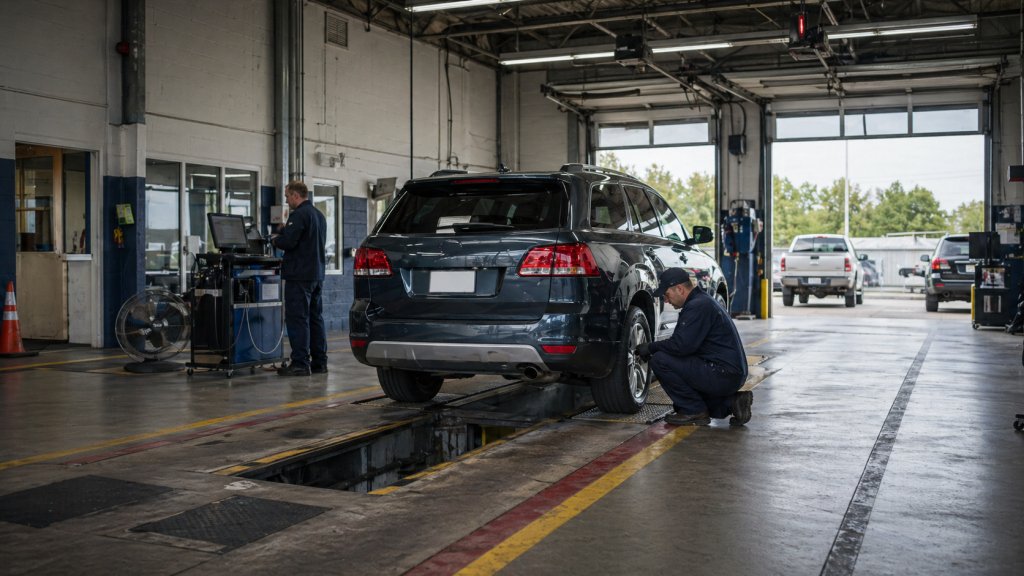






Austria — §57a KFG „Pickerl"
The Austrian periodic inspection regime, defined in §57a of the Kraftfahrgesetz (KFG) and colloquially known as „Pickerl" after the windscreen sticker that documents passing inspections, is the closest national analogue to the German HU in terms of methodology and depth. The first §57a inspection is required 36 months after first registration; the second inspection is required after a further 24 months; subsequent inspections are required annually thereafter. The shift from biennial to annual after the second inspection is one of the regime's distinguishing features and is intended to compensate for the absence of an emissions-only intermediate test.
§57a inspections cover approximately 130 individual check points and are conducted at authorised workshops rather than by a centralised inspection organisation. This is a structurally different model from the German HU and produces a more decentralised aggregated dataset, which is summarised by ÖAMTC in the published breakdown statistics. The inspection framework includes braking system performance (with measured deceleration figures rather than visual confirmation alone), steering geometry, suspension condition, lighting and signalling, tyre condition and depth, body and chassis structural integrity, exhaust emissions and noise compliance, and the operating condition of electronic safety systems where fitted. Pass rates published by national reporting place the typical figure at approximately 74% across the whole inspected fleet, with the failure rate concentrated in the 8-to-12-year-old vehicle cohort.
United Kingdom — MOT Test
The MOT (Ministry of Transport) Test is the United Kingdom's annual roadworthiness inspection, required from the third anniversary of a vehicle's first registration and annually thereafter with no intermediate change in frequency. The Class 4 test covers cars and light vehicles up to eight passenger seats and is the most numerically significant of the MOT classes. The test examines approximately 120 individual check points, with substantial overlap with the German HU but more limited coverage of structural and chassis items.
MOT tests are conducted at approved garages and authorised testing stations under the regulatory authority of the Driver and Vehicle Standards Agency (DVSA). The DVSA publishes aggregated pass-rate data quarterly, broken down by vehicle make, model and age, and the datasets are available without subscription. This level of public availability is the highest among the regimes covered in this reference and makes the MOT dataset an unusually rich research resource. The annual frequency from year three produces a denser longitudinal record per vehicle than the biennial regimes elsewhere in Europe, which has methodological implications for inter-regime comparison discussed in section 11.
France — Contrôle technique
The French Contrôle technique is the national periodic inspection regime, required 48 months after first registration and every 24 months thereafter. The inspection covers approximately 133 individual check points and is conducted at independent inspection centres approved by the regulatory authority UTAC OTC. Contrôle technique is operationally separate from any repair function — inspection centres are prohibited from performing repairs on vehicles they inspect — which is an important methodological distinction from the British MOT and the Austrian §57a regimes, both of which are typically conducted at facilities that also offer repair services.
The French regime has been progressively strengthened over successive reforms, most recently in 2018 to align with the EU 2014/45 directive on periodic roadworthiness testing. The 2018 reform expanded the failure-category taxonomy and introduced a three-level severity grading (minor defect, major defect, critical defect) that had previously been binary. Aggregated pass-rate data is published by UTAC OTC and supplemented by independent analysis from the consumer organisation UFC-Que Choisir.
Netherlands — APK
The Algemene Periodieke Keuring (APK) is the Dutch periodic inspection regime, with first inspection required at 48 months for petrol vehicles and 36 months for diesel vehicles, and annually thereafter for vehicles older than three years. The inspection covers approximately 110 individual check points and is conducted at approved garages under the supervision of the RDW (Rijksdienst voor het Wegverkeer). APK is the most consistently administered regime in this reference, with documented pass rates of approximately 85% reflecting both the relative youth of the Dutch fleet and the high standard of fleet maintenance characteristic of the Dutch market.
APK results are not aggregated and published with the same frequency as the British MOT dataset, but per-make and per-model summaries are released by the RDW on request and are occasionally analysed by the Dutch automobile club ANWB. The diesel 36-month requirement reflects the regime's emphasis on emissions integrity and is the principal structural difference between APK and the regimes of the surrounding countries.
Italy — Revisione
The Italian Revisione is required 48 months after first registration and every 24 months thereafter, in line with the broader EU 2014/45 framework. The inspection covers approximately 115 individual check points and is conducted either at the Motorizzazione Civile (the public regulator's own facilities) or at private workshops authorised under the MCTC framework. The regime has historically been less consistent than its German or Austrian counterparts in enforcement, although recent reforms have tightened both inspection requirements and documentation standards.
Aggregated Revisione data is published by the Italian transport ministry, although coverage is less complete than the published German or British datasets and there is more variance between regional motorisation offices in how results are reported. Italian revisione data is therefore used as a corroborating rather than a primary input for cross-border reliability indexing.
United States — state-level inspections
The United States has no federal periodic vehicle inspection regime; inspection requirements are set at the state level and vary considerably. Approximately fifteen states require periodic safety inspections, often at annual or biennial frequency, with the specific requirements varying by state. A separate set of states requires emissions inspections in certain metropolitan areas under federal Clean Air Act provisions, administered by state environmental agencies under EPA oversight.
The fragmented regulatory structure means there is no single equivalent to the TÜV Report or the British MOT dataset for the United States. Cross-border comparison between U.S. data and European inspection regimes therefore relies on auction-based, breakdown-based and survey-based sources rather than inspection data — which is the principal methodological reason that the U.S. input to the reliability index is the J.D. Power Vehicle Dependability Study rather than any inspection-derived dataset.
Pass-rate distributions and common failure categories
Across all the European regimes covered in this reference, the dominant failure categories at first inspection are remarkably consistent. The four most frequently cited primary failure reasons across published TÜV, ÖAMTC, DVSA and UTAC OTC summary data are:
- Lighting and signalling — typically 25-35% of all primary failure findings, dominated by burnt-out bulbs, misaligned headlamps and faulty rear-cluster wiring.
- Brakes — typically 18-26% of primary failure findings, dominated by worn pads, glazed discs and uneven hand-brake balance; the share rises sharply with vehicle age beyond seven years.
- Suspension and steering — typically 15-22% of primary failure findings, dominated by worn ball joints, leaking dampers and bush deterioration; geographic variance is significant, with regimes serving fleets exposed to road salt showing higher figures.
- Tyres — typically 10-15% of primary failure findings, dominated by depth below the regulatory minimum (1.6mm in most European jurisdictions), uneven wear patterns indicating geometry faults, and damage to sidewalls.
The remaining failure categories — body integrity, exhaust system, electrical and electronic systems, instruments, glazing and visibility — collectively account for approximately 15-25% of primary failure findings across all regimes, with internal distribution varying significantly by national taxonomy and by fleet age profile. Pass rates by vehicle age show a consistent pattern: approximately 90% at first inspection, declining to approximately 60% for vehicles aged 11-12 years, with the decline approximately linear in between.
Methodological caveats for cross-border comparison
- Different regimes count multiple defects per inspection differently. Some publish per-defect statistics, others publish per-inspection-with-at-least-one-defect statistics. Direct comparison of failure-rate percentages without verifying the counting basis will produce misleading results.
- The severity gradation introduced by the EU 2014/45 directive is not applied uniformly across member states, and pre-2018 historical data uses incompatible severity definitions. Analysts working with longitudinal inspection data should treat the 2018 boundary as a methodological discontinuity.
- Inspection frequency differences (annual versus biennial versus mixed) materially affect the apparent failure rate. A regime that inspects annually will record higher absolute failure-event volumes than a biennial regime serving the same fleet, even though the underlying vehicle condition is identical.
- Inspection facility independence from repair function affects the granularity of recorded defects. Facilities that also offer repair services tend to record more secondary findings, which inflates apparent failure rates relative to inspection-only facilities.
- Self-reported pass-rate statistics from national authorities are not directly comparable with internally aggregated pass-rate statistics from inspection organisations. The two figures typically differ by 2-4 percentage points, with the authority figure being more conservative.
Frequently asked questions
Why are German HU pass rates higher than UK MOT pass rates despite a stricter inspection?
The two regimes have different counting bases and different first-inspection ages. Adjusted for both factors, the underlying fleet condition is similar; the headline difference is largely a methodological artefact.
Are EV-specific inspection requirements documented in this reference?
Not yet in detail. EV-specific inspection requirements are still being standardised across the EU 2014/45 framework; an updated EV-specific section will be added in a future revision of this reference.
Why is U.S. inspection data not included in the cross-border comparison?
Because there is no federal inspection regime and state-level requirements are too fragmented to support meaningful aggregation. The U.S. input to the reliability index is therefore survey-based rather than inspection-based.
Which regime is closest to the German HU in methodology?
The Austrian §57a regime, although §57a uses an authorised-workshop model rather than the centralised approved-organisation model used in Germany. Methodological comparability is high; institutional structure differs.
How frequently is this reference updated?
Annually, in the first quarter, after the major national authorities publish their previous-year aggregated data.
Where can I find per-make and per-model pass-rate data?
The British DVSA dataset is the most accessible publicly. The German TÜV Report publishes per-make data annually but at lower granularity. Other regimes require direct request to the regulatory authority.
How does the EU 2014/45 directive affect cross-border comparison?
It standardises the inspection points and severity grading across member states, reducing structural divergence over time. The 2018 implementation date means that pre-2018 and post-2018 data should be treated as methodologically distinct.
