







Judd Power rebuilt the C30A block with titanium valves and ditched VTEC entirely, pushing the redline to 8,500 rpm.
Thirty-five cars. That is the run. JAS Motorsport confirmed production of the Tensei — its Honda NSX restomod developed with Pininfarina — pricing each example from €880,000, excluding the donor vehicle, taxes, and bespoke options. The car debuts publicly at the 2026 Paris Motor Show.
The Tensei lands in a low-volume restomod tier that has expanded sharply since 2020, with coachbuilders across Britain, Italy, and Japan targeting collector orders that sit well above the €500,000 mark. According to Pininfarina's official Tensei programme brief, published October 2025, the project involves full carbon-body replacement and a purpose-rebuilt drivetrain — not a mechanical refresh.
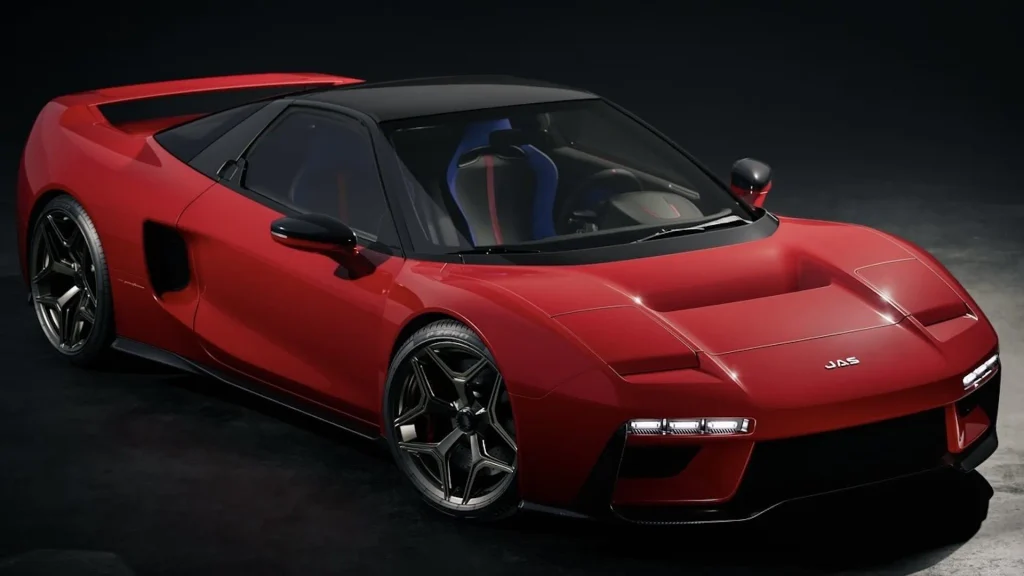
How JAS Strips and Rebuilds Each Donor Car
JAS Motorsport takes each customer-supplied first-generation Honda NSX and disassembles it completely. The aluminium body panels come off. Pininfarina's high-modulus carbon fibre shells go on in their place. JAS fits a flat underfloor and an active rear diffuser — neither feature appeared on any factory NSX variant. The suspension geometry is recalibrated around KW dampers running electronically adjustable Dynamic Damping Control, extending the ride-behaviour range beyond the original car's fixed setup. Brembo supplies six-piston front calipers and four-piston rears. Honda has no direct involvement; this is an independent coachbuild on a donor platform, a structure that keeps the project outside Honda's type-approval obligations. The approach sits within the european premium segment expansion coachbuild cluster that GlobalAutoIndex has tracked since the early 2000s resurgence of limited-series bodywork houses. JAS has not announced a dealer network or after-sales programme alongside the Tensei reveal.
Engine Numbers: What Judd Power Changed Inside the C30A
JAS retained the Honda C30A block — a 3.0-litre unit in standard NSX trim — but contracted Judd Power, the British motorsport engine builder based in Bridgnorth, to redesign the internals. Judd fitted a new crankshaft, light-alloy cylinder heads, and titanium valves. VTEC variable valve timing was removed entirely, replaced with fixed timing calibrated for high-rpm output. The result: 414 horsepower at 8,300 rpm and 305 lb-ft of torque at 5,500 rpm, with an 8,500-rpm redline. On-page calculation: 414 hp divided by a stated dry weight of 2,756 lb gives a power-to-weight ratio of 0.150 hp per lb — or approximately 150 hp per tonne in metric terms (414 hp ÷ 1,250 kg ≈ 331 hp/tonne). Drive goes to the rear wheels through a six-speed manual gearbox with a carbon twin-disc clutch and a Torsen limited-slip differential. The original first-generation NSX Type R produced 280 hp from a naturally aspirated 3.2-litre unit — a 134 hp deficit against the Tensei's Judd-built engine.
JAS's Stated Brief for the Tensei
JAS Motorsport described the Tensei's purpose in its published programme statement without qualification. The car, in JAS's own framing, is "built to survive in a modern supercar market without giving up the traits that made the original NSX an icon." That sentence does real work. It tells a prospective buyer that the Tensei is not a museum piece — it is meant to be driven against current machinery. The carbon bodywork, the Brembo brake package, and the Judd-engineered top end all serve that brief directly. What the statement does not address is homologation: because each Tensei begins as a registered donor car supplied by the customer, JAS sidesteps the type-approval process that would apply to a new-build vehicle. According to Pininfarina's official Tensei programme brief, published October 2025, design responsibility for the exterior sits entirely with Pininfarina, while JAS holds engineering authority over chassis and drivetrain.
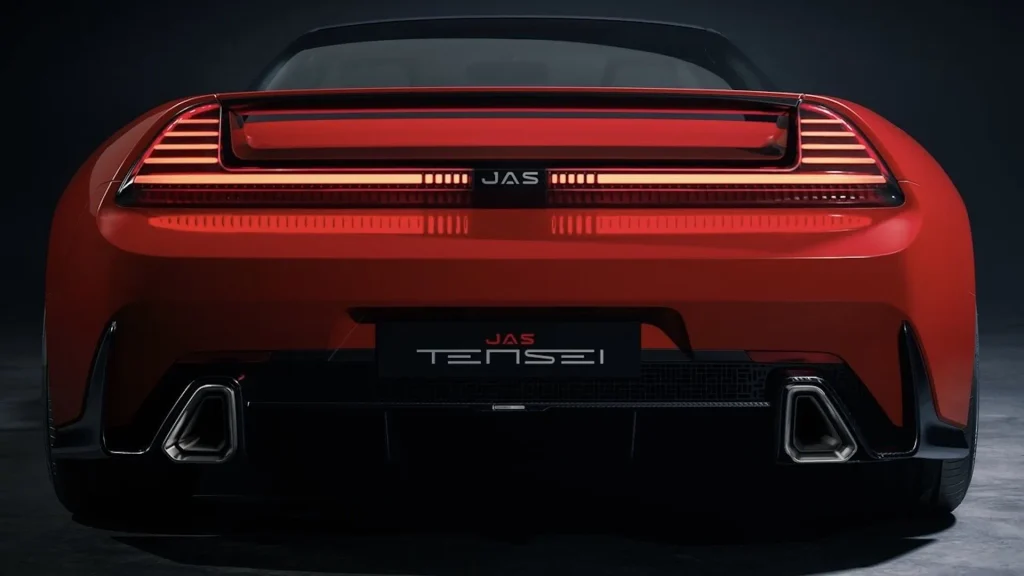
The Price Excludes the One Thing You Cannot Buy Without
The €880,000 base price is real. So is everything it omits. JAS's published figure excludes the donor car, local taxes, and any buyer-specified customisation. First-generation Honda NSX values have risen steeply in the past four years; a clean, low-mileage example in European specification now changes hands between €80,000 and €160,000 at specialist auction, according to pricing data published by RM Sotheby's in its January 2025 European sports car results report. Add the lower bound and total outlay clears €960,000 before options. At the upper bound, a fully specified Tensei could approach €1.1 million. JAS has not published a completed-car all-in price. That gap matters because the project's closest competitors — coachbuild restomods such as the Emory Motorsports Porsche 356 Outlaw series and Eagle Lightweight GT — both quote all-inclusive pricing. Whether JAS's pricing structure reflects deliberate collector-market positioning or incomplete programme disclosure is not answered in any document released to date.
Where the Tensei Sits Against Other Manual Restomods
The Tensei is not alone. Eagle Specialist Vehicles has sold more than 100 E-Type Lightweights since 1984 at prices now exceeding £700,000, according to Eagle's published specification sheets updated in 2024. Radford Motors, the relaunched British coachbuilder, priced its Type 62-2 Lotus Elan restomod at £350,000 for a 62-unit run — less than half the Tensei's base figure for more than 1.7 times the production volume. Singer Vehicle Design's Porsche 911 Dynamics and Lightweighting Study sold for approximately $1.8 million per unit across a 75-car run in 2019, making it the closest structural comparison: bespoke drivetrain, named engineering partner (Williams Advanced Engineering), defined run size. The Tensei's 35-unit ceiling is the tightest of that group. At 414 hp and a manual gearbox, the Judd V6 outpowers Eagle's 340 hp XK six by 74 hp, though Eagle quotes a dry weight roughly 200 lb lower than JAS's 2,756-lb figure for the Tensei.
JAS Motorsport was founded in Milan in 1996 and built its reputation primarily in touring car racing, supplying Honda-based machinery across the WTCC and TCR series. The Tensei marks the company's first confirmed road-car production programme. First deliveries have not been dated. The complete Honda NSX model history and specifications are catalogued in the Global Auto Index manufacturer database.
