


Belt debris packed the oil pickup screen tightly enough to choke pressure to the entire engine.
The belt shredded. Valves bent. Oil pressure died. A 2021 Chevrolet Trailblazer gave up its 1.2-litre LIH three-cylinder at around 84,000 miles—a figure that sits 66,000 miles below the replacement interval printed in GM's own owner's manual.
The gap between documented specification and physical reality is the story here. GM's owner's manual for vehicles carrying the LIH engine lists a timing belt and oil pump drive belt replacement interval of 150,000 miles or 15 years, according to Chevrolet's published maintenance schedule. The same engine currently powers the 2026 Trailblazer, 2026 Trax, Buick Encore GX, and Chevrolet Envista—a combined lineup that makes this more than a single-car curiosity.
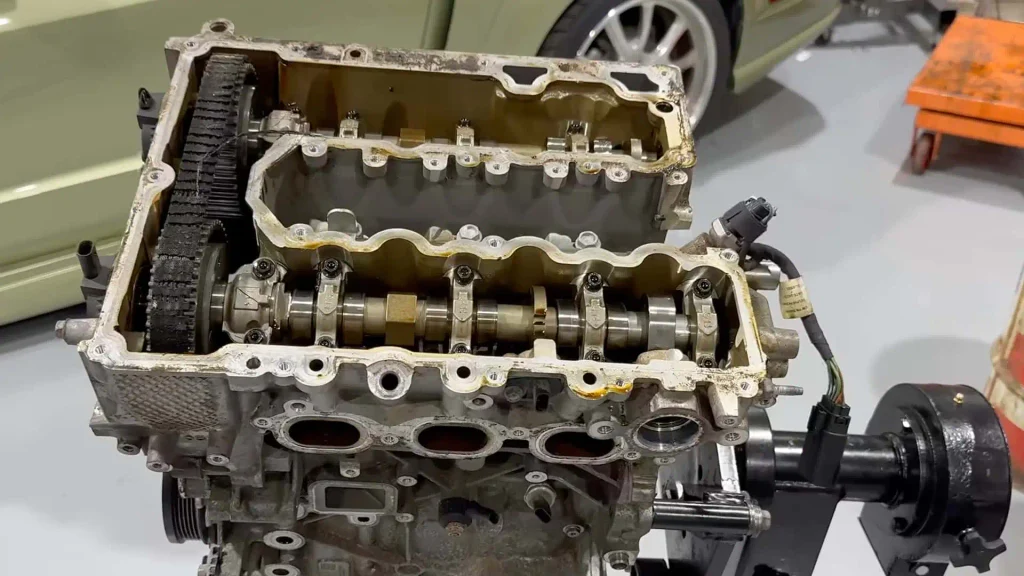
What the Teardown Found, Layer by Layer
The video went up on November 15. Uploaded by the channel I Do Cars on YouTube, it drew more than 470,000 views within days of publication. The host pulled the valve cover first. Rocker arms sat knocked sideways or were gone entirely. Both camshafts showed deep gouges across their lobes. Pulling the cylinder head exposed bent valves on all three cylinders—damage that follows a loss of timing, when pistons slam into valves that should already be closed. The timing belt, located lower in the engine in a wet-sump bath of oil, had cracked along its tooth profile and shed material directly into the lubrication circuit. The host described what he found blocking the oil pickup screen as "emulsified timing belt"—fibres packed densely enough to choke flow to the rest of the engine. Rod bearings showed wear but had not spun. Cylinder bores looked undamaged. The bottom end was salvageable. The valvetrain was not. This article is part of our coverage on industry restructuring and product reliability trends in 2026.
The Numbers That Don't Reconcile
GM's owner's manual interval: 150,000 miles. Mileage at failure: approximately 84,000 miles. That is a shortfall of 66,000 miles, or 44 percent of the stated service life still on the clock at the moment the engine destroyed itself. The LIH is rated at 137 horsepower from 1.2 litres of displacement, which works out to roughly 114 hp per litre—a figure that depends on sustained oil pressure to protect the valvetrain at higher loads. The 2026 Trailblazer carries a five-year or 60,000-mile powertrain warranty from GM. At 84,000 miles, the failed unit sat 24,000 miles beyond that warranty ceiling. A timing belt service on this engine, in the host's own estimate based on current labour rates he cited, runs between $1,200 and $1,500. That figure covers belt replacement alone. It does not cover head reconditioning, valve replacement, or camshaft machining—costs that apply the moment belt failure bends a valve. Total rebuild cost for the top end of this engine would run materially higher.
What the Host Said—and Stopped Short of Saying
The teardown host did not declare the LIH engine categorically defective. His specific caution: this was "the first example he'd managed to source," a constraint he attributed to the engine's low core value in the used-parts market. Engines like this tend to go straight to the scrap bin rather than circulate through rebuilder networks. That scarcity limits the teardown sample. He also flagged that the vehicle's history showed repair work carried out shortly before it was written off, raising the possibility that the engine itself had already been replaced prior to the failure event. If true, the 84,000-mile odometer reading may not reflect the original unit's actual service life. Neither GM nor any named representative of the automaker issued a public response to the teardown findings in the days following the video's publication, according to Motor1's reporting dated November 21. No safety recall covering the LIH timing belt appears on the vehicle's record, based on the same published account.
A Wet Belt Design in a Market Moving Away From It
The LIH uses a wet timing belt—a design where the belt runs submerged in engine oil rather than operating dry behind a separate cover. Wet belt systems were adopted by several European-origin engines during the 2010s partly to reduce friction losses and package the front of the engine more compactly. The tradeoff is contamination sensitivity: oil that degrades, overheats, or becomes diluted can accelerate belt wear faster than dry-belt or chain-driven equivalents. What doesn't add up here is the interval itself. Several competing wet-belt engines from other manufacturers specify replacement at intervals between 60,000 and 100,000 miles—shorter windows that reflect the design's known sensitivity. GM's 150,000-mile figure for the LIH sits at the outer edge of what any wet-belt engine has been rated to in mass production. Whether that interval was derived from accelerated durability testing under ideal oil-change conditions, or whether real-world degradation runs faster, is a question GM has not publicly addressed in any technical service bulletin visible in the available record.
Four Models, One Belt, One Maintenance Schedule
The LIH engine is not a narrow application. It currently sits under the bonnet of the 2026 Chevrolet Trailblazer, the 2026 Chevrolet Trax, the Buick Encore GX, and the Chevrolet Envista. All four models share the same published belt replacement interval. For owners of any of these vehicles who purchased new and followed the owner's manual without deviation, the first scheduled belt service does not arrive until 150,000 miles or 15 years—whichever comes first. An owner who bought a 2021 Trailblazer, drove a typical 12,000 miles per year, and followed that schedule would not reach the service interval until approximately 2033. The teardown unit failed at an odometer reading that, at that same annual rate, equates to seven years of ownership. For independent repair shops carrying these models, the teardown raises a practical question: whether to counsel customers to inspect or replace the LIH belt earlier than GM's printed schedule, and how to document that advice against a warranty that has already expired by the mileage at which the documented failure occurred.
GM introduced the LIH three-cylinder in the United States market for the 2021 model year as the base engine in the redesigned Trailblazer. A 2023 model-year Trailblazer vehicle record logged several dozen owner complaints touching the engine, electrical system, brakes, and powertrain—none of which resulted in a safety recall. The belt service window remains unchanged in current documentation. The complete Chevrolet model history and specifications are catalogued in the Global Auto Index manufacturer database.
